Hollow Enough to Hold

[A strong view walks into a room. What happens next in the body, before anything happens in the conversation, decides almost everything. A few reflections on where we go when we get hijacked, and on the field that lets us come back.]
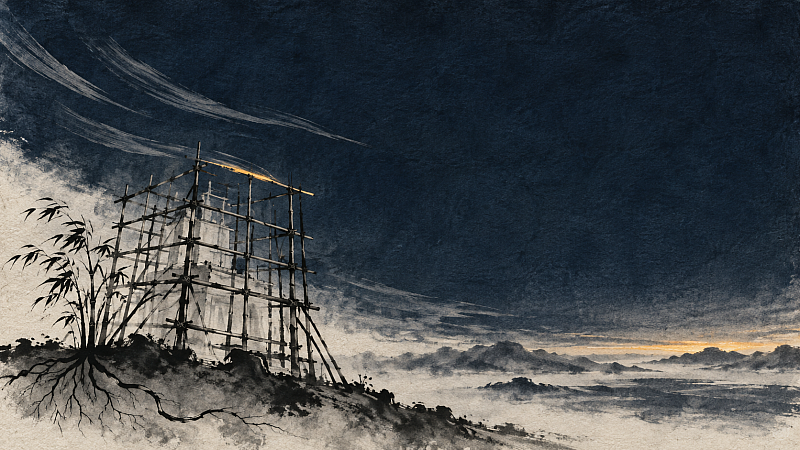
In Hong Kong, even high-rises are still wrapped in scaffolds of bamboo. Workers lash the poles together by hand, floor by floor, and the scaffold climbs alongside the building it serves. Bamboo can do this because of what it isn't. It is hollow. It is light. In strong winds, it flexes rather than fighting the force. And when the work is done, the scaffold comes down, and soon nobody remembers it was there.
Bamboo also does not grow alone. Underground, the stalks in a grove share a single root system, so that what looks like a hundred plants is often one. A stalk standing by itself in a storm is a different creature from a stalk standing in a grove.
It's an image that comes to mind whenever I see a group of good people get tangled in a difference of views.
• • •
John Prendergast, a psychotherapist who spent decades listening to where people feel their center of gravity, describes four stages of groundedness. He maps them not by belief but by where we feel the body to be: not in my body, in my body, body is in me, and finally, world is my body.
It occurred to me that the same four stages describe what happens when a strong view enters the room. In any given moment, someone speaks with force, and we find ourselves somewhere on this continuum. If we aren't skilful there, we create violence within and without, and get further entangled in the karma of it. So, four stages, with a name for each.
Not in my body. The Drifter. Someone louder, more articulate, more powerful shares a view, and we get suppressed. We become nobody in the room. Instead of dancing with the wind while staying rooted, we drift like a log in the current, going wherever the water goes. This can pass for humility.
In my body. The Lawyer. Now we have found our voice, and we want to be understood, because we are sure we are right. We have become somebody, and we defend it. We argue well, sometimes very well. Most of our institutions are built to reward this stage, and most of our conflicts are two lawyers in a room. The St. Francis prayer offers a medicine for not getting stuck here: seek to understand, rather than to be understood.
Body is in me. The Listener. Here we embrace what the Jains call anekantvaad: truth has many sides, and every view sees from somewhere. No single view exhausts it, including mine. My view is one cloud in a wide sky. You can only hold that many sides if you have stopped arguing and started listening.
World is my body. The Ladder. We lead with emptiness. A view is just a ladder. It helps us climb into a wider field, and then we set it down, and it disappears into the background. There was never anything substantial there. We are nobody again, but on a different rung. Fukuoka's radical intuition was that reality is always prior to whatever the mind makes of it.
• • •
Notice that the first stage and the last are both "nobody." The Drifter is nobody because the room erased her. The Ladder is nobody because there was nothing to erase. The whole journey is the hyphen between those two kinds of nobody.
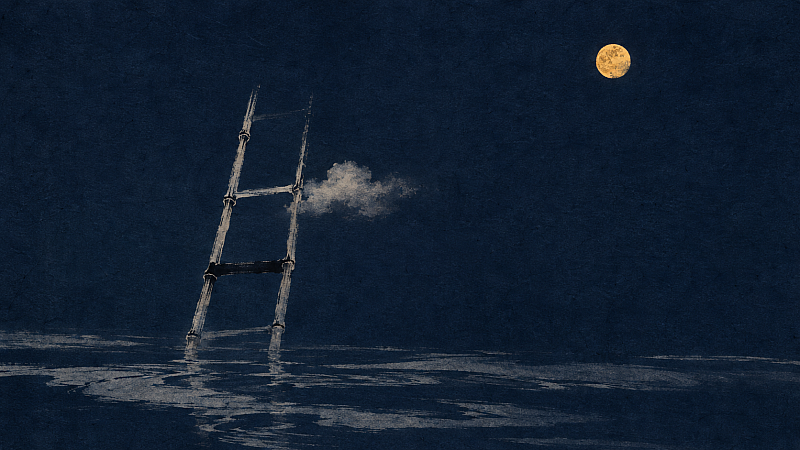
Which means the stages are not a ranking of people. They are rungs, and all of us are somewhere on them, in any given moment, often several times a day. The lawyer at the meeting is the drifter at home. The listener in the circle is the lawyer on the road.
And each rung has its own growth. For a Drifter, finding a voice is the growth. For a Lawyer, holding that voice lightly is the growth. For a Listener, hearing the many voices as one symphony is the growth. For a Ladder, the skilfulness of picking up a view and putting it down without residue is the growth.
This matters because our instinct, when a lawyer overpowers a drifter, is to train the drifter to be a better lawyer. It feels like empowerment, but it's actually an arms race. The room gets louder, not wiser, and the person we meant to help has simply been recruited into the stage that hurt her.
• • •
What allows four such different journeys to co-exist is not a rule. It is a field.
Without a field of cultivation, each stage curdles into its shadow. The Drifter mistakes silence for peace. The Lawyer silences the Drifter. The Listener starts teaching. The Ladder starts needing to remain. Every one of these is a stage mistaking itself for a destination.
With the field, a view lands as one more cloud rather than as weather.
Vinoba Bhave used to say that a person's virtues are doors, and their faults are walls. We can spend a lifetime banging on someone's walls, or notice the smallest door and walk through it. Perhaps that is the other thing a field does. It doesn't just hold what is there. It leans toward what is trying to grow.
And within such a field, each rung has its own medicine. None of them are arguments. They are doors.
For a Drifter, the medicine isn't a louder voice but a companion. Someone standing beside her, so she isn't alone in the room. Nothing needs to be said. Roots hold better in company.
For a Lawyer, the medicine isn't a better argument but a warmer ground. Something to do with the hands. A kitchen, a garden, a shared meal. It is very hard to keep litigating while kneading dough with someone.
For a Listener, the medicine isn't more understanding but fewer words. To keep asking past the point where explaining becomes tempting. The listener's temptation is subtle: to curate the frames, to become the one who sees all sides, which is just the lawyer's ego wearing a wider hat.
For a Ladder, the medicine is a more infinite game. To let yourself be leaned on, and climbed on, without ever becoming the destination. The moment a ladder starts to matter, it has become a wall.
• • •

The bamboo scaffold in Hong Kong doesn't argue with the typhoon. It doesn't drift either. It bends, because it is hollow, and it holds, because underground it is not alone. And when its work is done, it steps aside so that what it was serving can stand in the light.
Perhaps that is all a field ever is: a grove of hollow stalks, sharing a root, holding each other up in the wind, and disappearing when the building can stand on its own.
Where am I, right now, on the ladder?
The honest answer changes by the hour. The field doesn't mind.