Thousands of people in ServiceSpace answered this ad. They keep answering it. This is either very foolish or the beginning of the only economics that might survive the century.
For most of human history, work meant this: you pushed against the world, and the world, reluctantly, fed you. The ox pulled. The hand threshed. The body was the original machine, and it was compensated just enough to show up again tomorrow.
We built philosophies around this arrangement the way wasps build nests around a branch — elaborate, papery, and entirely dependent on the thing at the center holding still.
Marx said the branch was rotten: workers make the honey; owners keep the hive. Feminists pointed out that half the hive was invisible — the labor of feeding, holding, and keeping alive was never counted at all, because it was done by women and it was done for free, and these were apparently the same thing.
Gandhi said something even more surprising. He said everyone should spin thread. Not because the world needed more thread. Because the spinner needed more spinning. The work works on the worker. The cloth was almost beside the point.
King marched with sanitation workers in Memphis and said: a person who sweeps streets should sweep them the way Michelangelo painted ceilings. Not because floors and ceilings are the same. Because the dignity is in the one who labors, not in the thing produced.
Graeber, the anthropologist, looked at the modern economy and noticed that most people secretly believe their jobs are pointless — and that we have organized civilization around maintaining this secret. We are terrified, he said, of what happens when people stop being busy.
These were important arguments. But they all assumed the branch would hold. They all assumed human effort was needed — for survival, for justice, for meaning, for something.
The branch is not holding.
Recently, at a summit in India, Sam Altman was asked about the energy required to train AI models. He answered by comparing it to the energy required to train a human.
"People talk about how much energy it takes to train an AI model. But it also takes a lot of energy to train a human. It takes about 20 years of life — and all the food you consume during that time — before you become smart."
He said this cheerfully. He meant it as perspective. But all of us can hear what the logic implies: every lullaby our mothers sang, every time we fell off a bicycle and someone picked us up, every night we we lay awake as a teenager pondering the existential questions — all of it is a training cost. And by that metric, we are already less efficient than a chatbot.
If labor is computation, the computer wins. This is not a future prediction. It has already happened. AI writes contracts, diagnoses tumors, composes music, tutors children, and manages supply chains — faster, cheaper, and at a thousand times the scale. Five years ago it could barely string a sentence together. The pace is not slowing down.
When ATMs appeared, we thought banks would vanish. Instead, tellers changed roles. That pattern — technology kills old jobs, creates new ones — held for two centuries. But this time the technology is learning to do the new roles, too. The branch is not merely shaking. It is dissolving into the river.
They call the destination the "Economic Singularity" — the point where machines can do virtually anything humans can do, economically, at near-zero cost. At that point, the market value of your labor approaches zero. Not because you are worthless. Because the machine is cheaper. This is a different sentence, but the economy cannot tell the difference.
Here is the strange thing about a ghost: it haunts the shape of something that was once alive.
When AI produces everything but humans earn nothing, the GDP still rises. Corporate profits gleam. The productivity charts look like a renaissance. But the money doesn't circulate, because machines don't buy groceries. They don't rent apartments. They don't sit in diners at 2 a.m. wondering whether to order the pie. The wealth is real, but it pools and stagnates, like a river that has been dammed so efficiently it no longer reaches the sea.
Call it Ghost GDP. The economy of the phantom. Numbers without nourishment.
For a long time we knew that GDP didn't measure happiness. That was a philosophical complaint, and we could afford to ignore it. Now technology is delivering the punchline: GDP may stop measuring economic well-being, too. The market, which was supposed to tell us the value of things, has been ghosted by the intelligence it created.
So the markets cannot answer the question anymore. And survival — which always answered it before, because we had to eat — is being answered by machines.
Which leaves the question, finally, stripped bare:
Why labor at all?
The reasonable people propose reasonable things. Universal Basic Income: give everyone money. Universal Basic Capital: give everyone shares. Expanded commons: fund the work the market never valued — care, art, community, the holding of things that fall apart.
 These are necessary. Let's build them.
But they answer the survival question, and the survival question is not the interesting one. The interesting one is: if AI can serve meals more efficiently than your soup kitchen, why are you still in the kitchen?
If we say "for the impact," we have already lost, because the machine's impact will always be greater. This is math, and math does not negotiate.
If we say "for the meaning," we are closer, but meaning derived from output is still meaning hostage to efficiency. The moment the machine outperforms you, the meaning drains like water from a cracked cup.
There is only one answer that doesn't break when the machines get better:
The labor was never about the output.
It was about what love does to the one who labors.
A woman named Liz has read the weekly Awakin passage aloud, in her own voice, every week, for 20+ years. Before the AI revolution, her voice was already in one of four American cars — she was the GPS. She could automate this. She doesn't.
 Rupali reads each passage, sits with it at the family dinner table, discusses it with her mentor, and translates it into art — a practice she began at four years old. (All images in this blog is original art work.)
Christine, in Vienna, translates each reading into German by hand. Maria does the same in Spanish. AI translates instantly, fluently, perhaps more accurately.
In the slums of India, women shape small cotton-stuffed hearts by hand — heart pins given away at gatherings around the world. A machine could crank out ten thousand before lunch.
Why do they keep going?
Because Liz is not producing an audio file. She is becoming someone who shows up. Rupali is not producing an image. She is letting a passage travel through her body and out her hands, and what emerges is the residue of that journey. Christine is not optimizing a translation. She is offering the kind of attention that devotion requires — the hesitation over a word, the weighing of a phrase, the care that leaves fingerprints on every sentence.
And the women shaping heart pins are not manufacturing products. They are making prayers with their hands. The pin is a byproduct. The prayer is the point.
Should they stop?
Only if you believe the output was the reason. Only if Liz's value was in the audio file, Rupali's in the painting, Christine's in the German, and those women's in the cloth.
But if the value was in the becoming — in what the labor does to the laborer — then AI hasn't replaced anything. It can't. You cannot automate a transformation. You can only undergo one.
"That sounds like spiritual bypassing," says the reasonable critic, reasonably. "People are hungry. Power is concentrated. We can't meditate your way out of structural inequality."
The objection is legitimate. And it would be right — if the inner were merely inner. If the heart were merely private.
But anyone who has held a sustained practice of genuine service knows what Dr. King himself knew — and what powered him through years of death threats and jail cells: the labor doesn't just produce good feelings. It develops capacities — presence, resilience, compassion, the ability to stay when everything in you wants to flee. These aren't luxuries. They're the infrastructure that makes every other form of action more effective, more sustained, and less brittle. They help you attune to the "sound of the genuine."
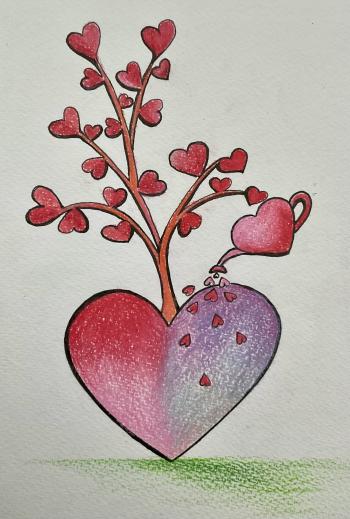 Here is what the scientists found when they measured the heart: it generates an electromagnetic field sixty times greater in amplitude than the brain's. One hundred times stronger magnetically. The field extends several feet beyond the body. It carries information — specifically, information about your emotional state.
When someone is in coherence — that smooth, sine-wave state that arises from genuine care — their heart's electromagnetic signal can be detected in the brainwaves of another person nearby. Not metaphorically. Electromagnetically.
And the key variable isn't proximity. It's the coherence of the receiver. Only a coherent heart can register the signal of another coherent heart. The channel opens both ways, or not at all.
So when we labor with genuine care — when we cook with love, when we translate with devotion, when we stitch a heart as though it mattered — we are not merely transforming ourselves. We are broadcasting. We are contributing to a field that no machine participates in, because machines do not have hearts, and hearts are what carry the signal.
The output of your labor might be replaceable.
Your presence is not.
There is a moon jelly that has no brain and no plan. It pulses. The ocean does the rest — delivering it to phosphorescence, to plankton, to the corridor of salt where it was always meant to arrive.
The moon jelly's gift is not strategy. Its gift is that it has not argued with the current.
A glove does not decide what shape a hand should be. It receives one.
This is the curriculum.
Peacebuilder John Paul Lederach, who has worked in conflict zones from Colombia to Nepal, says the ingredient that transforms societies is not critical mass. It is what he calls critical yeast. Yeast is the smallest ingredient in bread. It cannot rise on its own — it must be mixed thoroughly into the larger mass. But once mixed, it makes everything else rise.
The question is not how many. The question is who — which people, in what state, connected in what way, have the capacity to make things grow beyond their numbers?
Gandhi said only 10% should be overt resistance. The other 90% was constructive program — the patient cultivation of coherence. Vinoba said if gentleness doesn't work, get gentler. Not because gentleness is weak. Because coercion costs us our frequency. The moment we force, we are a moon jelly trying to swim upstream by thinking harder.
The yeast does not demand that the bread rise. The yeast rises. That is its entire contribution. And because it has been mixed into the dough — not hovering above it, not commanding from outside — the bread has no choice but to follow.
There is a WANTED ad that asks for labor without salary, service without credit, teams that dissolve. It is the oddest job listing in the world. It is also, possibly, the only one that AI cannot render obsolete.
 Because the ad isn't hiring for output. It is hiring for transformation. And the very things that make it absurd by market logic — no pay, no recognition, no permanence — are precisely what make it work by the logic of the heart. We cannot do it for reward. There is none. We can only do it for love. And love is what generates the field.
Sam Altman says it takes a lot of energy to train a human. He's right. Twenty years of meals, lullabies, scraped knees, and the full evolutionary inheritance of a hundred billion lives. But he is wrong about what that training produces. It does not produce an information processor to be benchmarked against ChatGPT on a cost-per-query basis.
It produces a heart.
An organ of perception. A generator of coherence. A hundred-thousand-beat-a-day antenna tuned to a frequency that no machine transmits on, because the frequency is love, and love is not a computation. It is a practice. It is what happens when a woman in a slum shapes cotton into the form of a heart and means it. When a grandmother in Germany weighs one word against another and chooses the one that carries more care. When someone shows up, week after week, for no reason the market can name.
The Economic Singularity is coming. It will be the strangest thing that has ever happened to economies, and the most ordinary thing that has ever happened to hearts. Because hearts have never operated on market logic. Hearts have always known that the labor is not the point. The love is the point. The labor is just how the love gets in.
For the first time in human history, we may be freed from laboring to survive. Which means we are free, at last, to discover what we were always laboring for.
Gandhi said: "In a gentle way, we can shake the world."
He did not say efficiently. He did not say at scale. He said gently.
The heart already knows the answer. It knew before our minds did. It has been broadcasting it your whole life — a hundred thousand times a day, whether or not anyone was listening.
All that remains is to attend.
ServiceSpace is a 27-year-old ecosystem exploring the intersection of inner transformation and external service. It operates on volunteer energy — because unpaid labor IS the point. Across its global network, people practice what this essay describes: laboring not for impact, but for love.

Share a Reflection
Your thoughts will be shared with the author