What Kind Of Teacher Am I Called To Be?

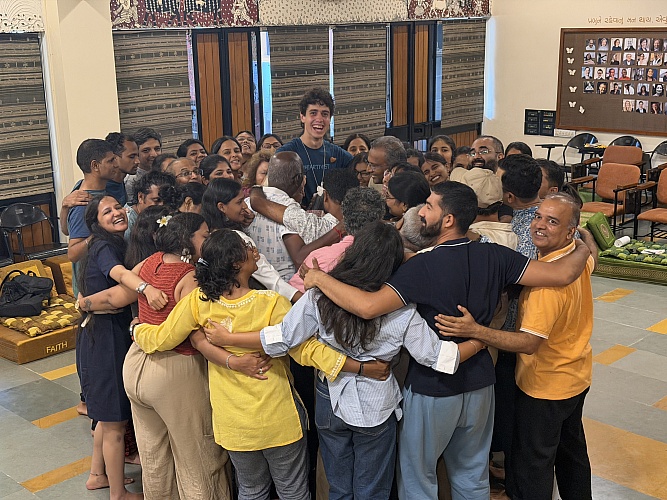
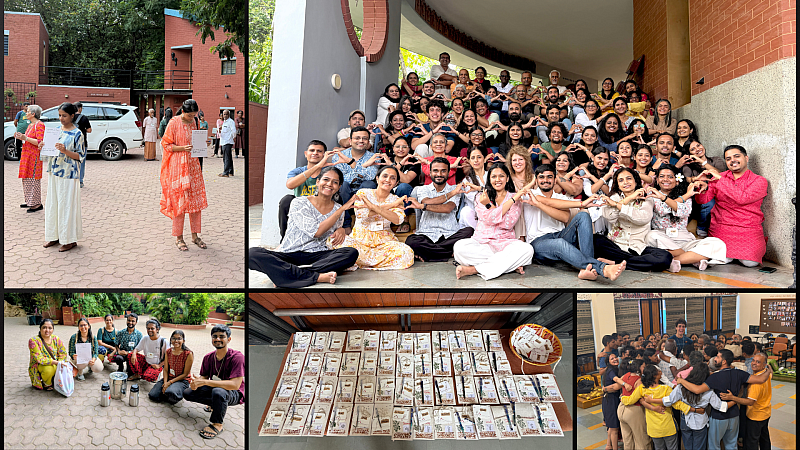
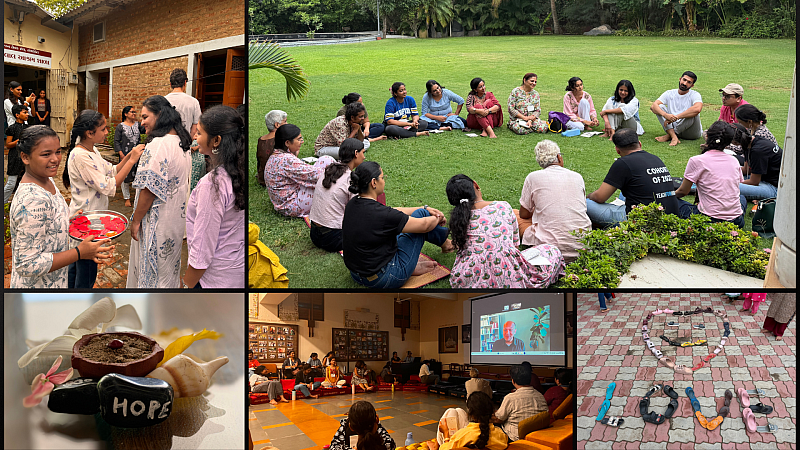
We hosted a small retreat for educators — to ask what grows when we teach from the inside out. Here is what unfolded.
See Retreat Photos · See Clips (coming soon)
A child comes home from school and tells his father his teacher was absent that day.
The father is confused — he’d dropped her off himself that morning. “Didn’t she show up?” he asks. “No,” the child says. “Her body was there. Her mind was absent.”
Nobody in the room needed that explained. Everyone had felt it. Many of us had been that teacher.
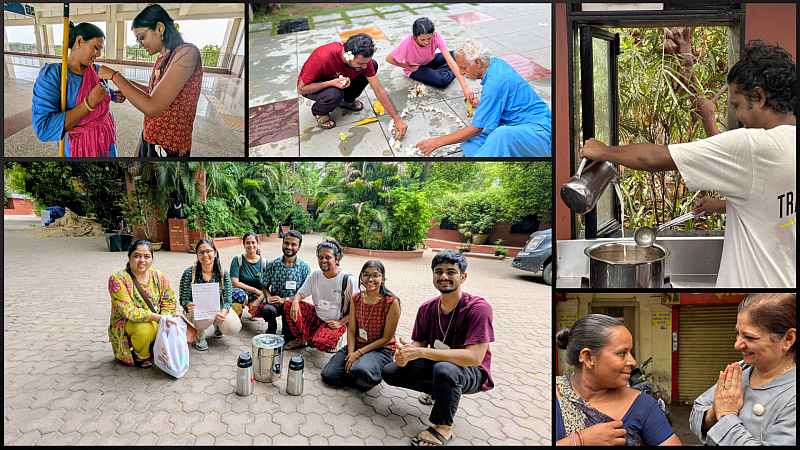
Something like that question — where am I, really, when I stand in front of a room? — carried sixty of us into a retreat in Sughad this July. Teachers and school leaders, a B-boy from Dharavi, a Rajasthani lawyer who teaches through art, a tabla player, a mental-health professional, a nineteen-year-old from Madrid still figuring out where he was needed. From Imphal to California. Nobody promised us answers. We were promised the company of others still asking.
The question underneath everything was quieter than what should I teach. It was: what kind of teacher am I called to be — and how much of that has to do with who I already am, outside the classroom, when no one is grading anything?
The Body Was Here
One moment from Nipun bhai’s talk that stayed with many of us was the story of Sal Khan, founder of Khan Academy, and how his thinking has evolved.
“The best curriculum, the best intervention — is you as a teacher becoming more aligned.”
— Nipun Mehta, citing Sal Khan’s own reversal on AI in education
Khan had once believed a personal AI tutor for every child would revolutionise learning. He came back years later and said, in effect: we were wrong. A machine can generate a curriculum in ten seconds. It cannot manufacture hunger. It cannot love a child into wanting to learn. Only a person can do that — and only when the person doing it is somewhat whole.
So the question in the room shifted. Not what should we teach here but what grows here. A permaculture farmer in Vietnam once said it to Nipun plainly: people always arrive asking the first question. She has spent her life answering the second. Do the right five percent, and nature carries the other ninety-five.
Teachers are burning out everywhere — not because they care too little, but because they are trying to hold a classroom with effort instead of coherence.
We Teach Who We Are
There was a story that kept returning, told in different voices, like a tune the whole retreat kept humming without meaning to.
A teacher wanted to transform her school and didn’t know how. So she made one small decision: I’ll keep teaching my curriculum exactly as I’m doing. But I will start meditating. Four or five years later, something had visibly shifted — not just in her, but in her students. Their behaviour changed. And the students who interacted with the rest of the school began, slowly, to shift the culture around them too.
Nobody redesigned the curriculum. Nobody introduced a new intervention. One woman decided to become quieter on the inside, and a whole ecosystem responded.
“We teach only who we are.”
Research on teacher effectiveness — the kind that tries to isolate what actually moves the needle for students — keeps landing on the same unglamorous answer: not credentials, not curriculum design, but what researchers dryly call “caring and captivating teachers.” That’s the thing Sal Khan’s AI still can’t manufacture. You cannot code presence.
There is something almost embarrassing about this, if you’ve spent your career trying to get better at teaching by getting better at technique. It suggests the deeper renovation isn’t in your lesson plans. It’s in you — in whatever room inside you is open or shut when a child walks toward it.
“Values are not taught. They are caught.”
One participant told a story about his aunt and uncle — nine children born, only two who survived to adulthood, the youngest going blind at thirty-five. And still, through all of it, they kept giving. Nobody sat the next generation down and lectured them on generosity. They simply watched it happen at the kitchen table, over and over, until it became instinct without anyone noticing the transfer. That’s the uncomfortable arithmetic of the profession. You can plan a lesson. You cannot really plan what a child absorbs from the shape of you.
The Empty Can
We watched a clip of old mechanical metronomes, placed side by side on a wobbling platform, falling into rhythm with each other purely through the shared vibration beneath them. No conductor. No lesson on synchrony. Just enough coherence in the system for it to happen.
“The classroom is like the empty cans. They come in, you get into sync, and eventually you are no longer needed.”
That last part is the hard part. Every instinct in teaching pushes toward being needed — indispensable, the source. But the retreat kept turning that instinct on its head. Instead of what’s my curriculum, try what’s already happening here. Instead of what do I grow in this room, try what grows here on its own, if I get out of the way enough to notice it.
One teacher spoke about a class she’d spent a year teaching about consent — about asking before touching. Her grandmother died during exam season. She walked in with the worksheets ready, but she herself was not. Before she could say anything, one child asked: “Can we do dua for them?” And then, one by one, every child in that room asked her the same question first: “Can I hug you, didi?”
“I go to the little children,” Gandhi once answered, when asked where he went to learn love.
Maybe the deepest privilege of teaching isn’t standing at the front of the room. It’s the chance, disguised as a job, to also be somebody’s student — to let a six-year-old teach you something about grief, or forgiveness, or the plain fact of being seen, that no professional development session ever managed to.
The tangerines, Fukuoka once said, don’t grow on the tree.
They grow on the whole farm.
What Grows Here
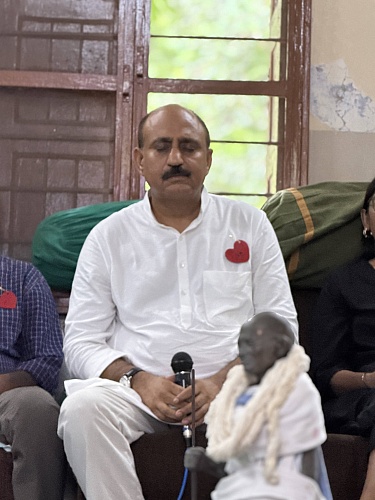 Jayesh bhai recounted an incident he was part of: a child in a municipal school, slapped by his teacher. Jayesh bhai, who had seen it, asked the wounded child to fetch a glass of water — for the teacher. The child did. Two minutes after being struck, he brought water to the person who struck him. Jayesh bhai turned to the teacher and asked simply: if this child forgave you in two minutes and brought you water, what would you learn from him? The teacher broke down.
It is a small, devastating story, and it says something true about where the actual curriculum in any room is coming from. It isn’t always coming from the adult holding the marker.
Nimo, who left a career at Wharton to work with children in the slums of Gujarat, told us about his performing-arts academy, where he and his students cleaned the public toilets after every rehearsal — not as punishment, as practice. “When you are cleaning a urinal with passion and joy, you’re able to root out of the child’s mind that the stage is the goal.” Sixteen children from that program eventually performed in Los Angeles and the UK. He hadn’t planned that outcome; he’d planted something smaller and stranger and let it grow sideways, in a direction no lesson plan would have predicted.
Whatever grows will grow.
Whatever dies will die.
Whatever works will work.
Whatever flies will fly.
I am planting seeds, nothing more.
Reconnecting With Me, Then We, Then Us
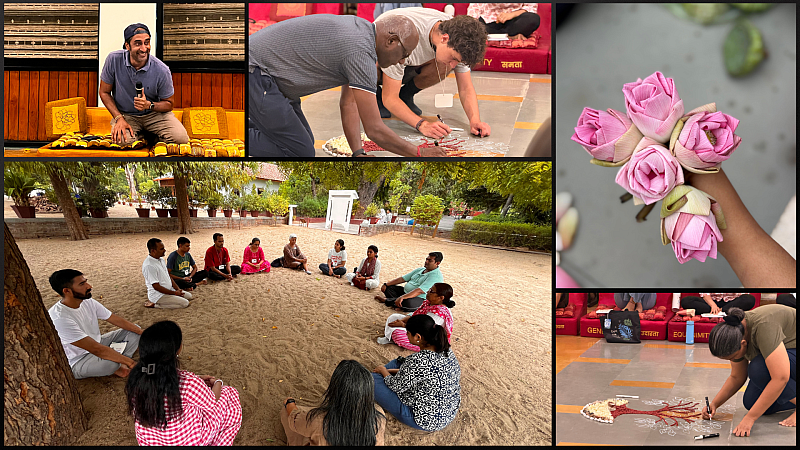
The retreat kept circling back to a simple architecture: Me — We — Us. Head, heart, hands. Not a hierarchy, but a sequence — because you cannot skip to the “us” of a thriving classroom without first doing the quieter work of the “me.”
“Where am I?” was the opening question of one session — not metaphorically, but literally. Am I in my body right now, or somewhere three tasks ahead of it? Reconnecting with me means noticing the difference. Reconnecting with we means noticing that my body isn’t separate from the room I’m standing in — a dysregulated teacher will unsettle thirty children before the bell finishes ringing, the same way a coherent teacher can, without a single instruction, settle a room simply by being settled herself.
And us is what happens after that — not built, so much as allowed. Trust the field. Let it go. From individual talent to something that belongs to no one person in the room, and yet moves through everyone in it.
“Impact equals actions divided by ego.”
Ten actions, divided by an ego of one, gives you ten. The same ten actions, divided by an ego approaching zero, tend toward infinity. Everyone recognised this in some form — the teachers they’d had, the teachers they wanted to be, the difference between a room that revolves around the person at the front of it and a room that simply becomes more alive because that person is standing there.
The Sound Of The Genuine
There’s a phrase from Howard Thurman that circulated through the retreat like a small current: the sound of the genuine. Something in each of us that hums beneath ambition and performance and the accumulated weight of other people’s expectations — and if we can’t hear it in ourselves, Thurman warned, we spend our lives on the ends of strings someone else is pulling.
Teaching, maybe more than most professions, tests whether you can still hear your own sound underneath everyone else’s needs — thirty children’s needs, a syllabus’s needs, a system’s need to measure what it can measure, even when the thing that mattered most that day was a silence nobody wrote down.
“You will record my words — but how will you record my silence?”
— Vinoba Bhave
That’s not a rhetorical flourish. It’s a real problem for anyone whose worth gets quantified by test scores and lesson-plan audits. The parts of teaching that change a child most durably are often exactly the parts that resist measurement — staying two extra minutes because something in a kid’s face said stay, answering a hard question honestly instead of efficiently, the version of yourself you happened to be standing in front of them on the day it mattered.
The Garden, Not The Factory
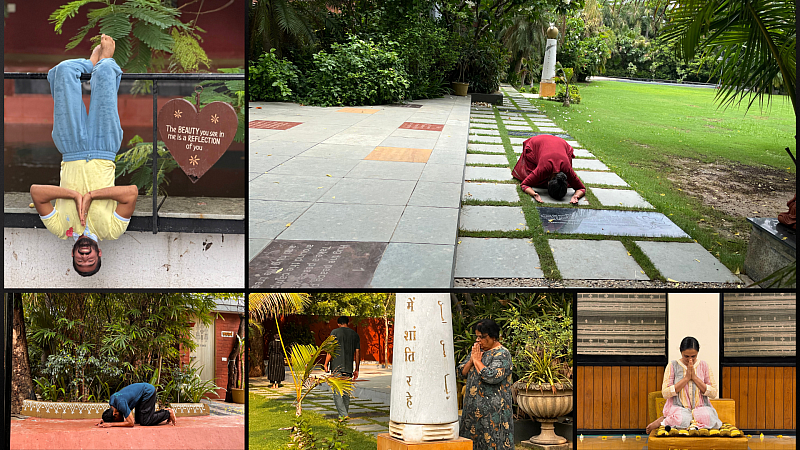
Somewhere near the end, someone offered a small, plain sentence that a lot of people wrote down: we come from the earth, we go to the earth; in between, we garden.
It’s a strange thing to hold next to a job so often described in industrial language — outputs, benchmarks, delivery of content. But everyone who has actually stood in front of a room of children for long enough knows the industrial language is a kind of lie we tell to make the job legible to people who evaluate it from outside. What actually happens in there is closer to gardening than manufacturing. You cannot force a seed. You can only tend the conditions — soil, water, light, and, it turns out, your own steadiness — and then trust something you didn’t fully design.
A child’s understanding doesn’t grow only from a worksheet. It grows from the whole ecosystem of a classroom — including, unavoidably, the emotional weather of the person who built it.
Which returns us, in the end, to the question the retreat never quite let anyone escape: not what kind of teacher should I become, but what kind of person am I already being, that a room full of children will absorb whether I intend it or not?
The curriculum was never only the curriculum. It was also whoever showed up to teach it — fully, or in pieces, present or merely physically there. And the children, it turns out, have always known the difference. They were simply waiting, with more patience than we usually give them credit for, to see which version of us would walk through the door.