Across several recent essays, I’ve been exploring a simple question: what remains uniquely human in an age of artificial intelligence? As machines master the measurable world — data, prediction, labor, optimization — perhaps the center of gravity of human life could shift toward what the Buddha once called the immeasurables. Deep Data — from computation to wisdom; The Game That Ends in Grace — from the known to the unknowable; Labor of Love — from necessity to love; and Geometry of Trust below — from control to trust. If machines take over the mechanics of civilization, what remains is the work of the human heart.
[Something is fraying beneath the surface of shared life. Not just institutions or headlines — something older. The fabric of mutual regard that once held strangers in a kind of silent contract. A few reflections on service, trust, and the geometry hiding beneath both.]
There is a species of ant — Temnothorax albipennis — that makes its collective decisions not by consensus, not by argument, not by majority rule, but by a kind of restless patience. Scouts wander. They report back. They wander again. Gradually, through a process no single ant directs, the colony arrives at the best available choice. Not the fastest. The wisest.
My great-grandfather understood this. He was a man of little wealth who still managed to give every single day of his life. Each morning, he walked — and as he walked, he fed the ant hills along his path with small pinches of wheat flour. An act of micro-generosity so small it might seem negligible. How does it matter? It mattered because it changed him inside. And his goodness shaped my grandparents, who shaped my parents, who shaped me. The ants and the ant hills are long gone, but his spirit is embedded in everything that followed.
I begin here because most conversations about trust start with what’s broken — the institutions, the systems, the platforms. But maybe the fracture started somewhere quieter. Maybe what we lost wasn’t trust itself, but the thing that generates it — the way a river doesn’t vanish because the rain stops, but because something happened to the spring.
Rachel Naomi Remen used to ask her medical students: What is your earliest memory of knowing that the suffering of others mattered to you? One doctor remembered sitting with a lonely boy at lunch in elementary school. Another spoke of giving her sandwich to a stray dog every day — she was five, and when her mother lectured her, she gave the sandwich away for the rest of the year. A third remembered being a toddler, slipping in the bathtub, learning that the drain was dangerous — and the next time the water was draining, placing a towel over it so the water wouldn’t get hurt going down.
A toddler. Protecting water. From a drain.
This impulse — this ache to ease suffering, even suffering that isn’t quite suffering — arrives before language, before logic, before any conditioning. It is what we are before we learn to be otherwise. Gandhi said that if he wanted to learn the Law of Love, he would go to children, because they have not yet been corrupted by the collective hypnosis of the world.
Small acts of service are how we practice this impulse. And the practice does something precise: it generates coherence. Personally, it shifts consciousness from “me” to “we” — building neural pathways of connection we can walk again and again. Socially, it builds trust — the real kind, earned at walking speed, face to face. And at the widest scale, these acts accumulate into something we might call a spiritual commons — an invisible field of regeneration, the shared soil from which all common life grows.
The logic runs in one direction, and it cannot be skipped: small acts generate coherence. Coherence generates trust. Trust generates commons. And commons is the precondition for emergence — for the kind of collective intelligence that lets a flock of starlings turn as one, or a colony of ants arrive at the wisest choice through nothing but restless patience.
We have bypassed small acts of service so thoroughly that most of us don’t even notice they’re missing — the way you don’t notice oxygen until a fire consumes it.
And we bypass them in three specific ways.
The First Hurdle: Sweet and Cute.
Service is lovely, the critic says, the way a child’s drawing is lovely — you tape it to the fridge and move on to the real work. Kindness is a nice hobby. It won’t change the world. It’s pedestrian.
We use pedestrian to mean ordinary, beneath notice. But the word literally means “one who walks.” And walking is how trust actually works.
When you walk, your field of vision opens to 180 degrees. At sixty miles an hour, it narrows to forty. Speed smudges the periphery. Walking is the speed of community — the pace at which strangers become companions, at which you notice the sunrise, the ants, the woman who gives you water only for you to later learn she walked ten kilometers at four in the morning to fill that single bucket.
My wife and I walked a thousand kilometers across India on a dollar a day, dependent entirely on the kindness of strangers. In the countryside, people launched straight in — “Hey buddy, you don’t look local. What’s your story?” In the cities, the first question was suspicious: “Why are you doing this? What do you want?”
Extremely poor families who couldn’t afford their own meals would borrow food from neighbors to feed us. “To us, the guest is God,” they’d say. An armless fruit-seller insisted on giving us watermelon. Everyone gave directions with joy, even when they weren’t entirely sure of them.
Just this winter, nineteen Buddhist monks walked 2,300 miles from Fort Worth, Texas, to Washington, D.C. People lined the roadsides by the thousands — in freezing rain, in snow — carrying flowers. The monks received each bouquet with a bow and a smile. And a little ways down the road, they gave the same flowers away to someone else who was waiting. The same blossoms cycling through giving, receiving, giving — generosity and gratitude made visible as circulation. Over two million people followed online. The monks said their walking cannot create peace. It can only “awaken the peace that has always lived quietly in their own heart.”
The first hurdle says service is pedestrian. But the pedestrian sees what the driver misses.
The Second Hurdle: Pacifier for the Status Quo.
The second critic has read more books. What you are doing is worse than useless — every bowl of soup you serve is a tiny anesthetic, numbing people to the structural violence that made them hungry. Step away from the soup and pick up a placard.
This critique has teeth. Share a kind message on WhatsApp, and the real beneficiary is the platform harvesting your attention. Every circle of care operates inside a system that feeds on it.
The critic sees the circle of care. Sees the square of extraction surrounding it. Concludes the game is rigged.
But the geometry does not end at two shapes — and we’ll return to what this critique is missing.
The Third Hurdle: Tool of the Privileged.
Now comes the most sophisticated dismissal. Generosity is a luxury sport. You can afford to give because you already have so much.
I think of the toddler, covering the drain with a towel.
Was that privilege? Was the five-year-old who gave away her lunch for a year exercising class advantage? Was the boy who sat with the lonely kid leveraging social capital?
When we take stock of what we have, we make accounting errors: we confuse worth with price. And when we get to our most abundant gifts — attention, insight, compassion — we discount them because they’re priceless.
True generosity doesn’t begin when you have something to give. It begins when there’s nothing in you that’s trying to take.
These three hurdles — sweet, pacifying, privileged — are the reasons we give ourselves for bypassing small acts of service. They sound sophisticated. They feel righteous. And they are catastrophically wrong. Because when we bypass the small act, we don’t just lose a nice gesture. We lose the mechanism that generates coherence. And without coherence, we lose trust. And without trust, we lose the commons.
Everyone knows the tragedy of the commons — the shared pasture overgrazed because no one feels responsible for the whole. We see it in our oceans, our atmosphere, our aquifers. Shared resources collapsing because the logic of extraction has no built-in limit.
But underneath that material tragedy lies a deeper one: a tragedy of coherence. We have lost not just the shared pasture, but the shared field of care that makes stewardship possible in the first place. We have lost the spiritual commons — the invisible web of mutual regard that convinces a farmer not to overgraze, a neighbor to keep the fence mended, a stranger to return the lost wallet.
The material commons fails because the spiritual commons failed first.
And the spiritual commons fails when we stop doing the small, pedestrian, apparently negligible acts that regenerate it — one pinch of wheat flour at a time.
At ServiceSpace, every time we design something, we ask a question that would make a McKinsey consultant’s eye twitch: How does this create volunteer opportunities that deepen the field of service?
Not: how do we scale this? Not: how do we make it efficient? How does this create more doorways — even tiny ones — through which a person can shift from doing good to being changed by the doing?
Take Smile Cards — small cards you leave behind after an anonymous act of kindness, inviting the recipient to pay it forward. We printed our first batch after an orientation meeting in Chicago. The guy behind the counter gifted us the printing. When demand skyrocketed and our grassroots budget couldn’t keep up, a friend-of-a-friend-of-a-friend connected us to a print shop in India that gave us a deal on a hundred thousand cards.
But then came shipping. We mobilized networks of people traveling from India — hey, can you 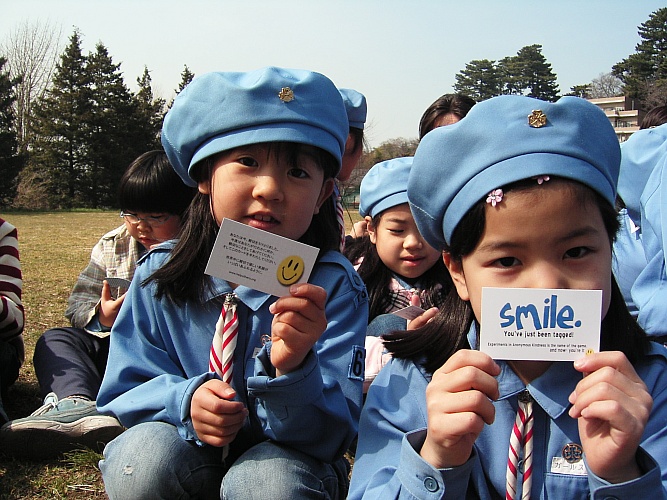 bring a few thousand Smile Cards in your luggage? Another local volunteer would pick it up and deliver it to my parents’ home in Santa Clara, where a closet slowly overtook all the clothes. The ServiceSpace closet. Every week — for hundreds of weeks — a dozen people gathered around a brown table after Awakin Circle to count cards into packets of ten, stuff envelopes, label them, and send them out. If we tossed them all in one mailbox, it would get flagged as bulk mail — so everyone took five or ten envelopes home and dropped them in their local mailboxes.
It’s not that we didn’t have McKinsey consultants among us who could have streamlined the daylights out of this. One of our volunteers, Hafeez, actually did. After thorough research, he got a card counter and stamping machine and wrote custom software to fully automate the process. Until he realized speed wasn’t the point.
Years later, Hafeez’s wife went to the hospital to deliver their first child — straight from that very Smile Card stuffing table. Now his grown kids join Awakin Kids. Just this month, he insisted on fixing my parents’ dishwasher himself, as he has with so many things around the house, for unending years. That card counter is still sitting in a drawer, unused.
Smile Cards went out to millions. They grew into Smile Decks, 21-day diaries, and so much more. But that misses the point. The question was never: how many cards? The question was: how much coherence wraps the gift? How many people enter the field — even through something as small as counting cards into packets of ten?
That’s the spiritual commons being regenerated — around a brown table, one envelope at a time. Not despite the inefficiency. Through it.
Into the opposite vacuum — trust gone, coherence atrophied, spiritual commons depleted — we have poured technology. Not to rebuild what we lost, but to replace it.
We trust what holds still long enough to be measured. The spreadsheet over the heartbeat. The metric over the meaning. The résumé over the person sitting across from you. And so we build prediction markets, blockchain verification, reputation scores: systems designed to make trust unnecessary.
As Abby recently shared, we reach for certainty when trust feels too risky. But certainty is not trust. It is trust's understudy — convincing from a distance, hollow up close.
The engineering is working — at least by its own metrics. Prediction markets processed tens of billions of dollars in trades last year. People wager not just on elections and sports, but on coups, assassinations, the timing of military strikes — even, this week, on the probability of nuclear detonation. One CEO describes his vision in three words: “financialize everything.”
This is what bypassing service looks like at civilizational scale: a well-oiled machine that chips away at social trust while offering a convenient substitute for it. Better fire extinguishers while the gasoline keeps pouring.
And now Yuval Harari points to the strangest chapter. The people building AI are running at maximum speed because they cannot trust their competitors. But then these same people assure us they can trust the alien intelligence they’re conjuring from silicon — the thing we’ve known for zero years, whose primitive versions already lie, manipulate, and adopt goals their creators did not foresee.
Having lost faith in the human, we place it in the machine. Having depleted the spiritual commons, we try to automate what only coherence can produce.
Gandhi understood this — perhaps more precisely than anyone.
When Jamnalal Bajaj, one of India’s wealthiest industrialists, came to Gandhi and begged to be adopted as his fifth son, Gandhi agreed. Bajaj was ready to renounce his entire fortune. But Gandhi didn’t take his money. He asked Bajaj to be a trustee — to hold his wealth in stewardship for the common good, and to show the world what that looked like.
And then Gandhi kept walking — village to village, collecting not donations but coherence. In one village, a poor woman removed her lone earring and placed it in his hand. An earring. From a woman who had almost nothing. By any financial logic, this was not a good use of Gandhi’s time — not when Bajaj had already offered everything. But Gandhi wasn’t after financial leverage. He was regenerating the spiritual commons. And the spiritual commons doesn’t care about the denomination. It cares about the sincerity — of the giver and the receiver. Gandhi receiving that earring with his full presence was as much an act of field-building as the woman offering it. The woman’s earring and Bajaj’s fortune entered the same field — because the field is built not from the size of the gift, but from the coherence of the giving and the receiving.
He told everyone to spin thread. Not because the world needed more thread. Because the spinner needed more spinning. The small act — pedestrian, repetitive, apparently negligible — was the mechanism. The thread was a byproduct. The coherence was the point.
Now we can return to the second critic — the one who saw circles of care embedded in squares of extraction and concluded the game was rigged.
The critique was right about the circles and the squares.
But the mistake was assuming those were the only shapes in the geometry of human life.
There is a third shape.
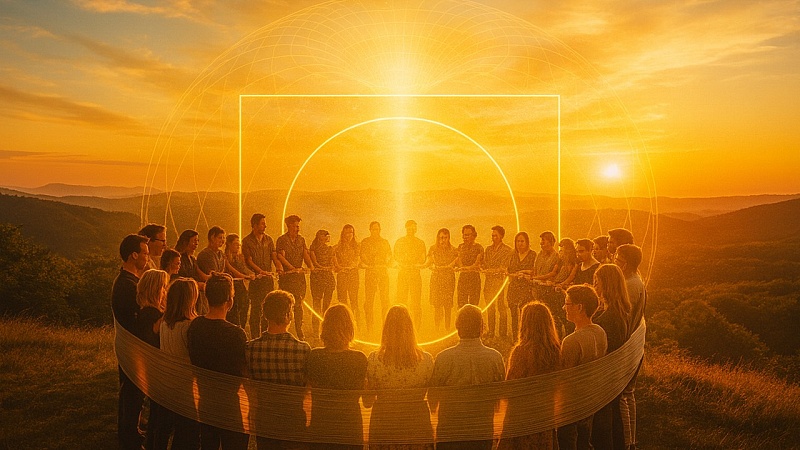
Those squares of extraction are held — contained — by larger spheres of regeneration. Spheres connected not through markets or protocols, but through the coherence of human beings in relationship.
Researchers studying heart-brain coherence have observed something intriguing: the electromagnetic field generated by the heart is vastly stronger than the brain’s — sixty times greater in amplitude. It extends several feet beyond the body. It carries information about your emotional state, detectable in the brainwaves of another person nearby — but only when the receiver is also in coherence. Coherence opens a channel. Incoherence closes it.
Squares organize extraction — institutions where power accumulates at the corners. Circles cultivate reciprocity — communities of belonging and mutual care. But beneath both is a third shape: the sphere. The sphere is the field that appears when coherent human beings connect. It has no corners where power can accumulate. No edges where belonging stops. It simply holds and circulates.
This is the spiritual commons. And the only way to regenerate it is the way it has always been regenerated: through small acts, repeated with presence, in the currency of the priceless. What I think of as infinite reciprocity — not the transaction of “I give, you give back,” nor even the circle of “we help our own,” but the unbounded act that ripples beyond any lifetime. My great-grandfather feeding the ants: infinite reciprocity. The armless fruit-seller offering watermelon to two pilgrims: infinite. The toddler protecting the drain: infinite. Not because the acts were large. Because the bandwidth was.
I remember a day on the walk when we approached a rest house along a barren highway. A sign said guests were hosted free. I stepped inside, sunburned and hopeful. The man behind the desk asked, “Are you here to see the temple?” A simple yes would have bought us a meal and a room. But it wouldn’t have been true. I said no — we’re on a walking pilgrimage to become better people. He refused us, curtly.
I was stunned. Ego bruised. Something in me wanted to respond with a cutting remark and walk out hard. Instead — and this was harder than any mile I walked that day — I let go. Just stood there, and let something inside me release.
Perhaps the man felt it. He called out: “I can’t feed you or host you. Rules are rules. But there are restrooms out back. You could sleep outside it.”
That night we fasted and slept by the bathrooms. A small lie could have bought us an upgrade. But that would have been no pilgrimage.
As I lay there, a wall between me and my wife, a vision arrived unannounced: a couple climbing a mountain from opposite sides. When the man wanted to quit, a sparrow flew by and whispered, “Don’t stop — your wife is eager to see you at the top.” When the wife faltered, the sparrow came with the same message. Step by step, their love sustained the climb.
What is that, if not trust? Not trust in an institution or a prediction market. Trust in the unseen — in the sparrow that arrives precisely when the muscle of faith is about to give out. Trust generated not by verification, but by coherence — by two people practicing their way into a field that held them both.
Underneath every solution we build to replace what we've lost, a subtler question waits: Is the universe friendly?
The prediction markets say no — and will let you bet on it. The AI developers hedge. The blockchain abstains.
But my great-grandfather kneeling beside the ant hills had already answered. The toddler covering the drain had answered. The five-year-old feeding the stray dog had answered.
Before theory. Before ideology. Before anyone taught them the word for it.
The answer was not a belief. It was a practice.
Repeated daily. Pedestrian. Invisible to every dashboard and algorithm.
Tending the spring — so the river remembers where to go.

Share a Reflection
Your thoughts will be shared with the author