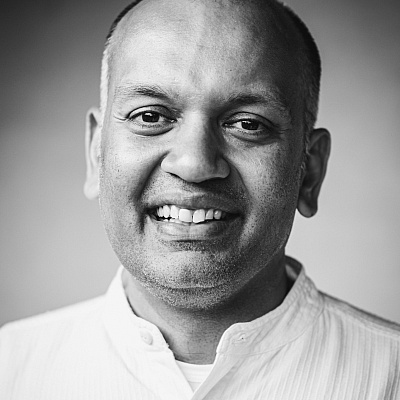
Fresh off our Pod, I'm sharing a few talks at Harvard Business School tomorrow. It got me thinking. The students are sharp, earnest, and trained to win. They study cases. They optimize outcomes. They build models of the world and then try to inhabit them. My background is quite the opposite: a volunteer ecosystem with no staff, no fundraising, and no business plan — an ecosystem that's run for twenty-six years on a simple hypothesis that people actually want to be good.
For twenty-one days of our Laddership Pod, we collectively distilled many insights. On paper, the Pod is a peer-learning journey. In practice, it is a counter-curriculum — not because it opposes traditional education, but because it tends to quietly undo the assumptions traditional education never thought to question. Having just reviewed the full arc of the latest Pod alongside the HBS syllabi, I was struck by how precisely each mirrors the other — like a photograph and its negative. Same shapes, inverted light.
Here's what I mean, in case these notes are helpful as you carry forward what the Pod opened in you:
1. From Content to Context: The Foundational Shift
At a place like HBS, everything is content — a strategy, a decision tree, a competitive analysis. The entire pedagogy is built around mastering what is in front of you: the case, the model, the market. And it works, brilliantly, within its frame.
The Laddership Pod makes a different bet. Its central move — introduced in Module 15 through the story of a German professor who spent years studying Zen archery in Japan — is that context is the higher-order variable. The professor was only allowed to shoot at a straw roll a few feet away. Frustrated, he asked when he could aim at a real target. His teacher replied: "The way to the goal is not to be measured!" When finally given a target, his arrows flew wildly off course. That night, in total darkness, the teacher shot two arrows — both bullseyes. He didn't need to see the target because he could sense the entire field. "Laddership isn't about doing more," the Pod says. "It is about seeing more." Henri Bergson put it plainly: "The eye sees only what the mind is prepared to comprehend." Most education trains the eye. The Pod works on what the mind is prepared to comprehend — the invisible field of trust, attention, and shared presence from which every decision actually arises. The curriculum calls this shift from content to context. And once you see it, you can't unsee it: the quality of the field in which a decision gets made matters more than the decision itself.
2. The Power Paradox: Why Leadership Needs Laddership
Business schools train people for power. And the research says power corrodes the very qualities that earned it.
Module 10 opens with data that lands like a cold shower: over 20% of corporate executives exhibit psychopathic traits — the same percentage found in high-security prisons. Seventy-five percent of employees leave their jobs not because of the work, but because of their managers. Dacher Keltner's research at UC Berkeley is unequivocal — power deactivates compassion and empathy circuits in the brain. Even driving behavior changes: low-powered cars almost always stop for pedestrians, while SUVs and high-powered cars stop only 52% of the time.
The Pod's response isn't to reject power but to redefine how it's held. A good conductor doesn't micromanage every note — she tunes into the rhythm of the moment, knowing when to guide with a light touch and when to step back entirely so the group learns to listen to itself. ServiceSpace calls this "laddership" — a word play that means racing to the bottom of the pyramid instead of the top, because that's where the relationships are. If a ladder does their job right, no one will know to thank them — because their gift lies in being completely natural. Reinhold Niebuhr framed it as the defining challenge: "Power without love is brutality, but love without consideration of power is sentimentality. How to make power express love, and love humanize power, is the distinctive task for the next hundred years." The Pod spends three weeks showing what that looks like in practice — from the volunteer drivers at Gandhi 3.0 retreats (one of Asia's largest diamond merchants sleeping in a hallway, saying afterward: "Thanks for the opportunity to grow in generosity") to Vinoba Bhave, who walked seventy thousand kilometers across India and redistributed more land than the size of Kuwait, carrying nothing but his own willingness to change.
3. The Scale Trap: Infinite vs. Finite Game
"A finite game is played for the purpose of winning," James Carse wrote. "An infinite game is played for the purpose of continuing the play." Most of what elite institutions teach optimizes for finite games — quarterly returns, market dominance, the exit. Module 9 asks what that optimization costs.
Its opening image is the Living Bridges of Meghalaya, in northeast India — possibly the wettest place on earth, where bridges are not built but grown from ancient roots and vines stretched across rivers. These bridges cannot be completed in a single lifetime. But once done, they last for centuries. Contrast that with venture capital's timeline: deploy in two years, exit in five, move on. The module names the addiction: "Our current systems prioritize immediacy — venture capitalists chase quarterly profits, politicians focus on re-election from day one, and media cycles demand instant responses. Even philanthropy, in its urgency to create measurable impact, often favors quick fixes over deep, systemic change." And it offers Gandhi's counter-image — keeping one eye telescopic and the other microscopic, the ability to zoom in for precise action while never losing sight of the vast, interdependent whole.
The haunting factoid: "For someone who is 10 today, when they're 60, they'll experience a year of change in 11 days." At that pace, the space between stimulus and response — where Victor Frankl located all our freedom — is being compressed to nothing. The Pod's question is whether we can protect that space as a design principle, not just a personal practice. Whether scaling up might sometimes mean not doing more of the same, but deepening relationships, regenerating ecosystems, and seeding ideas that ripple across generations.
4. Broadcast vs. Deepcast: Redesigning How Influence Moves
Every HBS student is being prepared for broadcast — personal brand, platform, reach. LinkedIn's own founder admitted: "Social networks do best when they tap into one of the seven deadly sins." Module 12 asks a question that should keep any aspiring leader up at night: what if we designed instead for "seven viral virtues"?
The distinction the Pod draws is simple and devastating. To broadcast is to send a message outward, hoping it lands somewhere — narrow, low-bandwidth connections optimized for reach. To deepcast is to send it with intention into a regenerative web that can hold, nurture, and carry it forward. Broadcasting measures success in reach. Deepcasting measures success in depth. Our friend Jac captured the underlying psychology: "Mind wants to broadcast because it is seeking a connection that can only be obtained through deepcast." This is the attention-economy trap — we keep reaching for more eyeballs when what we're actually craving is depth of contact, and the algorithm keeps offering us the wrong currency for the right hunger.
ServiceSpace does know broadcast -- it sends 50 million emails a year, for instance. But it chose not to optimize for it — "We prioritized the hard part -- deepcast, heart-to-heart." Today, the ripples speak for themselves. That isn't virality. It's vitality — spreading at the pace of trust, rippling outward in widening circles of care.
5. Effortless Effort: The 5% Principle
Here is the line that runs beneath the entire Pod like a root system:
"The success of an intervention depends on the interior condition of the intervener." — Bill O'Brien
Module 16 builds the whole architecture around it — and it's the most counter-intuitive frame of the entire curriculum while being the most empirically defensible.
The module opens with Fukuoka, the Japanese farmer who practiced what he called "do-nothing farming" — no pesticides, no fertilizers, no tilling, no pruning, no weeding. People traveled from all over the world to eat one of his tangerines. When asked where the apple grew, he'd say: "My tangerines don't grow on trees. They grow on my farm." The field is the product. Hang Mai, a farmer in Vietnam inspired by this approach, discovered that the best soil on the planet contains just 5% organic matter — but that 5% changes everything. "We only have to do 5%," she realized. "Nature does the other 95%. But it's not doing nothing — it's doing the right thing, the right part."
If you move from a place of grasping, the module says, you press too hard, disrupting the natural flow. If you act from a place of deep listening, your effort becomes a gentle nudge — a whisper rather than a shout. The Pod itself had been teaching this in real time: not everyone had the energy to read every module, engage with every prompt, comment on every reflection — and yet the field deepened anyway. Those who sat quietly found themselves found. Those who offered a single line of poetry moved others more than a thousand-word essay might have. The quality of presence mattered more than the quantity of output. For a population trained to believe that harder effort always equals better results, this is perhaps the most disorienting — and liberating — proposition in the entire twenty-one days. The wolves reintroduced to Yellowstone after seventy years didn't do everything. Their presence restructured the entire ecosystem. Rivers literally changed course. That is 5% leverage. That is what interior condition does to exterior systems.
6. The Empty Cans: Architectures for Coherence
W. Edwards Deming cautioned: "A bad system will beat a good person every time." The Pod takes this seriously. Good hearts planted in misaligned systems find their best instincts eroded. Module 17 asks: what are the invisible architectures that allow coherence to emerge?
Its signature image is the metronome experiment. Place five metronomes on a table, start them out of sync — they stay chaotic. But place them on a shared platform with empty cans beneath, and within minutes they lock into rhythm. The cans don't set the beat. They don't guide or override. They are structurally essential but experientially absent — allowing energy to travel, creating feedback loops of tiny vibrations that gradually bring the metronomes into unison. That's the design philosophy underneath everything we build: platforms that draw out latent gifts without imposing a rhythm.
The module also features a case study that every incentive-designer ought to memorize: the daycare fine experiment. When a daycare started fining parents for picking up their children late, parents arrived later — because the fine turned a social obligation into a transaction. The structure changed, and so did the behavior. Anyone trained in incentive design will recognize the mechanism; the Pod shows how it works in reverse. When you replace trust with price, you don't just change the price. You change the relationship.
"When a complex system is far from equilibrium, small islands of coherence, in a sea of chaos, have the capacity to shift the entire system." — Ilya Prigogine
You don't need to redesign the ocean. You need to tend one island of coherence well enough that its pattern becomes contagious. A kitchen table where people speak honestly. A team meeting that begins with silence. A circle where strangers learn to read each other slowly.
7. Creative Love — The Third Way
Most ethical training presents dilemmas as binary — fight or cave, resist or comply. Module 18 names a third force.
When Gandhi was thrown off the train because of his skin color, he spent the whole night shivering at the station and later called it "the most creative night of my life." Something in that long, cold night didn't harden into rage. It opened into a question: Is there a way to meet this that neither submits nor strikes back? The module calls this Creative Love — Sanskrit has over a hundred words for love, and one of them is ahimsa, which is not merely non-violence but an active, creative force that resists without an enemy, that refuses to mirror the harm it seeks to heal.
The cellist of Sarajevo carried his cello into a bomb crater where twenty-two people had been killed, and played for twenty-two consecutive days — one day for each. Not fight. Not flight. Something that rises from the same ground the Pod has been tending all along: coherence, trust, the small acts that build a commons strong enough to hold even suffering. Vimala Thakar defined it with surgical precision: "Compassion is a spontaneous movement of wholeness. It has the force of intelligence, creativity, and the strength of love." This is what happens, Module 18 argues, when the chain doesn't break — when someone stands inside a moment of destruction and responds with the full weight of their presence.
8. Designing for Emergence: Not Blueprints but Soil
Every business class teaches you to design for outcomes. The Pod teaches you to design for conditions. The distinction is not subtle.
Module 19 opens with Adyashanti's definition of faith — "the withholding of conclusion, so we allow what-is to arise" — which is the precise opposite of the certainty that most professional training rewards. The Pod's argument is that emergence is not guaranteed, but it is shaped by the quality of attention, the coherence of motivations, and the ability to hold tension without collapse. One Pod participant described hostel life after lights out: "Someone whispers, 'Are you awake?' And without seeing each other, from different beds, in the dark, voices slowly begin to answer. No one plans it. No one announces it. But somehow, everyone who needs to be there is there." That's emergence. Not just complexity but ordered complexity — a new pattern arising from relationships, not visible in any of the parts alone.
The practical architecture we've called "social permaculture" moves in four waves: draw out latent gifts (everyone is good at something), activate the impulse to give (the shift from consumption to contribution), let those gifts circulate in a trust ecology (not transactions but relationships), and watch broadcast dissolve into intimate many-to-many connection. You can't design the murmuration. But you can design the platform and the empty cans. A farming movement in Vietnam, seeded by this approach, spontaneously became a forest restoration movement. The emergence was unplanned. That's what happens when you tend the soil instead of micromanaging the seeds.
9. Joy as Operating System: Not Reward but Fuel
Most institutions treat joy as the reward for success — what arrives after the promotion, the exit, the tenure. Module 20 inverts this entirely: joy is not the result but the fuel. Tagore captured it in three sentences that function like a koan: "I slept and dreamt that life was joy. I awoke and saw that life was service. I acted, and behold, service was joy."
The module's core insight is that joy isn't something we find after we've eliminated suffering. It is what enables us to hold suffering without collapsing. Thich Nhat Hanh: "Suffering and joy are not enemies. They dance together." At one of our Gandhi 3.0 retreats, a seasoned meditator named Stephanie fell into a seven-foot hole late at night, needed fifty stitches, and showed up the next morning with a giant smile: "I'm so grateful." A friend who had been with her in the hospital wrote afterward: "Despite the immense pain, there was absolutely no change in the width of her smiles. In my mind, the thought that kept coming up: how could I be like that someday?" Harvard has actually studied her brain. But the width of her smile that morning was not a finding. It was a fruit. That's equanimity born of practice — not denial of pain, but the inner spaciousness to hold it without contraction. And it points to a metric that doesn't appear on any balanced scorecard: the most powerful act of laddership may not be a grand plan or a perfect answer, but simply becoming a steady presence — one through which others remember the joy of being alive.
The Inversion
If I had to map the Pod's twenty-one days against the curriculum across the river, it might look something like this:
Where elite institutions teach maximize shareholder value, the Pod teaches: maximize coherence, and value follows as emergence.
Where they teach scale fast, the Pod says: deepen first — Gandhi gathered 78 people for 15 years before millions followed on the Salt March.
Where they teach build your brand, the Pod offers deepcast over broadcast — the mind wants to broadcast because it is seeking a connection only deepcast can deliver.
Where they teach incentivize performance, the Pod points to the daycare fine study and a generation of research showing that extrinsic motivation is degenerative — you don't need to learn generosity; you need to learn greed.
Where they teach lead from the front, the Pod teaches laddership — race to the bottom of the pyramid, honor the iceberg below the surface, create conditions for others to step into their own power.
Where they teach plan for outcomes, the Pod teaches: design for emergence. Tend the 5%. Trust nature — or grace, or whatever you want to call the 95% that was never yours to control.
And where they teach measure impact, the Pod cites HeartMath's research: your heart generates an electromagnetic field sixty times greater than your brain's, and when you're in coherence, that signal is detectable in the brainwaves of people nearby. Not metaphor. Measurable physics. It changes the entire calculus of what "impact" means.
None of this, I should say, is anti-business. Adam Smith — the patron saint of markets — wrote The Theory of Moral Sentiments before The Wealth of Nations. The commercial logic of self-interest was always meant to nest inside a prior moral architecture — a web of social trust, mutual recognition, and community norms that Smith simply assumed would hold. The butcher and the baker pursue their own interest, yes, but they do it in a village where everyone knows their name and their character, where reputation is a living currency no ledger records.
We built a civilization on the second book and forgot the first. We took the superstructure for the foundation.
The Laddership Pod is a twenty-one-day invitation to remember. Not to reject the outer game, but to tend the inner one — because the success of the intervention, it turns out, has always depended on the interior condition of the intervener. And that condition is not fixed. It is not a given. It is a practice, available to anyone who is willing to sit with the question long enough to let it rearrange them.
The bridges of Meghalaya cannot be completed in one lifetime. But they last for centuries.
Tend the roots.

Share a Reflection
Your thoughts will be shared with the author