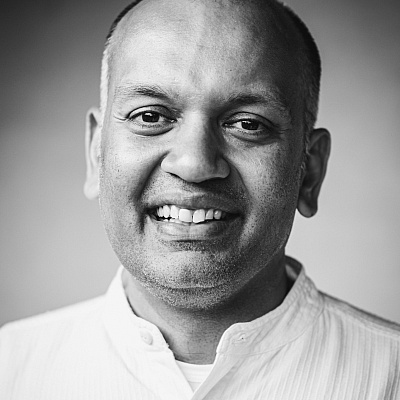
This essay is part of a series exploring what remains uniquely human in an age of AI. As machines master the measurable world, perhaps the center of gravity of human life shifts toward what the Buddha once called the immeasurables.
In Vietnam, a group of farmers gathers around a question. City visitors keep arriving with the same one: What should we grow here? The farmers have learned a different question: What grows here?
Such a slight shift. A few words rearranged. And yet in the space between those two questions lives everything this essay wants to say.
At an AI conference last week, I watched brilliant people speak earnestly about using artificial intelligence for flourishing, compassion, community. Nearly every slide seemed to have a metric. Flourishing as a KPI. Compassion as a dashboard. Wellbeing engineered into spiritual categories with evaluation frameworks. They were asking the first question — what should we grow? — with extraordinary computational power. Millions of dollars aimed at the cultivation of human thriving, and each dollar accountable to a spreadsheet.
But there is a farmer on the island of Shikoku who spent fifty years asking the second question, and his answer unsettled everything.
· · ·
Masanobu Fukuoka was trained as a microbiologist. At twenty-five, recovering from pneumonia in a hospital bed, he had a moment of clarity so total that he walked out of his research career and never returned. Nature, he realized, does not need our help. It needs our absence.
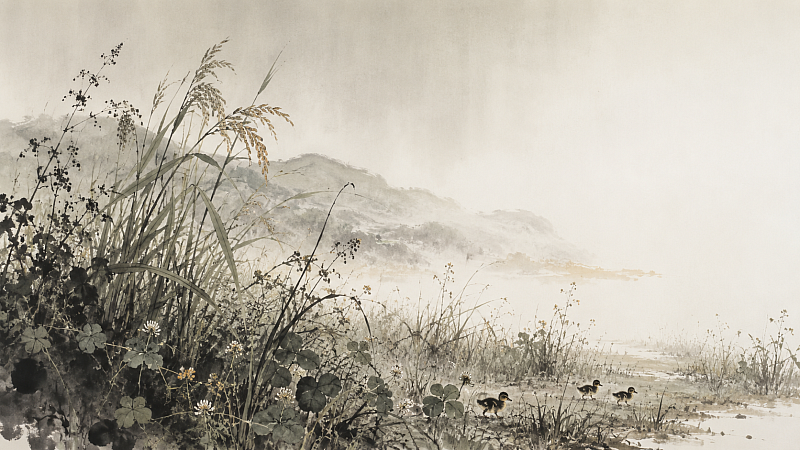
He went back to his family's farm and spent five decades developing what he called "do-nothing farming." No tillage. No fertilizer. No pesticides. No weeding. No pruning. His farm looked more like a forest than a field. Scientists came from around the world to study it. They scratched their heads. His rice grew dry, among grasses and insects. He didn't flood his paddies the way every farmer in Japan had done for centuries. He threw the straw cuttings back on the ground and scattered seed. He let ducklings wander.
His yields stunned conventional agronomists.
The insight was not laziness but precision. High-yield technologies, he argued, are merely glorified attempts to stave off reductions in productivity after we have already hamstrung nature. We spray pesticide, which kills the spiders, which would have eaten the leafhoppers, which now devour the rice. So we spray more pesticide. We test for nitrogen, add fertilizer, and kill the very microorganisms that were producing nitrogen on their own. We create the problem, then congratulate ourselves on the solution.
One gram of soil on his farm contained a hundred million nitrogen-fixing bacteria. He didn't put them there. He stopped killing them.
And there is this, which is hard to forget: "Rain does not fall from the heavens; it issues forth from the ground. Deserts do not form because there is no rain; rather, rain ceases to fall because the vegetation has disappeared."
The rain comes from the ground.
We have been building dams in the desert of meaning, engineering irrigation systems for the soul, and wondering why everything feels dry. Perhaps the vegetation was already there. Perhaps we destroyed it. Perhaps the work is not to manufacture rain but to restore what we have removed.
· · ·
The Buddha, twenty-five centuries before Fukuoka, gave this condition a name. He spoke of four apramāṇa — not four virtues, not four practices, not four feelings. Four immeasurables. Compassion, equanimity, joy, loving-kindness. Note the precision. Not "hard to measure." Not "not yet measured." Immeasurable. The way infinity is not a very large number but a different kind of thing entirely.
There is a difference between the unknown and the unknowable. The unknown is a frontier, a dare. It is the next data set, the next mountain, the next genome to sequence. The ego loves the unknown — it is a problem that flatters the problem-solver. The unknowable is something else. It is the weather on the other side of the Self. It does not resist our instruments the way a locked door resists a key. It is the medium in which doors and keys exist.
There is a force that moves through all living things — call it chi, call it grace, call it what the river calls the sea. It cannot be measured. It does not submit to spreadsheets. If you try to hold it in your hand, your hand is the wrong instrument. And yet a gifted acupuncturist, placing a needle no thicker than a whisper, can remove what blocks it, and the whole body remembers what it already knew.
This is the more ancient logic: you do not manufacture wellness. You un-obstruct it. You do not build the current. You clear the riverbed.
· · ·
The trouble with measurement is not that it fails but that it succeeds — so spectacularly that we begin to believe everything worth knowing can be known this way.
In 1975, Charles Goodhart observed what is now called Goodhart's Law: When a measure becomes a target, it ceases to be a good measure. British hospitals, pressured to keep wait times under eighteen weeks, found creative ways to game the clock — delaying referrals, performing unnecessary procedures — while actual care deteriorated. The metric consumed the thing it was meant to protect.
Extend this from hospitals to the heart. The moment you measure volunteer hours, you change the nature of volunteering. Track "mindfulness minutes," and meditation becomes a to-do item. Build a dashboard for flourishing, and flourishing becomes a performance of flourishing. The KPI for kindness produces a theater of kindness. Somewhere backstage, actual kindness — shy, unbidden, allergic to the spotlight — slips out the back door.
Fukuoka saw the identical pattern in soil. The fertilizer kills the bacteria. The pesticide kills the spiders. Each intervention justified by data, each data point made possible by the last intervention, the whole thing a tightening spiral of measurement producing the conditions that require more measurement.
Nora Bateson calls this mental mono-cropping — generating ideas in singular fields bred to be resistant to cross-pollination. Measurement mono-crops the mind. It isolates a variable, strips it from its ecology, labels the skeleton "practical," and discards the living body as "abstract." But which is the real abstraction — to pull a living thing from its web of relationships and label it, or to try to hold the whole tangled web in view?
She has a word for what a living web actually is: symmathesy, learning together. A forest is not an arrangement of trees. It is a conversation among its flora, fauna, fungi, and decay — and you cannot model that conversation mechanistically without ending it.
Thirty years ago, Toni Morrison warned of what comes next: when the marketing of life is complete, she wrote, "We will find ourselves living not in a nation but in a consortium of industries, and wholly unintelligible to ourselves except for what we see as through a screen darkly."
In the age of AI, this temptation becomes planetary: if something can be measured, it can be optimized; if it can be optimized, it can be governed by machines; and if it cannot, we begin to suspect it is not real.

· · ·
When I was born, my mother was chanting a verse from the Bhagavad Gita: karmanye vadhikaraste, ma phaleshu kadachana. You have the right to the action, never to its fruit. It was the first teaching I heard as I took my first breath into the world.
I did not choose it. It chose me. And everything that has followed — every circle, every experiment, every refusal to fundraise, every moment of trusting the field when the field offered no evidence it could be trusted — traces back to that verse.
I wish I could say this trust came easily. It didn't. Years ago, on a walking pilgrimage through India, Guri and I found ourselves before sunrise in a remote tribal area where the men still carried bows and arrows, and our guide — drunk, walking fast — mentioned that if they saw women, they might get ideas. For a split second, fear seized everything. My feet walked faster. The backpack no longer seemed heavy. And then something shifted in Guri that I have never forgotten. She journaled about it later, in a piece of writing that still gives me goosebumps every time I read it: "What am I trying to protect? Ultimately, it's just a physical body, it's just stuff. Aren't these the very attachments I'm trying to work on?" And then: "I feel a type of Freedom that I've never felt before. Freedom with a capital F, a Freedom that a leaf might feel in mid-flight after splitting from a tree. I have absolutely no fear. None. And this feeling is not coming out of denial. It's coming from a deep space within me." In that moment, she described feeling completely enveloped in love — her heart expanding further than it ever had. "The only thing left to do is to love. Everything else fades in comparison."
That morning taught us something no amount of measurement could verify: that the aperture of compassion can always stretch wider than the circumstance. The real work isn't securing external conditions. It's discovering, through noble friendships and practices held over time, a tender and vulnerable confidence that everything is workable. Not that nothing bad will happen. That the clearing is large enough to hold whatever does.
This is the spiritual root underneath Fukuoka's farming. Underneath the immeasurables. Underneath everything that follows. The Gita doesn't say don't act. It says act fully, with everything you have — but release your grip on the outcome. Pour yourself into the work. Let the rest follow.
What follows isn't nothing. But it isn't what the spreadsheet expects.
What follows is a trail of relationships. Which grows into high-trust noble friendships. Which opens into a field of unexpected emergence. Not money, not power, not influence — though sometimes these arrive unbidden, the way rain arrives when the vegetation is restored.
Next month, I will be with Brother David Steindl-Rast for his 100th birthday. He has lived this for most of his life. A Benedictine monk who meditated once for fourteen years straight. We first ran into him by accident, in a friend's hallway, the day after my wedding. He was walking down the stairs. Strangers, all of us. He stopped, discovered we had just been married, gave us a hug, and blessed us in a way that left both of us looking at each other afterward, thinking: What was that? Who is he?
Years later, over pizza in Assisi, I asked him: "Is it true that you don't ask for anything, as a personal practice?" He nodded. "What have you learned after sixty years of this?" "Well," he said, "you learn to be in the present moment and to be grateful for what you receive." Guri asked, "What if what you receive is suffering?" He smiled. "That's not possible. You may experience pain, but suffering is always optional."
We were sitting in front of a man who did not negotiate with reality. Some years later, in a rural village of Italy, after a week of small group dialogue on compassion, he gave me a hand-written card that has been on my desk ever since: "Whatever happens, whatever what-is is, is what I want. Nothing else. But this."
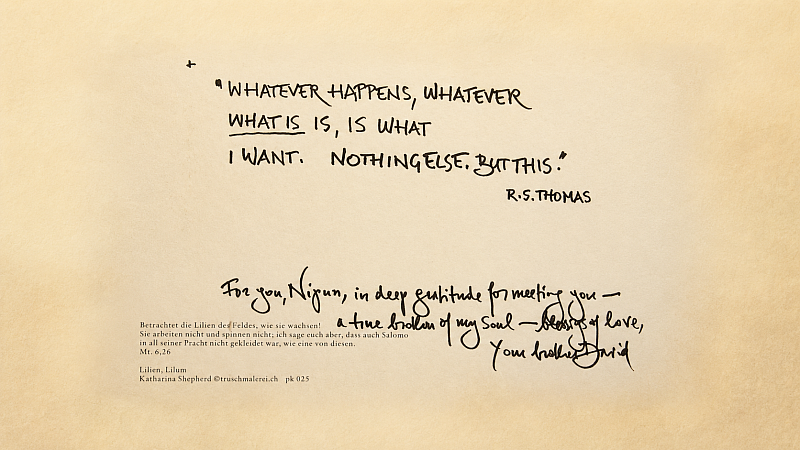
By not wanting anything, he had learned to receive everything with a full heart. He didn't aim to impress you with content. He touched you effortlessly with his emptiness.
Reid Hoffman's digital twin now handles many of his public appearances — trained on decades of books, speeches, and podcasts. It is a remarkable achievement: a broadcast self made portable. But what of those who deepcast?
And this was not only a monk's practice. Last week, I met a leader from Africa who said that his hero in life was an unknown Gandhian named Dwarko Sundrani. Dwarko-ji served children in India so hungry they ate stray rats to survive, yet his mentor Vinoba Bhave told him: don't fill out fundraising forms. If people give of gratitude, receive it. If nothing arrives, get creative with different forms of capital. He didn't write books. He hardly left recordings. No history book knows him. Yet, the Dalai Lama refused to sit on a higher seat than him, saying more than once: "I preach compassion. Dwarko-ji, you live compassion." No fundraising was not withdrawal from impact. It was the condition that allowed a different kind of impact to grow. A tree does not prepare a quarterly report on its oxygen.
That emptiness — Brother David's, Dwarko's, the Gita's clearing — is not a void. It is the space in which the immeasurables live. Fukuoka's farm looked like a forest because he let the forest be a forest. Brother David's life felt like grace because he let grace be grace. Both understood what the Gita teaches: the tighter you grip the fruit, the more you strangle the branch.
· · ·
Here, then, is the architectural claim — the thing we have intuited for a while and only now have the language for.
What Fukuoka demonstrated in soil, and the Gita articulates in spirit, we have been experimenting with in human systems for twenty-six years. I like to think of it as social permaculture: the art of tending the conditions through which human goodness self-catalyzes.
Fukuoka's five principles find their social equivalents in three constraints ServiceSpace imposed on itself from the start: stay volunteer-run, work with whatever you receive, and think small. No fundraising applications. No hired staff. No impact metrics. Most advisors said: you're limiting yourselves. By the metrics that made them wise, they were right.
But constraints, held long enough, reveal adjacencies invisible from the faster path. Without fundraising, we never had to demonstrate value — we could focus entirely on adding it. Without impact metrics, we could tend to what the Buddha called the immeasurables without collapsing them into a number. Without paid staff, every volunteer was there because something in them was stirred. The community wasn't overhead. It was the product. A pod, a circle, a story booth, a kitchen table, a retreat — these are not programs in the usual sense. They are trellises. They help what is already alive find something to climb.
And here is what happens to the commons when the operating system shifts to the quantifiable. What is common gets enclosed. The ordinary becomes commoditized. Care becomes a service category. Every shared resource begins looking for a price tag.
But when the operating system is social permaculture, the commons regenerates. Karma Kitchen serves twenty-six thousand meals purely with volunteers who have zero experience running a restaurant, with a team that doesn't know each other, and a 30-minute orientation process. Yet, it became the top-rated restaurant on Berkeley's Yelp reviews for more than a year. Not because of rules but because gratitude overflows when the container is held with care. Last week, an author asked about our impact but we have nothing to show her. What we have instead is high-trust relationships. And trust cannot be produced by measurement. It can only be grown in the clearing left by renouncing the fruit.
Twenty-six years: two inspiring emails sent every second; circles in living rooms across continents; Smile Cards and heart pins shipped as a labor of love; multi-day retreats without price tags; virtual Pods with participants from nearly every country; millions of volunteer hours offered without a trace. None of it planned. All of it the adjacent possible — what becomes available when you stay with the constraint long enough for the weed to flower.
Every human being wraps their actions in intention. Is that intention directed toward an outcome — a metric, a return, a proof? Or is it rooted in something subtler, something that regenerates on its own? The young Japanese man at Gandhi 3.0, who flew from his monastery in the Himalayas to hand people microphones, praying silently for each speaker before delivering the mic — he is answering the same question every philanthropist answers with every check, and every stranger answers at every held door. Is the action aimed at a fruit? Or does it release the fruit and trust the branch?
Bateson's deliverable, the practicality she offers in place of a five-step program: "The goal is not to crack the code, but to catch the rhythm. It will also make us into artists. I maintain that nothing could be more practical."
· · ·
And here is where artificial intelligence enters the field. Not as the farmer. As the one who carries water — so the farmer can keep both hands in the soil.
In the Bhagavad Gita, Krishna does not fight. He holds the reins so Arjuna can be fully present to his action. This, I think, is the role AI can play in a social permaculture ecosystem. It carries the cognitive load so that humans can return to the field of the immeasurables.
Recently, we started hosting "Story Booths" with everyday heroes. Vasco Gaspar, from Portugal, movingly spoke of his journey following a hummingbird. Before each booth, an AI agent does the arranging — schedules, roles, preparation — so that when the call begins, the only technology that matters is attention. Volunteers circle up. A moderator holds space. The guest speaks. Minutes after the call ends, the agent gathers what was said and offers it back as a written story, inviting volunteers to add their heart, art, and everything in between. After one recent session, Susan Clark wrote: "There was something about the field of group listening that added dimensions to familiar stories… I spent time editing the draft as a gift to my soul."
Or consider what we call the DailyGood Lens. A commencement talk I gave years ago — about being simultaneously miserable and magical — has lived on a website for over a decade. Now, through a simple AI layer, that same talk can become a bedtime story for a child, a rap song, a Gen-Z article, a conversation starter for the dinner table. The substance doesn't change. The vessel does. This is not AI generating meaning. It is AI carrying meaning across membranes it could never have crossed alone — the way wind carries seeds to soil it has never visited. The same pattern is now shaping KarmaTube watch parties: technology convenes the circle, then steps aside so a film can become a mirror.
This is not measurement as mastery. It is invisible infrastructure in service of tending — the way the clay pellet protects the seed until the rain. AI can convene the container. It cannot produce the rain.
Much of today's AI-for-flourishing discourse begins with a sincere hope: that technology might help us become more whole. But too often, it reaches instinctively for dashboards, categories, and evaluation frameworks. It asks, with admirable urgency: What should we grow here?
The social permaculture question is different: Can AI serve the conditions from which flourishing arises — and then get out of the way? Can it automate the measurable so we can attend to the immeasurable?
Not AI for flourishing. AI for the field in which flourishing teaches itself. That may sound like a small distinction but I don't sense it is.
· · ·
Nora Bateson: "I am an ecology within ecologies. Who are you? And what thoughts are we fertilizing together? The mind and the brain are not the same thing. One is in the head, and the other is spread everywhere."
The immeasurables are not a category of things that resist our instruments. They are the medium in which all things live — the way water is not one of the fish but what the fish swim in. A poem measured ceases to be a poem. A gift tracked ceases to be a gift. A life optimized ceases to be a life.
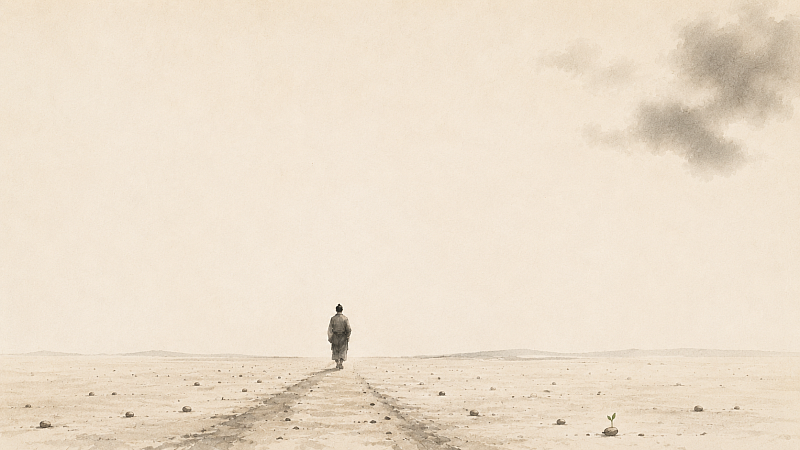
In 1964, Peace Pilgrim completed walking twenty-five thousand miles for peace. And she stopped. She did not stop walking. She stopped counting.
The scaffolding fell away. The cathedral remained.
My mother was chanting the Gita as I entered the world: perform the action, renounce the fruit. After some decades of experiments, I can report from the other side of that renunciation: what grows in the clearing is wilder, more abundant, and more nourishing than anything a plan could have produced.
The rain comes from the ground.
Scatter the seeds. Tend the conditions. Stop counting.
Keep walking.

Share a Reflection
Your thoughts will be shared with the author