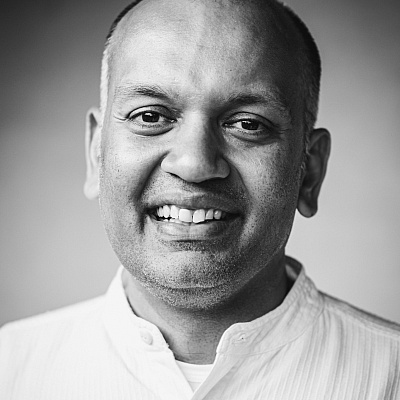
Today, 75 years ago, Gandhi was assassinated by a Hindu nationalist. Seeing some photos in today's NYT brought up our recent time together. Particularly Ishtar's feeling that few people in this particular retreat might've previously volunteered with Gandhi. :)
After I left India, I flew into Philadelphia to speak at a Martin Luther King Jr. Symposium at Penn. Inspired by our collective dialogues at the Gandhi 3.0 retreat, and with Michael Penn present in person!, I used my talk to add meaning to our t-shirts: #heartivism: Gently Shaking the World
Today’s activism is often built around an either-or logic -- my way or your way, where one way necessarily loses; in our attempts to build a bridge here, we often burn a bridge there.
Heartivism invites us to act from that deeper channel within us, where we are first united by our universality before we are differentiated by our particularlities. A heartivist is someone who responds to the suffering of the world without needing an enemy, who unlocks the genius of nonviolence to uncover a "third way" between two "right" positions, who pushes the limits of compassion to design more infinite games that transcend the winner-loser dichotomy.
Drawing on wisdom of Gandhi, Rev. Howard Thurman and Martin Luther King Jr, this talk frames the four successive pillars of Heartivism: inner transformation (Swaraj), opposing while loving (Satyagraha), creative Soul Force (Ahimsa), and designs that uplift all (Sarvodaya). Read Full Transcript.
Given that it is Gandhi's death anniversary today, I'm also sharing a few compelling excerpts from a book by Vincent Sheean, Lead Kindly Light.
Vincent arrived as a reporter, but he was drawn to India and Gandhi by a sudden and deep divination. Alongside his rich personal interviews with Gandhi, he also witnessed the assassination on Jan 30th. Similar to Sister Marilyn's beautiful story of the Tibetan attendant requesting to shake her hands that were once touched by the Dalai Lama, Vincent Sheean offers a rare glimpse into the subtleties of the collective murmuration at the time of Gandhi's passing.
"Here, as usual, there was a clump of people, some of whom were standing and some of whom had gone on their knees or bent low before him. Bob and I turned to watch -- we were perhaps ten feet away from the steps -- but the clump of people cut off our view of the Mahatma now. He was so small. Then I heard four small, dull, dark explosion. 'What's that?' I said to Bob in sudden horror. 'I don't know,' he said. I remember that he grew pale in an instant.
"Inside my own head there occurred a wavelike disturbance which I can only compare to a storm at sea -- wind and wave surging tremendously back and forth. I remember all this distinctly; I do not believe I lost consciousness even for a moment, although there may have been an instant or two of half consciousness. I recoiled upon the brick wall and leaned against it, bent almost in two. I felt the consciousness of the Mahatma leave me then -- I know of no way other way of expressing this: he left. The storm inside my head continued for little time -- minutes, perhaps; I have no way of reckoning. Then I was aware of two things at once: a burning and stinging in my fingers of my right hand and a similar burning and stinging in my eyes. In the eyes it was tears, although of some more acid mixture than I had known, and on my fingers I did not know for a while what it was, because I put them in my mouth (like a child) to ease the burning. In the wildness and confusion of that moment a young Indian -- unknown to me -- came to where I was doubled up against the wall and said: 'Is he dead? Is he dead?' The young Indian had staring eyes and was as filled with horror as I was, I suppose, although I do not know why he asked me such a question. 'I don't know,' I said, taking my fingers out of my mouth to do so.
Then I looked at my fingers. On the third and fourth fingers of my right hand blisters had appeared. They were facing each other, on the sides of those fingers which touch. The blister on the third finger was rather large and was already filled with water. The blister on the fourth or little finger was smaller. They had not been there before I heard the shots. The storm returned inside my head, but briefly, very briefly. I sat on the edge of the wall and looked at my fingers and then put them back into my mouth- they burned far worse than is usual with blisters. What was this?"
"The Mahatma was cremated on the following day (Saturday, January 31st, 1948) on the immense plain beside the river Jumna outside Delhi in the present of a vast multitude. There followed the thirteen days of mourning prescribed for orthodox Hindus of his particular cast. On the the thirteenth day, which was February 12, 1948, his ashes were distributed to the seven sacred ribers of India."
"The special train which was to carry the Mahatma's ashes to the confluence of the rivers was made up of third-class carriages, all swept and garnished but otherwise no different from ordinary carriages used by the Indian poor. The difference was that on this train each place was reserved and the unimaginable overcrowding which is the chief characteristic of Indian third-class carriages was avoided."
"Wherever the train stopped, and in a great many places where it did not stop, crowds of people had assembled for darshan. In many towns the behavior was impressively solemn. In empty fields, or small villages and at crossroads it was even more impressive to see the peasants standing with their hands joined in the attitude of prayer as the train passed. The terrific demonstration was at Cawnpore, which we reached at about five o'clock on Wednesday evening. An immense multitude, said to have been at least half a million, had gathered there, in and around the railroad station and along the tracks into and out of the town. We stayed in Cawnpore Station two hours for darshan and then had to leave before more than a proportion of the people had obtained it. As we pulled out, the excitement of the people could no longer be contained and their instinct moved them to cries of "Mahatma Gandhi ki-jai!" (Victory, or Triumph, to Mahatma Gandhi!), which was what they used to cry out to him in life. I thought this was thrilling, especially as it rose to a great height as we slowly pulled out of the city."
"Bonfires and torches burned along our way during the night until we reached Rasulabad, where we stopped for the night. In the morning at seven, we resumed the journey and reached Allahabad at 9AM. Nehru, Mrs. Naidu, Pandit Pant and other dignitaries were there on the platform to receive the ashes. We then started the long march to Snagam, the confluence of the rivers. That march was a long, dusty (in the end) sweltering pilgrimage. An assemblage of people which may indeed have formed the greatest single crowd ever known had converged upon Allahbad. The whole crowd, from Allahbad station to the confluence of the sacred rivers, about seven miles away, was said to have numered four million, the greater part of which had assembled in a dense mass on the great plain at the Prayag."


"Temporary miracle" as Dr. Home might remind us, with a smile embracing impermanence.

Share a Reflection
Your thoughts will be shared with the author