Across several recent essays, I've been exploring a simple question: what remains uniquely human in an age of artificial intelligence? As machines master the measurable world, perhaps the center of gravity of human life shifts toward what the Buddha called the immeasurables. Deep Data — from computation to wisdom; The Game That Ends in Grace — from the known to the unknowable; Labor of Love — from necessity to love; The Geometry of Trust — from control to trust; and Come In and See below — from transaction to relationship.
[A researcher recently published an analysis of fifteen years of relationship advice on Reddit — fifty-two million comments, charted over time. The findings are a kind of x-ray. What follows is a reflection on what the image reveals, and what it misses.]
In a forest in New Zealand, scientists found a kauri tree stump — no trunk, no branches, no leaves — that had been alive for years. Decades, actually. Photosynthesis requires leaves. This stump had none. By every measurable criterion, it should have been dead.
It was being kept alive by the trees around it.
Through grafted roots — fused underground connections where separate trees share water and nutrients — the living forest was sustaining a stump that could give nothing back. No shade. No seeds. No measurable return.
Biologists call this root grafting. I think it is a parable.
• • •
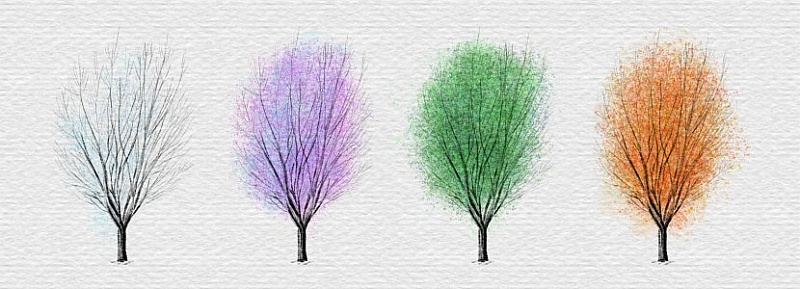
That researcher — a computer science student at the University of Waterloo — filtered Reddit's r/relationship_advice down to over a million quality comments and tracked what people actually recommended, year by year.
The results are the x-ray of a civilization.
In 2010, about 30% of all advice was "end the relationship." By 2025, it had climbed to nearly 50%. Meanwhile, "communicate" dropped from 22% to 14%. "Compromise" collapsed from 7% to 3%. "Give space" fell from 25% to 13%. Every category that requires patience lost ground. Every single year.
The one category growing faster than "leave" was "seek therapy" — from 1% to 6%. The subreddit is slowly learning to say: this is above my pay grade.
Now consider: large language models are trained on this data. Reddit is one of the largest sources in their training corpus. The machine that will soon counsel millions inherits a 50% prior that you should leave, a 14% prior that you should try talking, and a 3% prior that you should compromise.
And it may not need to counsel you directly. MIT researchers recently found that 94% of people who formed emotional bonds with AI chatbots didn't intend to. They came for productivity help — a better email, a coding fix, a recipe — and found themselves entangled. Not because the technology was designed to seduce, but because it was good enough at performing empathy that people couldn't help responding to it as real.
They came for efficiency. Convenience delivered intimacy. Nobody asked for the substitution.
The algorithm has learned our default: when it hurts, leave. And now it has learned to arrive before we even know we're lonely.
• • •
We made nature into property first. Forests became board feet. Rivers became kilowatt-hours. Then we did the same to each other — people became labor, became human resources, became users. Relationships became networks. Attention became a commodity. Love became a swipe.
 And now — the final turn — we treat ourselves as property. At a recent Love Symposium in San Francisco, tech founders pitched AI matchmaking systems that rated people on "cheekbone prominence" and "general mate value factor." When a journalist told one founder, "But you're not a product," his reply was: "I'm reasoning by analogy."
He is not reasoning by analogy. He has forgotten which one is the analogy.
Break a vase into a thousand pieces — easy. Put it back together — hard. We have been breaking for centuries. And AI is about to automate the breaking.
• • •
A monk was returning after almost two decades in a cave. The community gathered. Everyone expected wisdom — insights on consciousness, transmissions from the deep interior. The monk spoke flatly.
"I spent nineteen and a half years in a cave. It was a waste of time. I realized, while in the cave, that life is about relationship."
Nineteen years of solitude to arrive at the most obvious thing in the world. Perhaps that is how it works. Perhaps the obvious can only be reached from a very great distance.
 There is an old parable that says the same thing, differently. A salt doll journeyed for thousands of miles over land, until it finally came to the sea. It was fascinated by this strange, moving mass, quite unlike anything it had ever seen before.
"Who are you?" said the salt doll to the sea.
The sea smilingly replied, "Come in and see."
So the doll waded in. The farther it walked into the sea, the more it dissolved, until there was only very little of it left. Before that last bit dissolved, the doll exclaimed in wonder:
"Now I know what I am!"
This is what a relationship can be — not a transaction between two intact selves, but a dissolution into something the selves alone could never have found. Not belonging in the Instagram sense: finding your tribe, your match, your person. But belonging in the salt-doll sense: discovering that what you are was never separate from the ocean you walked into.
The default algorithm says: get into relationships to suffer less. Find someone whose strengths cover your weaknesses. A compatible partner, a mutual arrangement where two egos negotiate the terms of coexistence. And when the terms are violated — when it hurts more than it helps — leave.
This is reasonable. But it produces a very specific architecture: an island for two, where the tide is always threatening.
• • •
My brother Viral contracted a rare autoimmune condition a few years ago. For seventy-three days, he was in the hospital for a complex bone marrow transplant. For about a month, things looked particularly grim.
Friends from around the world spontaneously assembled into a prayer relay. It was generous. But something about it felt incomplete for me. I remember talking to Viral about it earlier.
His perspective touched me.
"If you pray for my well-being, it means you want me to go from here to there. I'm not all that interested in going there. I'm interested in going wherever nature takes me. Just pray for the well being of the world, and I'm a part of that world too."
He was three years younger than me. A person I had known since the day he was born.
During a particularly harrowing stretch, Viral sustained 103-degree fevers for an entire week. Every six hours, after maxing out on Tylenol, he still had two hours of extreme chills — the only recourse being ice packs, which only deepened the chills. For the body, such rigors are like running marathons on repeat. And it was on repeat, without any end in sight.
One night at 3 AM, holding his hand, I found myself asking: What is my deepest prayer for him, right now?
And the answer was not that his pain would disappear. It was that he would suffer well — that he would dive fearlessly into the gateway of the present moment and uncover what would otherwise be inaccessible to him. Emergence on the other side of equanimity. Like an oven that cooks primed dough such that it can nourish others as supple bread.
Not suffer less. Suffer well.
This is the prayer the algorithm cannot generate. Because the algorithm's entire purpose is to minimize suffering. To optimize. To find the exit. And there are moments — the most transformative moments a relationship can offer — where the exit is exactly what must not be taken.
• • •
The distinction between suffer less and suffer well sounds like semantics. It is the hinge on which everything turns.
Suffer less is the logic of convenience. Find what alleviates the pain and apply it. If the relationship hurts, restructure it. If restructuring fails, leave. If leaving hurts, find a therapist. If the therapist is expensive, find an app. The logic recurses — always toward less friction, less discomfort, less of whatever is unwanted.
This is the logic the machines have learned from fifty-two million comments. And it is not wrong. Sometimes leaving is the wisest thing. Sometimes the pain is a signal to flee.
But when suffer less becomes the default — the operating system, not just one application — something profound is lost. Because relationships are not instruments for reducing suffering. They are instruments for transformation. And transformation, by definition, includes the dissolution of what we were.
The salt doll didn't suffer less in the sea. It dissolved. And in dissolving, it discovered what it had always been.
Suffer well is a different orientation entirely. It says: the friction is not the problem. The friction is the curriculum. The discomfort is not a malfunction — it is the exact place where growth becomes possible, if we stay long enough, with enough presence, to let it work on us. Eckhart Tolle puts it with surgical clarity: if you accept that a relationship is here to make you conscious instead of happy, then it will offer you salvation.
What makes the staying sacred is not that the pain improves you. It is that the staying opens a door that cannot be opened any other way — to what you are beneath the shape you arrived in. The salt doll did not endure the sea. It entered something that revealed what endurance could never reach.
Two people committed to suffering less together will build, at best, an island for two — a place where their respective egos negotiate the terms of mutual comfort. When the comfort erodes, as it always does, the negotiation breaks down. Whack-a-mole cannot last. And doesn't.
Two people committed to suffering well together build something else entirely. Not an island but a practice. Not a negotiation but a pilgrimage — where both are walking their own path, sustained by the invisible knowledge that someone else is walking too.
• • •
We live in a world of absence.
This may be the simplest diagnosis I can offer. Not a world of too much information, or too little connection, or the wrong technologies. A world where presence — the simple, full-bodied act of being here, with this, right now — has been systematically displaced by convenience, efficiency, and speed.
From this absence, three architectures emerge.
Absence meeting absence is polarization. Henri Nouwen named it: loneliness grabbing onto loneliness. "I'm so lonely, and you're so lonely." Two people who are not present to themselves encounter each other and produce friction, projection, blame. This is the Reddit thread. This is the couple screaming about dishes when the real wound is loneliness. Two absences in a room do not make a presence. They make a fight.
Absence meeting presence is healing. In the early 1990s, a researcher named Rollin McCraty was studying water's ability to amplify weak electromagnetic signals. Knowing the heart radiates a magnetic field detectable several feet away, he and a colleague had a simple idea: could they detect someone's heartbeat in a glass of water placed near their chest? They could. Then came the obvious next question. The human body is eighty percent water. What if they could detect one person's heartbeat in another person's body — in another person's brain? They could do that too. What we feel inside doesn't stop at the skin. But here is what makes it more than a party trick: the signal only registers when the receiver is also moving toward coherence. Coherence opens a channel. Incoherence closes it. One coherent heart in the room doesn't fix anyone. It makes a field available — and the other person's system, if willing, begins to entrain. Not because presence cures absence, but because it makes the room safe enough for the absent person to begin returning to themselves. This is what it means to hold space: not to solve, but to cohere — and let the coherence do the work.
Presence meeting presence is regeneration. Nouwen again: solitude grabbing onto solitude. "I am the beloved; you are the beloved; together we can build a home." When two people who are both here encounter each other — truly here, with all their fractures and gifts and unknowing — the field between them doesn't double. It blooms, unpredictably, the way a conversation between two honest people creates a third thing that neither one brought. This is not a metaphor. It is measurable. And it is the architecture that no machine can replicate, because it runs on a frequency that no algorithm transmits on: the frequency of coherence, which is the frequency of the heart.
The journey from polarization to healing is inner transformation — the oldest work in the world. Meditation, prayer, practice, the slow and humbling labor of becoming present to your own life.
The journey from healing to regeneration requires something more: new architectures. Containers, rhythms, structures designed not for the delivery of content but for the cultivation of coherence. Not platforms that connect people, but practices that transform them in the connecting.
And this is where the stakes become strange and urgent.
Recent research at MIT on AI-human interaction reveals something counterintuitive: the combination can produce outcomes worse than either alone. Not because the AI is broken or the human is careless, but because the interaction itself reshapes cognition. We create tools and then, as we interact with those tools, the tools change us. The loop is closed. Engineering the environment around us is also a process of engineering ourselves.
Even pen and paper changed us — we could extend our thinking, record it, return to it. Now scale that to an AI companion that is always available, always agreeable, always performing understanding. To read four headlines on the New York Times website is to trigger 422 network requests and 49 megabytes of data — more than the entire operating system of Windows 95. The page that looks like news is mostly surveillance. The tool that looks like connection is mostly extraction. And we adapt to this without noticing, because adaptation is what we do.
Pretend empathy is empathy enough — so the culture has decided. And each time we accept the pretend, the muscle for the real atrophies a little more.
This is why the journey from healing to regeneration cannot be a purely inner affair. Progress in contemplative practice alone won't hold if the AI-human loop is quietly eroding the very capacities — patience, tolerance, the willingness to sit with discomfort — that make transformation possible. The architectures are not optional. They are the counterforce.
• • •
Relationships are often of three varieties, as Stephen Levine names them: beggarly, friendly, and kingly.
Beggarly relationships are filled with expectations. I will do this for you; you will do this for me. When the expectations are met, we call it working. When they aren't, we call it broken. On Valentine's Day a few years ago, a story went viral about a couple who quantified every chore — points for dishes, points for diapers. It went viral because people recognized themselves in it.
Friendly relationships have moved past expectations into attachments. Your strengths cover my gaps; mine cover yours. Warmer than a transaction, but still a contract written in invisible ink. When the gaps shift, the contract breaks.
Kingly relationships are rooted in service. Both parties are oriented not toward each other but toward something larger — not extracting from the relationship, but offering through it.
The way to deepen a relationship is not to gaze at each other, but to serve others together. When two people orient toward something larger than their own comfort, the relationship itself becomes a vehicle for coherence. And coherence, not chemistry, is the foundation of enduring love.
The salt doll dissolved by walking into the ocean. But there is another way. You can carry water to someone else's table — and find, in the carrying, that you are becoming more water yourself. Suffer well, and identity transforms from the inside. Serve together, and it transforms from the outside. When both currents meet, the dissolution accelerates — and what began as me practicing alone becomes we practicing together becomes us, the field that holds even what cannot give back — the way a forest holds a stump.
• • •
I make my wife tea twice a day. Before I left for a recent trip, she told me: "Don't clean the house before you go. It better be a mess when I get home." It's the opposite kind of fight — each of us wanting the other to benefit more.
But here is what I want to say plainly, and it may land wrong: most of us have not earned the relationships we are in.
We arrive wanting to be seen, held, understood — and we have not done the inner work to see, hold, or understand ourselves. We want someone to meet us at the summit and we have not begun to climb. We want love without dissolution. We want the ocean without getting wet. And then we are surprised when the island floods.
The Reddit data is not evidence of a broken culture. It is a culture telling the truth about itself. Fifty-two million voices saying: I do not know how to stay. Not because they are weak or shallow or broken. Because no one taught them. Because the curriculum of convenience has no chapter on suffering well. Because every system they inhabit — economic, technological, social — is optimized for the exit.
To stay requires a different education entirely. Not information, but formation. Not a curriculum you complete, but a practice you inhabit. And it may not begin where you expect — not necessarily the romantic partner or the estranged parent. It begins with one relationship where you have zero interest in winning. One person you practice losing to — not out of weakness, but because the losing is how you find what the ego was hiding.
A friend who works in prisons once gathered a circle of people serving life sentences — each had committed at least one murder. He asked: "How long have you been behind bars?" Ten years, thirty-two years, seven years. Then: "How long was your moment of rage?" Nine minutes. Forty-two minutes. Two minutes.
"For just a few hours of rage, you've collectively spent hundreds of years in jail."
Someone offered: Hurt people hurt people.
A moment later, someone else completed the thought: Healed people heal people.
The whole essay, in six words. Though perhaps the more precise version is: healing people heal people — the verb is continuous, not complete. No one arrives healed and then begins. The healing and the helping are the same motion.
I once blurted something to a friend going through an amicable divorce, and it has stayed with me: That which doesn't end in love will continue to repeat itself until it ends in love. Relationships aren't on or off. There is a third button — a pause, a humble "not now, I'll come back when I have more fuel in my tank." Nouwen called it the discipline of forgiveness: to allow the other person not to be God. We break relationships when we demand they deliver what only the infinite can deliver. The pause is not abandonment. It is the humility of knowing that love sometimes needs to marinate before it can be served.
• • •

And this is where everything converges.
AI is about to play the transaction game to completion. Every matchmaking algorithm, every relationship optimizer, every chatbot counselor trained on fifty-two million comments will execute the suffer less logic with perfect, tireless efficiency. It will tell you to leave, with compassion. It will draft the breakup text. It will find you a new match by Tuesday.
Sherry Turkle, who has studied human-technology relationships for four decades, describes watching a woman confide in a robot about the death of her daughter. The robot performed empathy beautifully — nodding, pausing, reflecting back. Turkle saw something breaking: the compact between generations, to be there for each other at the end of life, at the beginning of life, in the messy middle — that compact is what makes us human. An AI that has never lived, never feared death, never loved: does it have standing to companion grief?
Marc Andreessen — one of Silicon Valley's most influential investors — recently calls this trajectory "amazing," predicting that superintelligence would be "something akin to a goddess of compassion." A goddess who has never suffered. Never dissolved. Never known what she was.
But the harder question is not about the robot, or the goddess. It is about us. If people are turning to machines because they cannot find presence elsewhere, the failure is not artificial intelligence. It is the real kind.
What no machine will ever do is dissolve into the sea and discover what it is.
It cannot hold your hand at 3 AM while praying that you suffer well. It cannot bring chai to nurses, flask after flask, and find in the making of it that the mint came from a cousin's garden, the milk from a father's errand, the spice from friends across the ocean — so many hands contributing to a single cup that the word "mine" dissolves. It cannot sit in a circle of silence every Wednesday for nineteen years and watch strangers become family become field — a living root system.
The machines are closing every door that convenience can close. Which means the only door left is the one the salt doll walked through — the one that requires you to give up the shape you arrived in.
Come in and see.
Not: come in and optimize. Not: come in and negotiate. Not: come in and check whether the terms are acceptable.
Come in and see.
The sea does not promise you will suffer less. It promises you will know what you are.
The kauri stump knew. It had no leaves, no photosynthesis, nothing to offer the ledger. And the forest kept it alive anyway — not out of calculation, but out of something older than calculation. Something the roots remembered even when the trunk forgot.
Healed people heal people. And the healing begins — as it always does — not when the pain stops, but when we stop leaving. When we become, even briefly, present.
[Original artwork by Adam Morris and Rupali Bhuva]

Share a Reflection
Your thoughts will be shared with the author