
Effortless Effort: Between Grit and Grace
"Flower grows by the rain that flows on it. Not the thunder." --Rumi
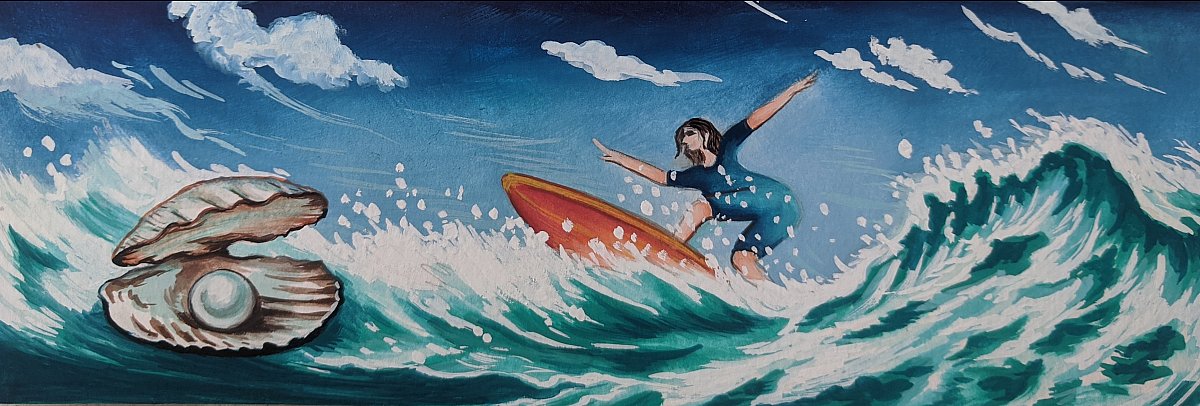
A seed doesn't struggle to become a tree. It simply unfurls, responding to the pull of sunlight, the embrace of soil, the rhythm of rain. A river does not force its way to the sea; it moves with gravity, with patience, with the wisdom of a thousand tributaries joining its flow. Nature teaches us that effort and surrender are not opposites but companions, woven together in the quiet intelligence of all growing things.
The farmer does not make the plants grow—she tends the soil. She does her part, her 5%, then steps back, trusting the sun, the earth, and the unseen web of mycelium beneath her feet to do the rest. The success of her labor is not in the force of her effort but in her alignment with the rhythm of life.
Fukuoka called this “do-nothing” farming—not a withdrawal, but the wisdom to know what is unnecessary. The grace to let go of control. Bill O'brien reminds us, “The success of an intervention depends on the interior condition of the intervenor.” If we move from a place of grasping, we press too hard, disrupting the natural flow. If we act from a place of deep listening, our effort becomes a gentle nudge, a whisper rather than a shout.
In a world that glorifies doing, laddership invites us to reconsider: What if the most powerful action is not in exertion but in attunement?
When an intervention doesn’t work, our instinct is to push harder, to add more, to wield bigger tools. But what if the answer is to soften? To listen more deeply? To shift from force to invitation?
The wind does not need to be commanded to move the leaves, nor does the tide need to be urged to return to shore. Perhaps our work, too, is not to impose but to partner—to align ourselves with the forces already at play.
Gandhi once said, “In a gentle way, you can shake the world.” But gentleness is not passivity. It is knowing when to hold on and when to let go, when to labor and when to trust.
So we are left with the question: How do we learn this balance? Do we grit our teeth and try harder? Do we surrender completely? Or is there another way—the way of the seed, the way of the river, the way of the farmer who does just enough and let nature carry the rest?
Today’s invitation is to step into this paradox with curiosity: What does it mean for our effort to be "nature funded," backed by the larger arcs of causation? How might we move with the rhythm of grace?
When wolves were reintroduced to Yellowstone National Park in the United States after being absent for nearly 70 years, the most remarkable "trophic cascade" occurred -- Wolves Changed the Rivers.
Start with a short reading (6 mins) on the legendary permaculture farmer, Masanobu Fukuoka: "If we act without understanding what it means to do nothing, then what we create is chaos, not harmony." And then watch another farmer in Vietnam, Hang Mai, share about her 95/5 principle (3 mins).
Attune to the delicate balance of grace and grit in this rarely told story of How Smallpox was Eradicated. A young man in his twenties gets instructions from a Himalayan recluse: 'Go, remove smallpox from the planet.' After repeated 17-hour bus rides to the United Nations, growing in surrender, he leads a team of 150K healthcare workers to indeed change history!
On leading with gentleness, consider any of these explorations that speak to you ...
-
With Yourself: Curious lessons from a tennis coach: Inner Game of Tennis (3mins) “Why are you playing so badly today? We have two selves -- conscious (the ego) and subconscious. When we get angry at ourselves, our first self is upset at our second self.” And top it with an old Cherokee Story: Beyond the Conflict of Inner Forces (3 mins)
-
With Others: Gentleness is Always an Option (12 mins) “If you pick up an animal and hold it in a way it doesn’t like, you will soon know about it. It’s the same with people.”
-
With Systems: Gentle Change (17 mins) "In a complex world...please don’t mistake the speed or size of our step with the urgency, gravity, or magnitude of our goal. We go slow to do less harm, and to learn from mistakes; so in the long run we can go the distance." And Gentler, Gentlier, Gentliest (3 mins) -- an excerpt from the ServiceSpace experience of "do nothing" generosity.
Close it out with a short story, May I Help You? (2 mins) from a laddership alum, "Why do we always use stone as an example for a ripple? Why not the dry, light leaf? Why don't we say: 'When a leaf drops, there is a ripple.'"
[For more, see bonus bibliography.]
Practice "Wu Wei" -- the Taoist practice of non-doing, to align with the natural flow. "The child growing in the mother’s womb is not doing anything; he is in wu-wei. But it is not that nothing is happening. In fact, so much is happening that never again will so much ever happen in his life. "
Step 1: Do Less, Feel More
Choose an everyday task—washing dishes, walking, or typing an email—and notice where you can ease your effort. Let your movements become fluid, intuitive, and unforced. Rather than imposing control, feel the natural rhythm of the moment.
In that a state of balance, observe the clarity that emerges naturally. Instead of pushing for answers, notice space for insight that was created. The solutions we seek often arise when we step back and stop obstructing the flow.
Step 2: The Wisdom of Not Acting
 Another key aspect of Wu Wei is knowing when not to act. Sometimes, restraint is the most skillful response until the right action becomes clear.
In traditional Chinese painting, artists do not rush to place ink on paper. They sit in stillness, waiting until they can see the image before they make a single mark. Similarly, we can learn to wait, observe, and allow understanding to settle before we act.
Reflection: Where in your life might less effort lead to more flow? What happens when you replace force with patience, control with trust?