
Value: Between Money and Wealth
Not everything that can be counted counts, and not everything that counts can be counted. -- Einstein
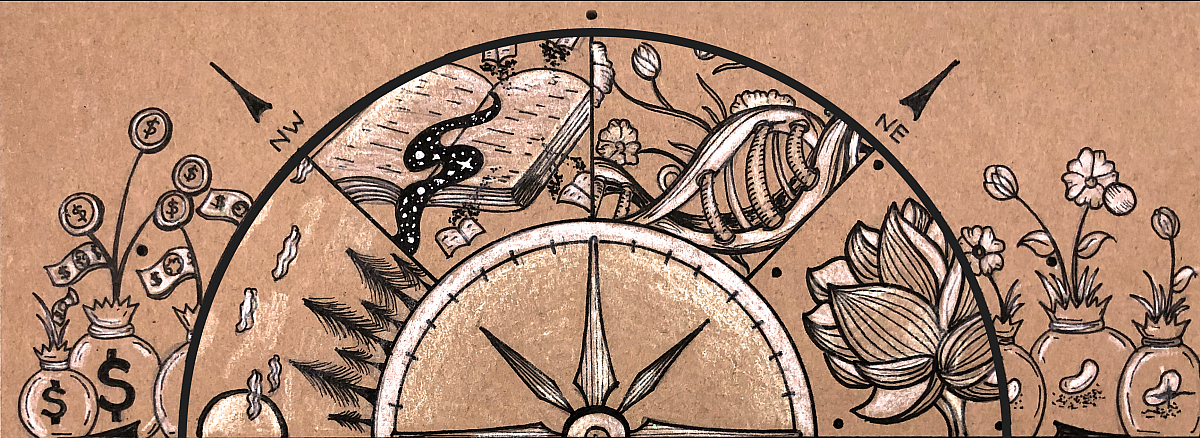
Much of today’s world is designed through the narrow lens of financial wealth—but is our world richer for it? When money is issued as debt, it demands perpetual growth; and when that growth reaches its limits, it leads to extraction—from nature (climate), from each other (division), and even from ourselves (burnout). Yet so much of what makes life meaningful—love, generosity, trust—cannot be measured, let alone bought or sold.
Money and wealth are often used interchangeably, but that oversimplification erases the complexity of both markets and human experience. Money is a tool, a means of exchange. Wealth, in its true sense, is much more—time, relationships, knowledge, attention, community, and the subtle gifts that sustain our well-being. When money becomes the dominant metric, it often crowds out the priceless, turning connection into transaction, generosity into calculation, and the commons into commodities.
But what if we dared to redefine wealth? How do we expand our portfolio of abundance beyond money? What happens when we place relationships, reciprocity, and shared well-being at the center rather than the margins? How do we regenerate forms of capital that grow when shared—like trust, kindness, and wisdom? Within a market-driven world, how do we still count on what cannot be counted? What designs can help us circulate the subtler qualities of human experience? If our definitions of profit, return, and success were reimagined via intrinsic motives, what new possibilities would emerge?
Today’s theme excavates the assumptions baked into our systems and invites us to broaden the landscape of value—to recognize not just what we can count, but what truly counts.
The great poet Shantideva said “For as long as space endures. And for as long as living beings remain, Until then may I too abide. To dispel the misery of the world.”
Today, we invite a heart practice to witness and remember the suffering of others, to allow it to break our hearts, so that it can break-open into compassion.
Start with a visual meditation, based on three years of James Mollison's global travels:
Dive into E. F Schumacher's small essay in 1966 that is now a global phenomenon: Buddhist Economics “The Buddhist point of view takes the function of work to be at least threefold: to give man a chance to utilize and develop his faculties; to enable him to overcome his ego-centredness by joining with other people in a common task; and to bring forth the goods and services needed for a becoming existence.”
Watch this expansive talk by Nipun on Multiple Forms of Wealth. "How do we expand our portfolio of non-financial forms of capital and regenerate it? design for the full spectrum of value, the possibilities are limitless." [Related: 6 examples of intentional currencies to circulate subtler forms of value.]
Close it out with a short story from Lynne Twist on how money is a lot like water: In a Church Basement in Harlem.
[For more, see bonus bibliography.]
Give in a form of wealth that you usually don't think to engage. For example, if you're usually rushing through the day, build attention wealth by practicing stillness for 10 minutes every hour. Or cultivate social wealth and call up a friend you haven't spoken to in a long time.
Then, make a list of 10 distinct non-financial expressions of wealth that you have in abundance. Observe how hard (or easy) it was for you to come up with this list, and what that implies in terms of your relationship to money.
[Bonus: Researchers have put a price tag on nature -- and bees. Consider things in your life that you would never put a price tag on!]