
The Noticing Is the Practice
"Well-being is a skill." — Richie Davidson
"We don't have to go anywhere. We just have to notice what's already here." — Cort Dahl
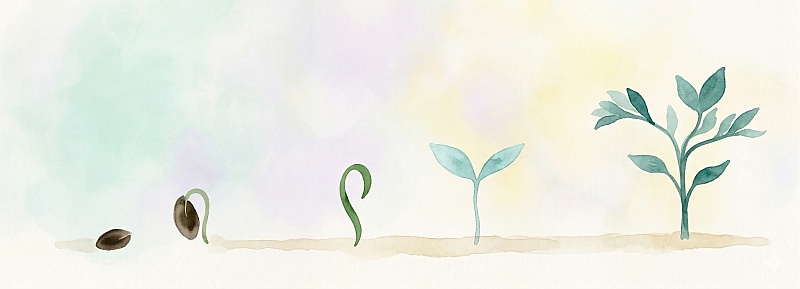
Think of something you couldn't do a year ago that you now do without thinking. Maybe it's a recipe you no longer need to look at. A conversation you can navigate in a second language. A route you drive while your mind is somewhere else entirely. You didn't decide one morning that your brain should rewire itself. It just did — quietly, through repetition, without asking your permission.
Now notice what just happened as you read that. You scanned your own life, found an example, and felt a small flicker of recognition. You didn't strain to do it. Some part of your mind simply knew — because the brain is not fixed. It is continuously reshaping itself through the patterns we repeat, strengthening certain pathways and weakening others, whether we are aware of it or not. Scientists call this neuroplasticity, and it works on everything — including your sense of well-being.
Here's where it gets surprising. You might assume that reshaping something as deep as well-being would take years of intensive effort. But Richie and Cort's research — across hundreds of college students, schoolteachers, healthcare workers — has consistently found that even brief daily practice produces significant, measurable improvements, often within just a few weeks. The brain, it turns out, is already listening. It just needs a nudge in the right direction.
But here is the shift that changes everything. There are two very different ways to approach this kind of inner work. The path most of us default to is the path of fixing: we focus on what's wrong, scan for flaws, and try to correct our shortcomings. The approach we take here starts from a different place entirely. Instead of asking "What's wrong with me?" we begin to ask "What's right with me?" And when we look carefully, there is far more right than we assumed. This is not self-improvement. It is self-discovery — and the noticing itself turns out to be the practice.
Start with this one — an intriguing visual illusion opens the door to what practice actually is. Not fixing yourself, but simply noticing what was always there.
Foundational extracts from the book covering rich ground — from the neuroplasticity of the brain to flourishing amidst adversity, and broadening our understanding of well-being beyond just positive emotions.
Drawn from a conversation with Mingyur Rinpoche — challenge in practice is not a detour but the path itself. A reframe that changes everything about how we sit with difficulty.
Researchers asked college students to sit quietly for just 6 to 15 minutes with no phone, no book, nothing. Many found it so uncomfortable they chose to give themselves mild electric shocks instead. What do we actually mean by non-doing — and what happens in the brain when we shift from “narrative self” to “experiential self”?
- Settle in with a few slow breaths.
- Notice how you feel right now. Not to fix anything — just to take an honest look. What's the general weather of your inner life in this moment?
- Now try a small experiment. Shift your attention, gently, to something that is going well — however small. It could be the fact that you are sitting here. The breath moving through you. A relationship that is intact. A kindness you offered or received recently.
- Stay with that for a moment. Notice what happens in your body when you rest your attention there. Not forcing gratitude — just directing the spotlight.
- Now notice: you just changed something. A moment ago, you were in one mental landscape. Now you are in a slightly different one. That shift — that's neuroplasticity in miniature. That's the practice.
- Sit for another minute or two, gently alternating: let your attention rest wherever it naturally goes, then consciously redirect it toward something that is already whole, already working.
Guided Meditation Practice: Inner Weather Check
[For more, explore the Healthy Minds App]
Today, run a small experiment. Choose a five-minute window — during a commute, a break, a walk — and deliberately shift your attention to what's already going well. Not what needs fixing, not what's on the to-do list. What's actually working: in your body, your surroundings, a relationship, anything.
But here's the thing to watch for: don't focus on what you notice. Focus on the noticing itself — the moment your attention moves. That shift, from autopilot to awareness, is what's actually rewiring the brain. You're not manufacturing positivity. You're discovering that you can choose where the flashlight points.
At the end of five minutes, notice: did anything shift? The research says even this much is enough to begin changing the brain. But don't take their word for it — test it and see.