Interfaith Compassion: Closing Celebration
Virtual
About This Event
For the last 21 days, people from dozens of countries have gathered to deep-dive into interfaith practices of compassion. Every day featured a unique faith tradition — with "hands" practices, "head" insights from scripture, and "heart" music and art. We've stretched into Sufi zikr and Buddhist metta, Sikh seva and Indigenous ceremony, Franciscan simplicity and Jewish tikkun olam. Thousands of reflections later, we discovered what we suspected all along: beneath our different names for the sacred runs a single river of compassion.
This Sunday, we gather one last time — not to close a chapter, but to ask: Now what?
We've downloaded 21 practices. But what does it mean to upload presence into our lives? When the challenge ends and Monday arrives, how do these seeds take root?
We'd love to have you join this closing call — broaden our circle, and help carry these ripples forward. Please RSVP below.
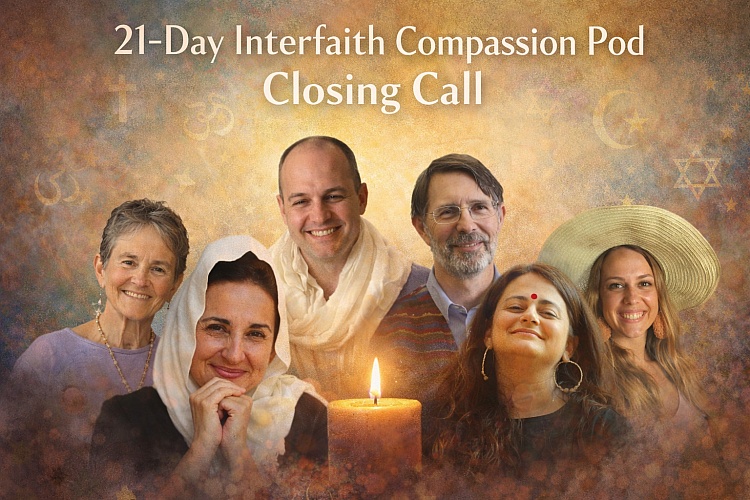
We're honored to be joined by some remarkable voices:
- Fawzia Al-Rawi — Born in Baghdad, initiated into Sufi wisdom by her grandmother, Fawzia has spent 25 years building bridges between cultures from her House of Peace in Vienna. Through whirling, zikr, and the Divine Names, she opens a space where traditions don't collide but dance.
- Cortland Dahl, PhD — From years of solitary retreat in Himalayan caves under revered Tibetan masters to earning the first-ever Ph.D. in Mind, Brain, and Contemplative Science, Cort bridges ancient wisdom and modern neuroscience. What happens in our minds when compassion practices from different traditions land in the same heart?
- Grace Dammann, MD — A physician who signed over 1,200 death certificates in San Francisco's AIDS ward, Grace's life was transformed when a devastating car accident on the Golden Gate Bridge left her with 17 broken bones and 48 days in a coma. Her brain injury became an unexpected doorway to profound presence. Now directing a meditation-based pain clinic from her wheelchair, she embodies her own teaching: "You can't control what happens, but you can control how you behave in response."
Weaving through our time together: poetry from Chelan Harkin, who once sat in Baha'u'llah's cell and heard the words "Let us dance" — alongside some sacred invocations by Bijan Khazai. Holding it all: Rev. Charles Gibbs, founding director of the United Religions Initiative and a lifelong pilgrim at the intersection of traditions.
This is a public call — so feel free to share with friends who might be curious about what happens when faith becomes bridge instead of a fortress.
To join us, click RSVP below and you'll receive call details by email. If timezone conflicts make it hard to attend live, RSVP anyway to receive the recording.
Thank you for practicing with us — and for the courage to let 21 traditions stretch your heart.
Bijan Khazai: A Persian Poem
Full Transcript
Charles Gibbs: I would like to welcome one of our wonderful guests, Bijan Kazai, who bridges… First of all, the world of, he's a disaster science, who, what's here says, Bijan, you've spent your entire life asking one question. What helps communities survive? What breaks them? Thank you for that service. And today, you're going to offer a little bit about your multicultural journey, and then bless us with a Persian, Farsi chant. Thank you, and welcome, we are in your good hands.
Bijan Khazai (Risklayer): Thank you, Charles, and thank you all for inviting me into this sacred space. I know what kind of work it is. I've been through the pod once, at least 21 days of deepening, so it's really special to come in at the tail end of that and share this space with you.
Bijan Khazai (Risklayer): I was born into what I often call an East-West family. So my mom, who is in this call, has completed this 21-day pod, I think, for the third time now. It's one of her favorites. She is from Germany, and my father, who passed four years ago now, was from Iran. From very early on, I had to learn how to navigate not just different languages, but also different cultural codes, expectations, and just ways of being in the world. That experience has taught me to be adaptive, but it also gave me an early glimpse that the world is much larger than the cultural frame that we happen to be born into.
Bijan Khazai (Risklayer): My mom comes from a Catholic background, my father came from an Islamic one, but interestingly, neither of them practiced their religion at home. Still, spirituality, as I was growing up, was a strong presence in our upbringing, even though it wasn't framed through any specific faith tradition. There was a sense always that there's something larger, meaningful, that mattered without having to put a name on it.
Bijan Khazai (Risklayer): It wasn't much later in my life that I found through Sufi poetry, being drawn into Sufi poetry, especially the poems of Rumi and Hafez initially, when I suddenly felt that I had entered a spiritual and emotional universe that felt like home. When I read Rumi's line, "Outside of the ideas or the circles of wrongdoing and right doing, there is a wide open field. I'll meet you there." It felt like a direct invitation to my heart. And then through Hafez, I entered into an expansive world where love itself is the religion. And in that world, there is no East and West.
Bijan Khazai (Risklayer): Johann Wolfgang von Goethe, a German poet and writer, felt such a deep kinship with Hafez, he called him his spiritual twin. In his West-Eastern Divan that was inspired by Hafez, Goethe wrote something that still feels very relevant more than 200 years later today. He said, if you know yourself and know the other one's heart, you will also know that East and West cannot be separated.
Bijan Khazai (Risklayer): For a long time, it was this expansiveness in the grace, the beauty, the intoxication of love that drew me back to Sufi poetry. But through my spiritual journey, there have been other phases, more contractive ones, periods where I didn't feel grace or any sense of divine presence. Those times felt dark and wry and empty. But once again, Sufi poetry held me. I come back to it, and recently, and I shared with Nipun that I'd like to recite this with you because I just heard this some weeks ago, a poem by a 14th-century Sufi poet called Shah Nimatullah Ali.
Bijan Khazai (Risklayer): There was an older man, he was not a musician, but he was singing these lines, and he was embodying it in such presence that it felt like the universe came in for a deep embrace in a moment where I felt I was in a tunnel. So I'd like to sing that for you, even though I'm not a singer, but Sufi poetry is often sung, and then I'll translate it and try to translate it. So the poem is in Farsi. It goes…
Bijan Khazai (Risklayer): It translates roughly to, if He showers us with grace, it is His will. And if He drives us into despair, that, too, is His will. We are thirsty, and we seek His mercy. Whether He lets it rain or not, it is His will. I love this poem because it places joy, despair, mercy withholding, presence, and absence of the divine all on the same footing. It might sound dark at first, or even fatalistic, but I don't think that's the point. The point isn't resignation, it's training the heart to stop clinging to bliss and rejecting sorrow. In this view, all states, joyful and painful, serve to polish the heart. And they all come from the one source.