Interfaith Compassion: Closing Celebration
Virtual
About This Event
For the last 21 days, people from dozens of countries have gathered to deep-dive into interfaith practices of compassion. Every day featured a unique faith tradition — with "hands" practices, "head" insights from scripture, and "heart" music and art. We've stretched into Sufi zikr and Buddhist metta, Sikh seva and Indigenous ceremony, Franciscan simplicity and Jewish tikkun olam. Thousands of reflections later, we discovered what we suspected all along: beneath our different names for the sacred runs a single river of compassion.
This Sunday, we gather one last time — not to close a chapter, but to ask: Now what?
We've downloaded 21 practices. But what does it mean to upload presence into our lives? When the challenge ends and Monday arrives, how do these seeds take root?
We'd love to have you join this closing call — broaden our circle, and help carry these ripples forward. Please RSVP below.
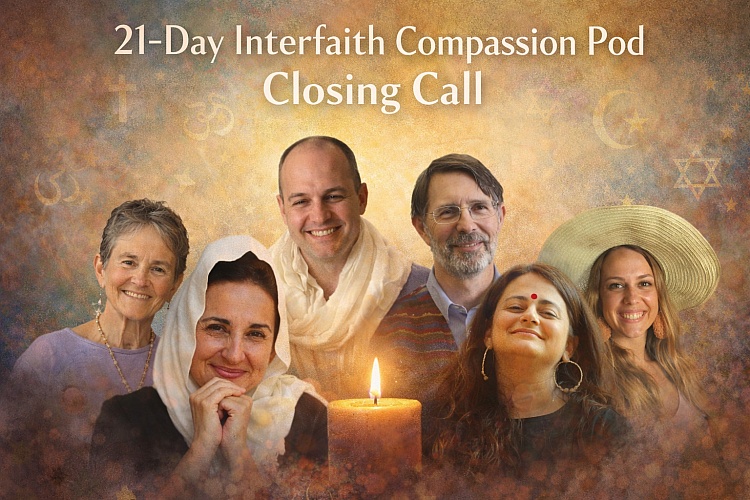
We're honored to be joined by some remarkable voices:
- Fawzia Al-Rawi — Born in Baghdad, initiated into Sufi wisdom by her grandmother, Fawzia has spent 25 years building bridges between cultures from her House of Peace in Vienna. Through whirling, zikr, and the Divine Names, she opens a space where traditions don't collide but dance.
- Cortland Dahl, PhD — From years of solitary retreat in Himalayan caves under revered Tibetan masters to earning the first-ever Ph.D. in Mind, Brain, and Contemplative Science, Cort bridges ancient wisdom and modern neuroscience. What happens in our minds when compassion practices from different traditions land in the same heart?
- Grace Dammann, MD — A physician who signed over 1,200 death certificates in San Francisco's AIDS ward, Grace's life was transformed when a devastating car accident on the Golden Gate Bridge left her with 17 broken bones and 48 days in a coma. Her brain injury became an unexpected doorway to profound presence. Now directing a meditation-based pain clinic from her wheelchair, she embodies her own teaching: "You can't control what happens, but you can control how you behave in response."
Weaving through our time together: poetry from Chelan Harkin, who once sat in Baha'u'llah's cell and heard the words "Let us dance" — alongside some sacred invocations by Bijan Khazai. Holding it all: Rev. Charles Gibbs, founding director of the United Religions Initiative and a lifelong pilgrim at the intersection of traditions.
This is a public call — so feel free to share with friends who might be curious about what happens when faith becomes bridge instead of a fortress.
To join us, click RSVP below and you'll receive call details by email. If timezone conflicts make it hard to attend live, RSVP anyway to receive the recording.
Thank you for practicing with us — and for the courage to let 21 traditions stretch your heart.
Interfaith Compassion: Closing Celebration
Nuggets From Our Time Together
After twenty-one days of diving into the compassion practices of the world's faith traditions—from Sufi zikr to Buddhist metta, from Sikh seva to Indigenous ceremony—thousands of people gathered for what Charles Gibbs gently insisted was not an ending at all. "I would rather say it's the beginning of the onward journey," he offered, reframing completion as commencement. "The beginning of a journey of a lifetime begins with 21 days spent together in rich community."
The celebration itself felt like stepping out of ordinary time. Gibbs invited everyone to turn their phones upside down, to remove their watches. "There are at least two kinds of time," he explained. "There's clock time... but there's also sacred time that transcends the ticking of each second." What followed was a journey through voices, poems, and practices that revealed what the group had suspected all along: beneath our different names for the divine, something essential pulses.
Bijan Khazai shared how he found his spiritual home in a Rumi poem that felt like "a direct invitation to my heart." Growing up between cultures without a specific faith tradition, he discovered that poetry could be a doorway when doctrine felt distant. He offered the radical teaching from a 200-year-old Goethe line: "If you know yourself and know the other one's heart, you will also know that East and West cannot be separated." Then came his interpretation of a Sufi poem about joy and sorrow: "The point isn't resignation, it's training the heart to stop clinging to bliss and rejecting sorrow." All states—divine presence, divine absence—serve to polish the heart.
Fawzia joined with her own medicine, cutting straight to what ails us: "We don't suffer because life is hard. We suffer when life feels meaningless. And meaning doesn't come from facts, it comes from connection." She named the heart as the organ capable of holding what the mind cannot—complexity, contradiction, paradox. "My mind divides, but the heart integrates," she said. "A heart-centered human being can say, 'I disagree with you, and can still protect your dignity.'"
"I heard the little eagle that wanted to make comments about this person... And the heart, in that moment, always tells you, please. Love. Please… Choose love."
— Fawzia, catching herself mid-judgment at a Christmas market
Victoria reflected on what the 21 days created: a container safe enough to "get out of my own head, my own opinions, my own thoughts, and just learn." She named a contemplative practice that stuck with her—thinking of people in three groups: beloved friends, strangers, and those whose beliefs trouble us. "It encapsulated the experience of this pod for me, this 21 days of warm-heartedness towards all."
Then Ray Kauffmann brought the room to tears with a story about socks. A student facing financial struggles had given him a mug that said "best teacher ever," but that's not what broke him open. At the bottom of the bag were socks "for when you walk your dog, to keep your feet warm when the weather is cold." He wept recognizing: "Here she is, caring about my feet on my path." Later, when a quiet boy stood up and said, "Mr. Kauffmann, this was hard," Ray was puzzled until the girls translated: "That means he loved it." So Ray borrowed the language: "This interfaith pod for me was really, really hard."
Chelan Harkin shared the poem that emerged from acute despair at age 21, alone in Bahá'u'lláh's prison cell, when she received three words that changed everything: "Let us dance." Her poetry dismantles the distance we've created between sacred and ordinary:
"The worst thing we ever did was put God in the sky out of reach, pulling the divinity from the leaf, sifting out the holy from our bones."
— Chelan Harkin
Cortland Dahl reframed our negativity bias with startling clarity: "Harmony is actually the norm. Care is the norm. Cooperation is the norm. Kindness is the norm. It's just that these things are so common, it's like the air we breathe. You only notice when it's gone." Then he offered something even more radical: "Anxiety is rooted in love... depression, feeling frozen, feeling stuck... all of it, actually, at its core, is love." Even our shadow sides stem from caring about what matters.
Grace Dammann brought the energy of thriving over mere survival, sharing stories of Charlie, an AIDS patient who chose to enjoy the cats rather than rush toward death. Her guided meditation was simple: "Ask your heart, what tools do I need? And if your heart's saying, you can't do this, just say, we'll talk about that later."
Charles closed by inviting everyone to imagine packing a backpack for the journey ahead. "What, from this time together, do you want to carry with you as a resource?" Then, with gentle humor: "People are hard to put in a backpack, but you could just, you know, write their name."
"No matter our age, our life is new in this moment. Let us dance."
— Charles Gibbs
Twenty-one days of interfaith practice, and what remains? Not answers, but an invitation. Not certainty, but the willingness to say yes to the journey—wherever it begins.