Interfaith Compassion: Closing Celebration
Virtual
About This Event
For the last 21 days, people from dozens of countries have gathered to deep-dive into interfaith practices of compassion. Every day featured a unique faith tradition — with "hands" practices, "head" insights from scripture, and "heart" music and art. We've stretched into Sufi zikr and Buddhist metta, Sikh seva and Indigenous ceremony, Franciscan simplicity and Jewish tikkun olam. Thousands of reflections later, we discovered what we suspected all along: beneath our different names for the sacred runs a single river of compassion.
This Sunday, we gather one last time — not to close a chapter, but to ask: Now what?
We've downloaded 21 practices. But what does it mean to upload presence into our lives? When the challenge ends and Monday arrives, how do these seeds take root?
We'd love to have you join this closing call — broaden our circle, and help carry these ripples forward. Please RSVP below.
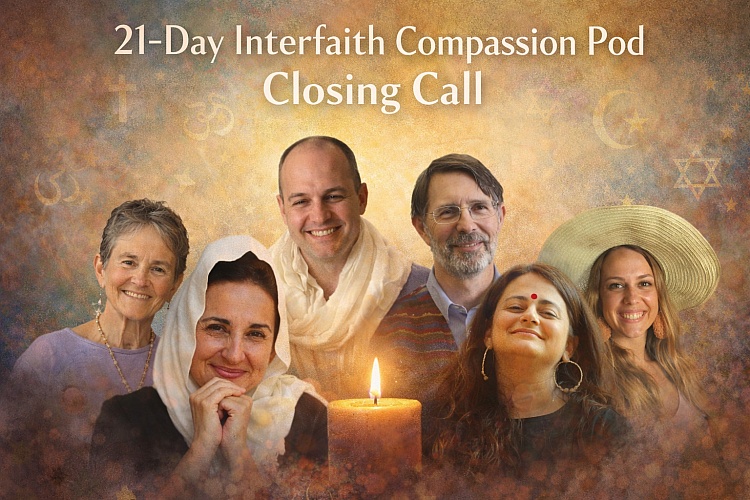
We're honored to be joined by some remarkable voices:
- Fawzia Al-Rawi — Born in Baghdad, initiated into Sufi wisdom by her grandmother, Fawzia has spent 25 years building bridges between cultures from her House of Peace in Vienna. Through whirling, zikr, and the Divine Names, she opens a space where traditions don't collide but dance.
- Cortland Dahl, PhD — From years of solitary retreat in Himalayan caves under revered Tibetan masters to earning the first-ever Ph.D. in Mind, Brain, and Contemplative Science, Cort bridges ancient wisdom and modern neuroscience. What happens in our minds when compassion practices from different traditions land in the same heart?
- Grace Dammann, MD — A physician who signed over 1,200 death certificates in San Francisco's AIDS ward, Grace's life was transformed when a devastating car accident on the Golden Gate Bridge left her with 17 broken bones and 48 days in a coma. Her brain injury became an unexpected doorway to profound presence. Now directing a meditation-based pain clinic from her wheelchair, she embodies her own teaching: "You can't control what happens, but you can control how you behave in response."
Weaving through our time together: poetry from Chelan Harkin, who once sat in Baha'u'llah's cell and heard the words "Let us dance" — alongside some sacred invocations by Bijan Khazai. Holding it all: Rev. Charles Gibbs, founding director of the United Religions Initiative and a lifelong pilgrim at the intersection of traditions.
This is a public call — so feel free to share with friends who might be curious about what happens when faith becomes bridge instead of a fortress.
To join us, click RSVP below and you'll receive call details by email. If timezone conflicts make it hard to attend live, RSVP anyway to receive the recording.
Thank you for practicing with us — and for the courage to let 21 traditions stretch your heart.
Fawzia Al-Rawi: Faith As Bridge
Full Transcript
Nipun: Thank you, Charles. I am absolutely delighted to be introducing our next speaker. Fawzia Al-Rawi, I think most of you have read the bios, so I'll skimp you on the details. But Fazyah is a Sufi teacher, she's a lineage holder, she was born in Baghdad, spent her childhood in Iraq and Lebanon, has lived through three wars.
But it was actually her grandma. Who initiated her into the Middle Eastern feminine traditions, and I think this is true, I don't know for sure, but I think I read it online. It says her grandmother's first lesson was to draw a dot and concentrate all your energy into this one dot. That is the beginning and the end, the navel of the world.
So she ultimately found her teacher through a dream. And it says, go to Israel, your teacher's in Israel, and I don't know how she managed to find one specific person, but she did. Siddhi Saik Muhammad al-Rafaik was her teacher, Sufi Sheikh, who transformed her life. Fazia also holds a PhD.
She's the author of three books. I think the first one was Midnight Tales: A Woman's Journey to the Middle East. They've been translated into many languages, from Arabic to German to French. From dancing and whirling to breathing techniques, and Zikr, she flows a lot out to the world in so many remarkable ways.
She is in Vienna, she has a center for female spirituality, where I understand that all backgrounds of people practiced whirling in a public place. I think it was thousands and thousands of people. So, Fazia, welcome. We are honored that you have accepted our invitation to join this interfaith call.
And we would love to hear a bit of your journey, how that's informed your perspective of faith. And faith really has a bridge to ourselves, our deeper self, to each other, and to the larger cosmic forces that are invariably ever-present. So, with that, Fazio, welcome, and thank you for being here.
Fawzia Al-Rawi: Thank you so much. Thank you for your invitation for giving me that honor and pleasure. It was very beautiful to listen to Bijam because, just like him, my parents—my mother is from the West, if I may say. She's Austrian, my father is Arab from Iraq.
So, when he talked, I could immediately understand what he's talking about. I grew up in an area in West Asia, or what you call more known as the Middle East. And it is an area where, how should I say, you get used to war. So often in our history, we lived war.
One of my most interesting experiences in life was when I lived in Lebanon. Lebanon is a very tiny country. And there are 18 different religions and confessions there. It is amazing to experience, within a little piece of land, so many people with different faiths and different ideas and ideologies living together.
Sometimes they lived well together, and sometimes they would fight each other and misunderstand each other. But for me as a young woman, as a child, and as a young woman, it was interesting to observe all these grown-ups, and how they behave, and how they all try to live, survive, and be happy. And I always ask myself, why is everybody so convinced of their path? Why are they not able to share together and live in peace together?
And one day, I had this really burning feeling in the chest. And out of that, I said, there must be a source, a greater source. Then, all of us. And it must be, like, a sun.
And the rays come down to us, and each one of us reflects it differently. So we are like mirrors of that one sun. And every ray comes down and is reflected uniquely by each mirror, meaning that multiplicity is an expression of that oneness. That was the first experience I had, and then, never by coincidence.
I walked and searched for if this is true, what I felt. And that's the way I came to Sufism, and that's the way I understood that what we need as human beings in order to come together, in order to understand each other, is not more information. We have accumulated more information than any generation before us. But the question is not how much we know, but how do we relate to each other?
Because growth happens when consciousness expands. That's the feeling I had, that when the heart opens. The heart-conscious humanity can help us to overcome barriers. And growth happens when consciousness expands, when we move from reacting to witnessing, from defending to understanding.
Isolation to connection. And I always had the feeling that the only part in us that is able to do that is the heart. So it was very natural that I found the resonance in Sufism. Because this is exactly what the Sufis say.
They say that the consciousness of us human beings grows in the heart. And the problem that we have is that the fragmentation of human beings—our mind is faster than our heart, our ego speaks louder than our conscience. And our identity becomes more of a fortress instead of a bridge. So everybody asks themselves, who am I?
But rarely, from where and how am I seeing the world? And the only part in us that asks differently is the heart, because it asks, what is my responsibility towards what I see? For me, Sufism is a path of love, and a path of love is actually one of the most difficult paths of the world. Because it has no form.
It takes the form of the vessel. And the vessel is the human being. And at the same time, it is only the heart that can bring differences together. Because we don't suffer because life is hard.
We suffer when life feels meaningless. And meaning doesn't come from facts, it comes from connection. We feel meaning when we're seen, when we belong. And the Sufi path describes human maturity as a movement of consciousness.
And it was so beautiful to see exactly that. Awareness pulsating in what Nippon was holding. As I said, I had the honor of being in one of these gatherings. Where he was talking about the me, and the we, and the us.
And the Sufism does it similarly. It starts with the me, and this is nothing wrong, it is necessary. The me is where survival lives. The identity, the safety, the boundaries, the pain, and the history.
But when we stay stuck there, everything becomes personal. My truth, my trauma, my religion, my fear. And in that sense, the world becomes then a threat. The others become competition.
So many conflicts are simply unhealed me screaming for validation. And then the Sufis say, and as I said, I heard that at Nippon as well, and that was so touching for me. And then we come to the we. This is a progress from the me, but it is also a danger, because we creates belonging.
Community, nation, religion, ideology. It gives warmth and meaning and direction. But when we defines itself against others, it hardens. We against them.
Pure against impure. Right against strong. So the only thing that helps us to come out of that is, so to speak, the third stage of us. Us is not sameness.
It is shared existence. So here, difference no longer threatens identity, it enriches it. You don't need to agree with me, but to recognize me as fully human, this is what us is. You don't need to share my beliefs.
But to share responsibility for this world. And this is not naive love; this is mature consciousness. So, for the Sufis, the heart is essential. It has nothing to do with sentimentality.
It is the center that can hold paradox. Because the mind divides, but the heart integrates complexity, contradiction, and depths. So a heart-centered human being can say, I disagree with you, and can still protect your dignity. Can say, I believe deeply, and I remain curious for others, or I am rooted, but I'm still open.
So, in Sufi language, the heart is the meeting place between reason and compassion and self and others, and this is essential. Because consciousness is not what you think, it is how you see. Consciousness is not intelligence, it's a quality of attention and of awareness. You don't need more, we don't need more opinions.
We need deeper presence, and we need to be real and truthful to ourselves. And we don't need loud identities, we need wider hearts. And we don't need to become the same. It is in the multiplicity of existence.
That we can feel the pulsation of oneness behind it. So our future will not be saved by a geology. It will be shaped by the quality of human consciousness we embody in how we speak, and how we listen, and how we choose to see one another. So faith was actually always meant to soften the heart.
So it could hold the world. And that's why, as I said, Sufism concentrates on the heart, because it knows it can bring the seen and the unseen together. And stay open to the mysteries of existence. The goal of every religion is to help inform and awaken human beings.
And I think for that, we need each other, so that we support each other in our awakening, and honor and enjoy our multiplicity. This is how Sufism sees it. And Sufism, maybe some of you do not know, is the love school in Islam. So, it is the school that has understood that we were born out of love, and it is through love that we find back home.
Nipun: Wow, beautiful Fazia. And for those of you who haven't had the privilege of meeting Fazia in person, Let me just say that it feels like, at least to me, it felt like she's always in transmission mode, that you feel like there's a field of goodness surrounding her. And so those words, you know, like, we don't suffer because life is hard; we suffer when life feels meaningless. Or consciousness is not intelligence; it's a quality of attention.
We don't need more opinions, but more presence; not louder identities, but wider hearts. Like, these are all things she lives and embodies, and so I was especially rejoicing hearing those words, Fazia, thank you. So, just one or two questions that we have time for here, but you have lived through three wars and intense, externally challenging circumstances. And you practice the Sufi path.
In fact, you're a lineage holder in that path. You are inspiring so many people to walk this path of the heart. So how... what...
how do you hold, and what has your practice taught you about the relationship between outer conflict and inner peace? I mean, this is something we all deal with ourselves, but I think we deal with, just looking out at the world as well. So how does your practice inform your relationship between outer conflict and inner peace?
Fawzia Al-Rawi: What I have noticed in our life is that approximately, in the rhythm of three months, we always have an opportunity given by life. An opportunity to go deeper, to understand ourselves, to say yes to love. And we can ignore that, and go running in the fields, or we can look at many films, or we can listen to it. But life always calls us to make a decision, a decision every human being has to make.
Am I taking the path of love and light, or am I taking the path of darkness? We are constantly confronted with different kinds of fears. Fears can be a prison, or they can be opportunities. And this is a decision that, when we listen to the heart, the heart will always say, yes, love, overcome.
For example, yesterday, I was on a Christmas market, because here in Austria, we have beautiful Christmas markets around this period. I was there with my daughter and some friends and my grandchild, and I really had the feeling that I was living and enjoying that Christmas market from my soul, and it was enjoying all the children and all the people there. At the same time, I heard the little eagle that wanted to make comments about this person, and wanted to say something not so nice about that, or compare, or whatever. And then I got a little bit irritated, and immediately I knew when I come into such a situation, I have to turn to my heart.
And the heart, in that moment, always tells you, please. Love. Please… Choose love. And when you listen to the heart, it will always show you to choose love.
To choose compassion, because it is the only quality that allows us human beings to grow. There is no other quality. It is only with compassion and mercy that we can overcome the barriers between us, and we can listen to each other and learn from each other. And the question is then no more: You're this or that.
The question is then, show me how you are reaching the divine. Show me an aspect that I have not yet lived. And in that sense, everything becomes an enrichment.
Nipun: That's beautiful. Just to close out our time, I can't resist but ask you a personal question around choosing love. What would you say has been a moment, a formative moment perhaps, where you understood this power of love, of choosing love, and its infinite capacity? That we tend to think of, we often tend to reduce love as an emotion, but this, what you're talking about is something that goes far beyond some feeling you get when you watch a movie.
You're talking about this grand cosmic force, so maybe from your personal life, we get a little glimpse into who you are as well.
Fawzia Al-Rawi: Well, maybe I will have to say sorry to my husband later, but when a man and a woman have a relationship, often, especially women, think, oh, I will try to change him, I will try to inform him in a way. I thought the same thing, you know, I thought, okay, I will be patient, and things will change, and so on. And then came a moment where I understood that the only thing that is really important in a relationship is to follow the pulsation of accepting the other one unconditionally. And this is not something the mind can do.
It is only the heart. By accepting the other human being unconditionally, then transformation comes. Because what is beautiful, nothing transforms your character and your way of looking at life as somebody who reflects that he can accept you unconditionally. And this is something only the heart can do.
And for me, this was one of the great teachings of understanding how we can grow from an ego consciousness into a universal consciousness.
Nipun: Beautiful, beautiful. Fazia, I feel like when we had a little breakfast circle with you one time, when I was in Vienna, we probably thought it was going to be a half hour or an hour, but we were there for many hours. I feel like we could do the same here, and just benefit and soak in your wisdom. But thank you, Fazia, for who you are.
And what you bring to the table, and for courageously holding up the flag of the path of the heart. And showing, shining light on the possibilities of what this profound love can do in the world.