Interfaith Compassion: Closing Celebration
Virtual
About This Event
For the last 21 days, people from dozens of countries have gathered to deep-dive into interfaith practices of compassion. Every day featured a unique faith tradition — with "hands" practices, "head" insights from scripture, and "heart" music and art. We've stretched into Sufi zikr and Buddhist metta, Sikh seva and Indigenous ceremony, Franciscan simplicity and Jewish tikkun olam. Thousands of reflections later, we discovered what we suspected all along: beneath our different names for the sacred runs a single river of compassion.
This Sunday, we gather one last time — not to close a chapter, but to ask: Now what?
We've downloaded 21 practices. But what does it mean to upload presence into our lives? When the challenge ends and Monday arrives, how do these seeds take root?
We'd love to have you join this closing call — broaden our circle, and help carry these ripples forward. Please RSVP below.
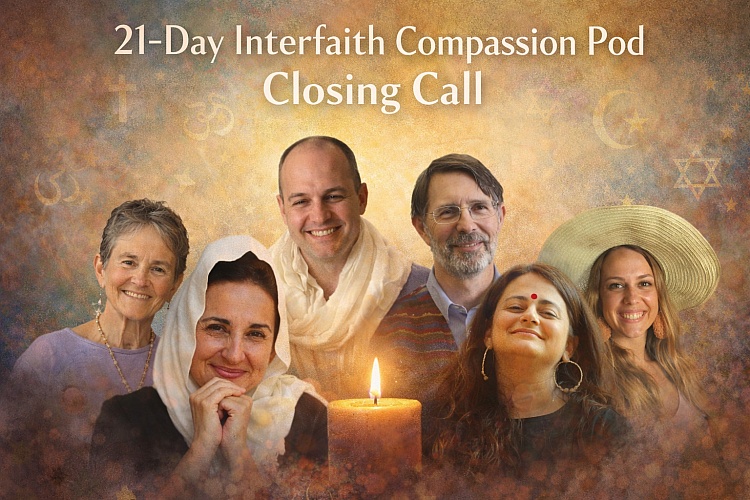
We're honored to be joined by some remarkable voices:
- Fawzia Al-Rawi — Born in Baghdad, initiated into Sufi wisdom by her grandmother, Fawzia has spent 25 years building bridges between cultures from her House of Peace in Vienna. Through whirling, zikr, and the Divine Names, she opens a space where traditions don't collide but dance.
- Cortland Dahl, PhD — From years of solitary retreat in Himalayan caves under revered Tibetan masters to earning the first-ever Ph.D. in Mind, Brain, and Contemplative Science, Cort bridges ancient wisdom and modern neuroscience. What happens in our minds when compassion practices from different traditions land in the same heart?
- Grace Dammann, MD — A physician who signed over 1,200 death certificates in San Francisco's AIDS ward, Grace's life was transformed when a devastating car accident on the Golden Gate Bridge left her with 17 broken bones and 48 days in a coma. Her brain injury became an unexpected doorway to profound presence. Now directing a meditation-based pain clinic from her wheelchair, she embodies her own teaching: "You can't control what happens, but you can control how you behave in response."
Weaving through our time together: poetry from Chelan Harkin, who once sat in Baha'u'llah's cell and heard the words "Let us dance" — alongside some sacred invocations by Bijan Khazai. Holding it all: Rev. Charles Gibbs, founding director of the United Religions Initiative and a lifelong pilgrim at the intersection of traditions.
This is a public call — so feel free to share with friends who might be curious about what happens when faith becomes bridge instead of a fortress.
To join us, click RSVP below and you'll receive call details by email. If timezone conflicts make it hard to attend live, RSVP anyway to receive the recording.
Thank you for practicing with us — and for the courage to let 21 traditions stretch your heart.
Chelan Harkin: Two Poems
Full Transcript
Charles Gibbs: It seems as though we have opened a wide heart channel flowing through this call, and I have a sense it's just going to keep getting wider and wider. Our next guest is Chelan Harkin. From what I can tell, she has been a channel for sacred wisdom expressed through poetry at least for all of this lifetime. I'm pretty sure there were several before this one, where that channel just continued to grow, before she was old enough to write herself. The poetry she received, she recited.
Chelan Harkin: Now, there's an important word in some traditions, recite.
Charles Gibbs: She recited to her mother, who took them down. She has been receiving, writing, and reciting ever since, with a deep soul openness, and opening the door for many of us for our souls, our hearts, to open wider. Joanne, we are in your hands and heart.
Chelan Harkin: Thank you, Charles. Thank you, everybody. It's so nice to be here with you. So, it's true that I did come in with sort of this poetic proclivity. But then, it was incredibly blocked off, actually, from about age 6 to age 21. Largely, that's because I didn't know what to do with my suffering that really came in hard and heavy into my system. I had ideas that I took on, that suffering was wrong, and that the way to be a good person was to somehow be perfect. It was a very disjointed set of ideas that came into me. So, I became very closed down and blocked off, really, from about age 6 to 21.
Chelan Harkin: At age 21, in a time of really acute despair, when my disconnect from anything that really felt real and true and alive in myself was at its peak, I was on a Baha'i pilgrimage. The Baha'i Holy Land is in Israel, in Haifa. I was in the prison cell of Baha'u'llah, the founder of the Baha'i Faith. I was in his prison cell alone and received this profound message that wasn't just a message, but it was really an unlocking force. It untied a lot of these false ideas about needing to self-reject to be embraced by God, or to be in alignment, and to actually embrace my wholeness, my pain, my potential, the wounds, and the wisdom. All of it was the path for me. I received this message: let us dance.
Chelan Harkin: It unlocked these energy channels that came through as poetry and have been flowing through me ever since in that way. So that's kind of the origin story of how all this kicked off. I'll share two poems. As soon as I came home from Haifa, poetry just started pouring through, and it hasn't stopped. This is the first one that came through in this way, where it felt like I wasn't just trying to force a poem through my pen, but that I was opening to a greater flow that was both intimately part of me and definitely beyond me as well.
Chelan Harkin: This poem here is called Say Wow.
Chelan Harkin: Each morning, before our surroundings become flat with familiarity and the shapes of our lives click into place, dimensionless and average, as Tetris cubes. Before hunger knocks from our bellies like a cantankerous old man, and the duties of the day stack up like dishes. And the architecture of our basic needs commissions all thought to construct the four-door sedan of safety. Before gravity clings to our skin like a cumbersome parasite, and the colored dust of dreams sweeps itself obscure in the vacuum of reason. Each morning, before we wrestle the world and our heart into the shape of our brain, look around and say, wow.
Chelan Harkin: Feed yourself fire. Scoop up the day entire, like a planet-sized bouquet of marble, sent by the universe directly into your arms, and say, wow. Break yourself down into the basic components of primitive awe, and let the crescendo of each moment carbonate every capillary, and say, wow. Yes, before our poems become calloused with revision, let them shriek off the page of spontaneity. And before our metaphors get too regular, let the sun stay a conflagration of homing pigeons that fights through fire each day to find us.
Chelan Harkin: Oh, end with one more. This is called The Worst Thing.
Chelan Harkin: The worst thing we ever did was put God in the sky out of reach, pulling the divinity from the leaf, sifting out the holy from our bones, insisting God isn't bursting dazzlement through everything we've made a hard commitment to see as ordinary. Stripping the sacred from everywhere to put in a cloud man elsewhere, prying closeness from your heart. The worst thing we ever did was take the dance and the song out of prayer, made it sit up straight and cross its legs, removed it of rejoicing, wiped clean its hip sway, its questions, its ecstatic yowl, its tears. The worst thing we ever did is pretend God isn't the easiest thing in this universe, available to every soul, in every breath. Thank you all.
Charles Gibbs: Wow.
Chelan Harkin: And...
Charles Gibbs: Thank you for those wows that kept appearing behind you.
Chelan Harkin: Yeah!
Charles Gibbs: Yeah, what a wonderful addition to our community to have those up-and-coming wows give us their presence.
Chelan Harkin: Yeah, thank you. It's nice to have them with me.