Interfaith Compassion: Closing Celebration
Virtual
About This Event
For the last 21 days, people from dozens of countries have gathered to deep-dive into interfaith practices of compassion. Every day featured a unique faith tradition — with "hands" practices, "head" insights from scripture, and "heart" music and art. We've stretched into Sufi zikr and Buddhist metta, Sikh seva and Indigenous ceremony, Franciscan simplicity and Jewish tikkun olam. Thousands of reflections later, we discovered what we suspected all along: beneath our different names for the sacred runs a single river of compassion.
This Sunday, we gather one last time — not to close a chapter, but to ask: Now what?
We've downloaded 21 practices. But what does it mean to upload presence into our lives? When the challenge ends and Monday arrives, how do these seeds take root?
We'd love to have you join this closing call — broaden our circle, and help carry these ripples forward. Please RSVP below.
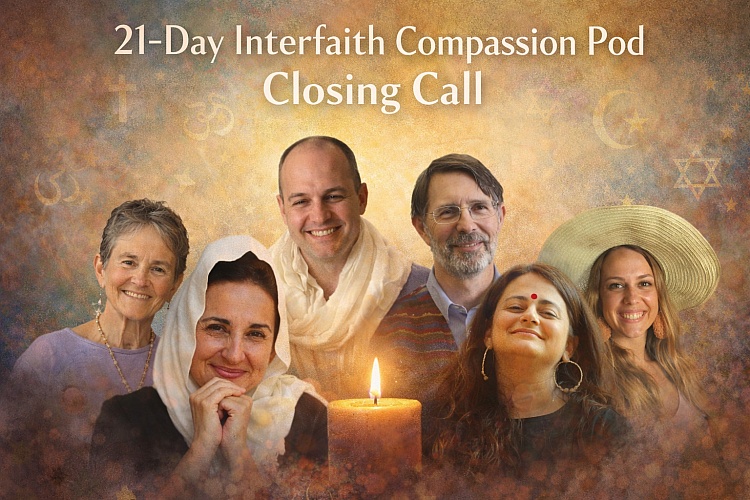
We're honored to be joined by some remarkable voices:
- Fawzia Al-Rawi — Born in Baghdad, initiated into Sufi wisdom by her grandmother, Fawzia has spent 25 years building bridges between cultures from her House of Peace in Vienna. Through whirling, zikr, and the Divine Names, she opens a space where traditions don't collide but dance.
- Cortland Dahl, PhD — From years of solitary retreat in Himalayan caves under revered Tibetan masters to earning the first-ever Ph.D. in Mind, Brain, and Contemplative Science, Cort bridges ancient wisdom and modern neuroscience. What happens in our minds when compassion practices from different traditions land in the same heart?
- Grace Dammann, MD — A physician who signed over 1,200 death certificates in San Francisco's AIDS ward, Grace's life was transformed when a devastating car accident on the Golden Gate Bridge left her with 17 broken bones and 48 days in a coma. Her brain injury became an unexpected doorway to profound presence. Now directing a meditation-based pain clinic from her wheelchair, she embodies her own teaching: "You can't control what happens, but you can control how you behave in response."
Weaving through our time together: poetry from Chelan Harkin, who once sat in Baha'u'llah's cell and heard the words "Let us dance" — alongside some sacred invocations by Bijan Khazai. Holding it all: Rev. Charles Gibbs, founding director of the United Religions Initiative and a lifelong pilgrim at the intersection of traditions.
This is a public call — so feel free to share with friends who might be curious about what happens when faith becomes bridge instead of a fortress.
To join us, click RSVP below and you'll receive call details by email. If timezone conflicts make it hard to attend live, RSVP anyway to receive the recording.
Thank you for practicing with us — and for the courage to let 21 traditions stretch your heart.
Cortland Dahl: Neuroscience Of Love
Full Transcript
Charles Gibbs: Our next guest… There he is. Cortland Dahl. Court, great to see you again.
Cortland Dahl: Wonderful to be here with you, Charles.
Charles Gibbs: Court is, among many other things, a scientist, author, translator, entrepreneur, and meditation teacher. Who, as I said earlier, without attributing it to him, went from meditating in the foothills of the Himalayas to the laboratory, and discovering a whole new field that he pioneered. He says his true passion, and this squares with that, is using ancient wisdom and modern science. To help people flourish.
There is a noble pursuit. He's someone, from my experience, who just embodies deep stillness, and the depth of that stillness is a gift when it flows out. And from having had lovely time with him in the community of Gandhi 3.0 in January this year, I can also say he's a lot of fun to be around. So, court...
We're all yours.
Cortland Dahl: Thank you so much for that generous introduction. I wish I had... two astral children flickering in and out of existence at my shoulders. That was so lovely.
It was somehow just perfect with the words, and the spirit, and the poetry, and then these little astral beings. So, I've been very moved just by hearing everything today, and thought I would share a little bit about the biology of love. Which might be an unexpected pairing of words. I wanted to start, actually, with an image, an experience that each of us has had many times over.
So, if you just walk out your door and hop in a car and drive somewhere, you'll get to where you're going. In all likelihood, you'll forget all about the drive. You won't even remember it. If you do remember it, what you'll probably remember is something that went wrong, or that was out of the ordinary.
If you drove by an accident, for example, or somebody cut you off, or something that basically was out of the norm. And this highlights something really important about human biology. Which is that, for better or worse, we didn't really evolve to be happy. We evolved to survive.
And what has helped us survive as a species is that we are really, really good at detecting threats. So what you wouldn't have noticed on that drive is many people, sometimes hundreds of people, all driving these incredibly dangerous machines, doing this complex social dance seamlessly. And this is so ubiquitous that we don't even notice it. So, if you start paying attention to these kinds of things, you'll see that harmony is actually the norm.
Care is the norm. Cooperation is the norm. Kindness is the norm. It's just that these things are so common, it's like the air we breathe.
You only notice when it's gone, or something changes. And this is, again, because our biology has gotten really good at detecting changes in the environment. So that's just one basic observation, is that a lot of these things that we think we're lacking are actually here. And the path and the journey is more tuning into these things and bringing them up to the level of our conscious experience.
Than feeling like we don't have enough connection, or we don't have enough wisdom, or awareness, or any of these things. So both the science and, of course, many of the world's wisdom traditions point to the idea that these are really innate capacities that we have. We need to nurture them. And we don't always feel like we're in touch with them, but they're actually part and parcel of who we are as human beings.
And it actually shows up in really surprising places, so all of us, or most of us, have our shadows, our inner demons, what we view as our bad habits, or things about our lives, or the way we are that we just wish didn't exist. And if you, again, you look at it from the point of view of evolutionary biology, you can say that we have evolved over centuries to become extremely good at detecting threats, as I mentioned. And yet, we're not very good at discerning emotional threats from physical threats. Or psychological safety from physical safety.
So oftentimes we might be at work, and somebody says something unkind. And our biology responds as though it's like a physical threat, as though we need to fight, or run away, or freeze, but really, where are you gonna run? Where are you gonna… right? It's just, our system has not caught up to the context that it finds itself in.
So it's really good, it's doing its job of detecting threats, it's just having trouble calibrating to what's going on in the moment. And now we live in this world with social media, 24-7 news cycle, the barrage of information that never shuts off, that's just triggering this threat response over and over again. To the point where it almost becomes a chronic state. And so even here, too, the impulse would be to see this as a problem.
I mean, of course, there's a lot of things going on in the world and the environment that we desperately need to work on. But when it comes to the inner experience of that, the threat response. It's easy to sort of feel this is, like, a personal failing that we have. But look again.
What is the threat response, in its essence? Threat response is essentially about protection. It's a protective mode, so it can be dysfunctional, it can get us in trouble. But protection, at its core, actually, is love.
We protect things we care about. We protect things that we feel deeply connected to. We connect things that we love. So, even though the expression of it can be dysfunctional at times, it can be imbalanced at times, if you actually look at the core of these protective mechanisms and this threat response that the world, collectively, and each of us individually is experiencing so commonly.
Actually, the core of that, the baseline, is actually love, just like the traffic. Like, the ubiquitous part, the air we're breathing in, actually is something incredibly beautiful. When we don't see that clearly, it can have this toxic impact on our lives. But when you start to tune into that, you start seeing that anxiety is rooted in love, that depression, feeling frozen, feeling stuck, feeling burnt out, feeling overwhelmed.
You go down the list, all of it, actually, at its core. Is love. It has these same just basic protective mechanisms. And this is amazing, because it just reframes the whole path, not from, we're gonna fix some fundamental flaw.
In us individually, in our relationships, in our communities. But it's really just getting in touch with who we are and who we've always been. So, to go to the science, I had planned to say a little bit more about the science, but I think hearing what everybody shared today, I wanted to maybe just share a little bit of that wider perspective. So in the research that we've done, we've developed a lot of ways to help introduce some of these ideas to people, and then we're studying, essentially, what happens.
And so there's a few basic insights to mention briefly. One is this idea that flourishing really is a skill? We tend to just feel like we feel it sometimes, we either have it or we don't, rather than viewing it as a practice. It's something that we're learning, it's something that we're nurturing, it's more of a process than just this thing that somehow is based on your circumstances, or your biology, or your genetics, or anything else.
It's steps. That's actually a series of small steps. And then if you look beneath the surface, a lot of my work has been looking at the common threads across the world's wisdom traditions, and from different fields of science, from cognitive and affective neuroscience to clinical psychology and psychiatry. And you see that there's really common ingredients that run through all these traditions.
Awareness and presence. Being is a thread that runs through all these traditions. Connection, of course. Kindness, compassion, love, all...
you find this in every single tradition, right? This is not limited to any religion or psychology or philosophy. Insight and wisdom. Purpose.
So these four in particular, awareness, connection, insight, and purpose, are the four that have emerged most clearly as kind of the core constituents of flourishing. And the beauty is that the evidence shows, and all of the thousands of years of history we have as human beings, that these are capacities that we all have, and we can nurture them. And like I said, it's not that we lack these things. What we lack is being in touch with them and seeing them clearly.
So that's really the path. So the last thing I'll say, I know we're a little bit beyond our time, the last thing I'll say is that when we do this, and we've done now very rigorous research with thousands and thousands of people. In addition to our work here at UW-Madison, where I live, many other research groups have shown that not only does this benefit people, and even just very small steps. Literally minutes a day for a week or two can benefit, and can make a pretty dramatic benefit.
But it actually ripples out to affect the systems within which we live. For example, we've done work in education settings showing by just giving teachers these tools, the grade point average and standardized test scores of students will improve 6 months later. By giving doctors and nurses these tools. Not saying anything about the patients or the system.
Patient outcomes improve months later. Hospital stay times, recovery times, all these very hard-nosed metrics. And the tools we're giving, I'm not saying anything about the students, or the classroom, or anything about the patients. It naturally ripples out, because we are wired in a social way.
We are constantly infecting each other with our mental and emotional states. And therefore, if we're flourishing, it's just naturally going to ripple out and affect everybody around us. So, anyways, I could geek out for a very long time here, but I'll just pause here and turn it back to you, Charles. Thank you for inviting me into this beautiful circle.
Charles Gibbs: Well, thank you, Court. I could see Nippoon's smile get particularly big when you talked about rippling out. That's one of his favorite activities.
Cortland Dahl: Kunis is a... oh. True master of the ripple effect, as we've all experienced and enjoyed and benefited from.
Charles Gibbs: Here, here. Well, I'm gonna ask what might be a challenging question, but—
Cortland Dahl: My favorite.
Charles Gibbs: You talked about tools, and they weren't complicated, huge tools. If you were to offer this lovely community gathered here in this Zoom room, one tool we could take with us as a next practice beyond the 21 days, what would you offer?
Cortland Dahl: Well, one that I love and have found so beneficial is, you know, these have been lifelong practices, and our own practice and journey goes in all sorts of different areas. Oftentimes it's about getting in touch with something. Maybe it's simply being more aware and present, or kindness, love, whatever the case may be. A really beautiful way to put this into practice is to see other people as the embodiment of the thing that I'm nurturing myself.
Charles Gibbs: And so, especially right when you move into an interaction.
Cortland Dahl: It could simply be something as... You know, like we've been talking about love. See the other person as though they're just radiating love, as though they're made of love. And just see the world around you as just made of the thing that you're aspiring to and working towards, embodying yourself.
And it becomes this really beautiful... I mean, it's like the ripple effect going both ways. It becomes this little, really... and it opens...
you don't need to say anything different or do anything different. But something opens up, I think, when you just... when we see each other and see the world through a different lens. Thought that might be something interesting to experiment with.
Charles Gibbs: Well, that's fantastic, and it reminds me of a line from a Sufi poem by Ezeddin Nassafi that says, look around you and see a universe saturated by the fragrance of love.
Cortland Dahl: It feels at the beginning like you're manufacturing it, but then you see, actually, everybody is made of love. Everybody is made of awareness, and then it… yeah, anyways.
Charles Gibbs: Does that also work when you look at the other you see in the mirror when you wake up in the morning?
Cortland Dahl: That's the hardest one, but yes.