Interfaith Compassion: Closing Celebration
Virtual
About This Event
For the last 21 days, people from dozens of countries have gathered to deep-dive into interfaith practices of compassion. Every day featured a unique faith tradition — with "hands" practices, "head" insights from scripture, and "heart" music and art. We've stretched into Sufi zikr and Buddhist metta, Sikh seva and Indigenous ceremony, Franciscan simplicity and Jewish tikkun olam. Thousands of reflections later, we discovered what we suspected all along: beneath our different names for the sacred runs a single river of compassion.
This Sunday, we gather one last time — not to close a chapter, but to ask: Now what?
We've downloaded 21 practices. But what does it mean to upload presence into our lives? When the challenge ends and Monday arrives, how do these seeds take root?
We'd love to have you join this closing call — broaden our circle, and help carry these ripples forward. Please RSVP below.
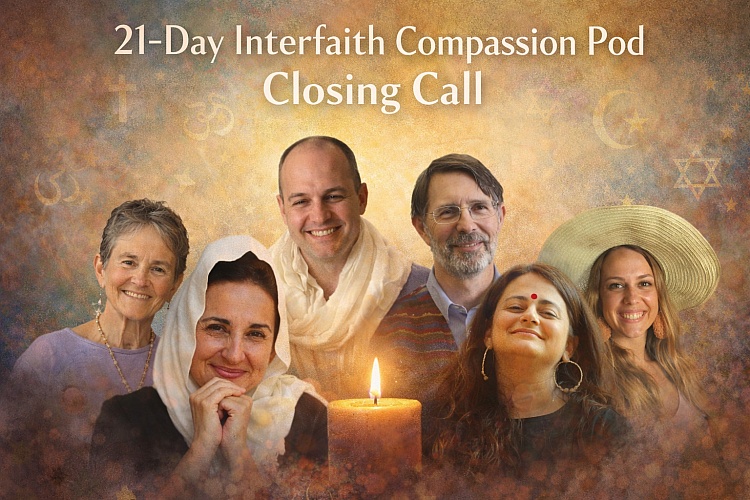
We're honored to be joined by some remarkable voices:
- Fawzia Al-Rawi — Born in Baghdad, initiated into Sufi wisdom by her grandmother, Fawzia has spent 25 years building bridges between cultures from her House of Peace in Vienna. Through whirling, zikr, and the Divine Names, she opens a space where traditions don't collide but dance.
- Cortland Dahl, PhD — From years of solitary retreat in Himalayan caves under revered Tibetan masters to earning the first-ever Ph.D. in Mind, Brain, and Contemplative Science, Cort bridges ancient wisdom and modern neuroscience. What happens in our minds when compassion practices from different traditions land in the same heart?
- Grace Dammann, MD — A physician who signed over 1,200 death certificates in San Francisco's AIDS ward, Grace's life was transformed when a devastating car accident on the Golden Gate Bridge left her with 17 broken bones and 48 days in a coma. Her brain injury became an unexpected doorway to profound presence. Now directing a meditation-based pain clinic from her wheelchair, she embodies her own teaching: "You can't control what happens, but you can control how you behave in response."
Weaving through our time together: poetry from Chelan Harkin, who once sat in Baha'u'llah's cell and heard the words "Let us dance" — alongside some sacred invocations by Bijan Khazai. Holding it all: Rev. Charles Gibbs, founding director of the United Religions Initiative and a lifelong pilgrim at the intersection of traditions.
This is a public call — so feel free to share with friends who might be curious about what happens when faith becomes bridge instead of a fortress.
To join us, click RSVP below and you'll receive call details by email. If timezone conflicts make it hard to attend live, RSVP anyway to receive the recording.
Thank you for practicing with us — and for the courage to let 21 traditions stretch your heart.
Grace Dammann: Thriving
Full Transcript
Charles Gibbs: Well, before I hand this over to Grace, I would just like to say personally, that at the time of Grace's accident, I had the great privilege, and it connects with what everyone on this call has been going through, experiencing other faiths. I was part of an interfaith meditation group that included Grace's partner at that moment, Fu Schrader. During the time Grace was in a coma, we held Grace as a group of people from many different faith traditions, holding her in the light of love.
Charles Gibbs: It is such a joy to be in this space and to see a living miracle with her feet on the ground, taking the next step, and the next step, and the next step. Grace, we're all yours.
Grace Dammann: Thank you, Charles, and thank you, everybody. But I don't really want to talk about my own story. I'm bored of my own story by now. And Court, thank you so much for talking about flourishing, because that's exactly where I am these days. I've managed to survive and survive very well. I've managed to complete my bucket list for living.
Grace Dammann: So now what I decided I want to do is to really thrive, because I think thriving is what's going to help everybody around me the most. Meaning, what kind of joy do I get? What kind of joy can I give out?
Grace Dammann: So let me tell you two stories, both from my hospital days, from when I was a doctor on the AIDS unit. We started the AIDS unit at a time when there were no medications to help people survive, so our job was to hold the ambiguity of whether they were living or dying. They didn't know, we didn't know. There was very little we could do for them but just be present. So I had this one patient, I'll call him Charlie.
Grace Dammann: Every day, I would come in, and he'd say, "Dr. Grace, today is a great day to die." Two thumbs up, great day to die. And I'd ask him something about what made it a great day to die. Well, he said, "Do you know that the outdoor cat is finally pregnant, and she's about to deliver babies? So don't you think it'd be great if I died, and all of these little cat babies were born on my bed?" I said, sure, sure. So one day, I came in, and Charlie didn't say that. As I was writing a note on him, I thought, I better go back. It's really important to find out why he said what he said.
Grace Dammann: So I went back and I said, "Charlie, you didn't say to me, today is really a good day to die. Why didn't you?" He said, "You know, Doc, I've been thinking about it for a long, long time. I mean, what's the big rush? I'll be dead for a very long time. How about if I just enjoy the cats?" And I said, great. And he never again mentioned the word dying, and he lived for two and a half more years, with very little that we did but interact.
Grace Dammann: Anyway, you guys, this is your time. You're all beautiful people. I'm wondering, for each of you, what it is you're taking from this course, from this pod structure, from this wonderful offering of service space. They really know how to do it right. Naipun, thank you very much. I'm serious, this is my third pod that I've even been somewhat a part of, and it touches heart, hand, and mind. Anyway, I'm sure all of you have the same questions that we all have, which is, number one, why am I here? Number two, what is it that I'm supposed to do? Number three, am I doing it?
Grace Dammann: Okay, so this is an exercise that I've often used with myself. I'm gonna give it to you. So just everybody take three deep breaths in through your nose, out through your mouth, and as Court can tell you, this will reset the autonomic nervous system. And now is the tricky part. You're gonna ask your heart, heart, what do you want me to do? What is it that I'm supposed to do next? Whenever. What is it that you would like me to do? And the important thing is you've got to be willing to listen. And if you have to, just say thank you very much, but deeply listen to what your heart says.
Grace Dammann: Now ask your heart, what tools do I need? Court mentioned one. The song, "You're Beautiful," is another one. All of the songs, Sly and the Family Stone, great songs. The Condor and the Eagle story. Those are all important tools. But ask your heart, what kind of tools do I need? And if your heart's saying, you can't do this, just say, we'll talk about that later.
Grace Dammann: Now, finally, ask your heart, who could best support me in this process? What kind of people, what people in particular do I need to support me? Now then, take a deep minute and summarize for yourself, this is what my heart told me to do. This is what the tools are available to me, as given by my heart. And this is the community or people I need to support me. And just say yes. Thank you all.