Interfaith Compassion: Closing Celebration
Virtual
About This Event
For the last 21 days, people from dozens of countries have gathered to deep-dive into interfaith practices of compassion. Every day featured a unique faith tradition — with "hands" practices, "head" insights from scripture, and "heart" music and art. We've stretched into Sufi zikr and Buddhist metta, Sikh seva and Indigenous ceremony, Franciscan simplicity and Jewish tikkun olam. Thousands of reflections later, we discovered what we suspected all along: beneath our different names for the sacred runs a single river of compassion.
This Sunday, we gather one last time — not to close a chapter, but to ask: Now what?
We've downloaded 21 practices. But what does it mean to upload presence into our lives? When the challenge ends and Monday arrives, how do these seeds take root?
We'd love to have you join this closing call — broaden our circle, and help carry these ripples forward. Please RSVP below.
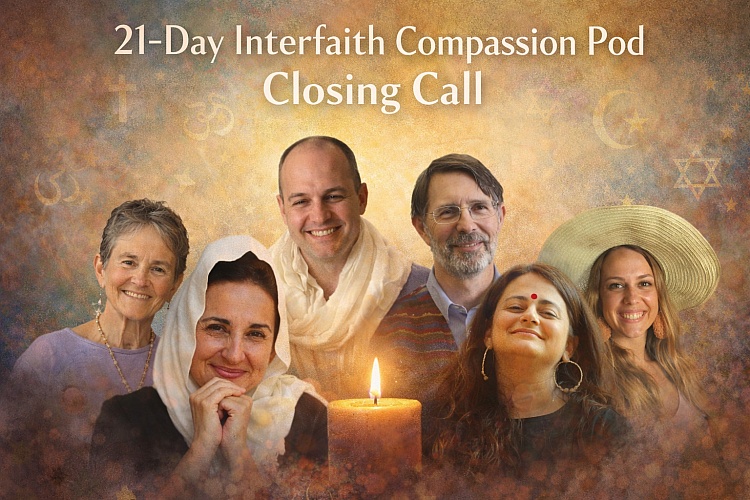
We're honored to be joined by some remarkable voices:
- Fawzia Al-Rawi — Born in Baghdad, initiated into Sufi wisdom by her grandmother, Fawzia has spent 25 years building bridges between cultures from her House of Peace in Vienna. Through whirling, zikr, and the Divine Names, she opens a space where traditions don't collide but dance.
- Cortland Dahl, PhD — From years of solitary retreat in Himalayan caves under revered Tibetan masters to earning the first-ever Ph.D. in Mind, Brain, and Contemplative Science, Cort bridges ancient wisdom and modern neuroscience. What happens in our minds when compassion practices from different traditions land in the same heart?
- Grace Dammann, MD — A physician who signed over 1,200 death certificates in San Francisco's AIDS ward, Grace's life was transformed when a devastating car accident on the Golden Gate Bridge left her with 17 broken bones and 48 days in a coma. Her brain injury became an unexpected doorway to profound presence. Now directing a meditation-based pain clinic from her wheelchair, she embodies her own teaching: "You can't control what happens, but you can control how you behave in response."
Weaving through our time together: poetry from Chelan Harkin, who once sat in Baha'u'llah's cell and heard the words "Let us dance" — alongside some sacred invocations by Bijan Khazai. Holding it all: Rev. Charles Gibbs, founding director of the United Religions Initiative and a lifelong pilgrim at the intersection of traditions.
This is a public call — so feel free to share with friends who might be curious about what happens when faith becomes bridge instead of a fortress.
To join us, click RSVP below and you'll receive call details by email. If timezone conflicts make it hard to attend live, RSVP anyway to receive the recording.
Thank you for practicing with us — and for the courage to let 21 traditions stretch your heart.
Charles Gibbs: Let Us Dance
Full Transcript
Charles Gibbs: So, this call may mark completion, but it is not an ending. It's a beginning, and we have received so much rich nourishment to carry with us into this beginning. I would invite everyone in the spirit of the kind of process I heard Grace inviting, to also use something like that. Look at the whole of these 21 days, and imagine you're getting ready to go on a journey, and you have a backpack. What, from this time together, do you want to put in the backpack to carry with you as a resource?
Charles Gibbs: It may be, as Grace's question, people... people are hard to put in a backpack, but you could just, you know, write their name. But what are the things that have been most precious to you, that have raised good questions, that have inspired you, reassured you, challenged you, that you want to carry forward into the next chapter of this engagement?
Charles Gibbs: And in the spirit of that question, I would love to offer a poem that, strangely enough, has the same title as the words that Shalan heard in Baha'u'llah's cell those many years ago. Let us dance.
Charles Gibbs: This poem is Let Us Dance. Each of us will die one day. It doesn't matter. More important is to practice living, to practice thriving. Still, all that does not serve our truest becoming. Listen to the music of the universe inviting us to begin the dance that is ours alone. The beloved has been waiting from before time for our first step, for our next step. No matter our age, our life is new in this moment. Let us dance. Let us dance.