This essay is part of a series exploring what remains uniquely human in an age of artificial intelligence. As machines master the measurable world, perhaps the center of gravity of human life shifts toward what the Buddha once called the immeasurables. Deep Data — from computation to wisdom; The Game That Ends in Grace — from the known to the unknowable; Labor of Love — from necessity to love; Geometry of Trust — from control to trust; Come In and See — from transaction to relationship; and The Overlooked below — from extraction to emergence. And building on our counter curriculum, The Intelligence Between Us below — from minds to fields.
The mantis shrimp sees sixteen primary colors. We see three. It is not that we are looking at different oceans — we are standing in the same water, perceiving different worlds.
Ed Yong, the science writer, spent years documenting this. Every creature inhabits its own sensory universe — what biologists call an Umwelt. The bee sees ultraviolet nectar guides  painted on petals that appear plain white to us. The bat navigates by sound-shape, constructing a world from echoes. The whale sings across ocean basins in frequencies we cannot hear.
Each Umwelt is complete. Each is coherent. And each is invisible to every other.
Now consider a room full of humans. A grandmother who has buried a child. A software engineer who has never lost anything. A teenager vibrating with a question she cannot yet name. A monk. A banker. A translator who quietly changed a language.
How many Umwelten in that room? How many forms of intelligence, layered and invisible to one another, waiting to be called forth?
This is not Howard Gardner's multiple intelligences — still one skull, still one taxonomy. This is something wilder: an ecology of knowing, distributed across mortal bodies, irreducible to any single mind. No curriculum could design it. It can only be allowed.
· · ·
Vinoba Bhave — Gandhi's spiritual heir — once received a group of seasoned business luminaries. His Bhoodan movement had already walked across India, gathering millions of acres of gifted land for the landless. They wanted to help him scale it further. He answered their question with a sentence they had no category for.
"What you fail to understand is this. The wind will carry the message. The birds will sing the anthem. The rivers will spread the movement."
That was his volunteer network.
So it is not surprising that when he turned, in his later years, to a small circle of nuns at Pavnar ashram, his charter for them contradicted every assumption about what a spiritual movement is supposed to do.
Do not grow. Do not measure your reach. Do not worry about what comes after you. Tend, instead, to one thing: coherence among yourselves.
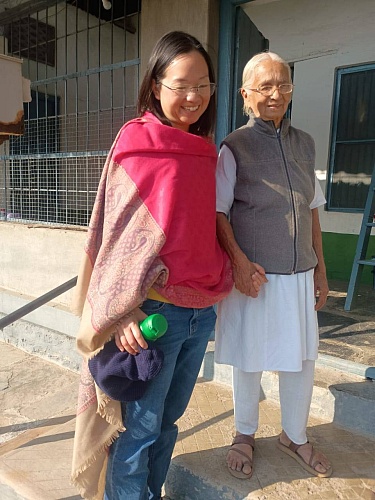 He called it Samuhik Chitt Shuddhi. The collective purification of mind. Of all the charters Vinoba could have offered for humanity's future, he believed this one was the most important.
The community is small now. Most of the nuns have passed. Usha Tai is ninety-four. Our circles continually overlap — Ragu and Nisha and Aum visited just last month.
Humanity has never really been good at small-group coherence. We are good at crowds. We are good at solitude. The middle terrain — five, ten, twenty people in a room, actually attuning — has always been the hardest.
Perhaps AI, for the first time, will help us get good at it.
· · ·
We have two superpowers. Jon Kabat-Zinn names them plainly.
Thinking built civilizations, split the atom, wrote symphonies. Thinking is magnificent. It is also what we instinctively reach for when we are drowning — and it is the wrong life vest. When you are in pain and you think about your pain, the thinking loops and tightens. When you are aware of your pain, you have shifted to a capacity that was never in pain.
Awareness is the other superpower. It does not analyze. It does not fix. It holds what thinking cannot — the way the sky holds weather without being disturbed by it.
The problem is that when we need awareness most, we reach for thinking instead. Kabat-Zinn's chronic pain patients had been doing this for eight years. So had every doctor they had seen. Think harder. Analyze more. Apply another intervention. The wrong superpower, deployed with increasing sophistication, to decreasing effect.
The orthogonal rotation is the moment you stop reaching for thinking and fall into what was already there. Awareness was never damaged. It was never contaminated. It was always clear. You do not build it. You un-obstruct it. Any meditator who has sat long enough knows this in their bones.
And here is what gets missed: awareness is not only a private capacity. It is also what allows one person to register another. Thinking makes us intelligent as individuals. Awareness makes us intelligent together. What happens when many people attend at once — that is the subject of the rest of this essay.
· · ·
And now, both superpowers are under siege.
Before AI arrived, we were already losing awareness. The attention economy is an awareness-extraction machine — every scroll, every notification, every algorithmic nudge pulling us out of presence and into reactivity. Social media did not hack our thinking. It hacked our capacity to be still.
Now AI threatens even thinking. Researchers draw a distinction between cognitive offloading — shifting a task to a calculator — and cognitive surrender — adopting AI's judgment as your own. One is a tool. The other is an abdication. And the line between them blurs faster than we can track.
A writer struggling through draft after draft is doing the thinking in the struggling. The chiseling IS the pedagogy. When AI drafts the essay, the toil that would have deepened understanding never occurs. The vague thought that might have become an insight stays vague.
So: awareness atrophying through decades of digital distraction. Thinking atrophying through cognitive surrender. A species heading toward neither superpower fully online — scrolling without seeing, outsourcing without understanding, surrounded by systems that do both for us.
· · ·
The entire AI-and-education conversation is stuck on one axis. It compares individual human learning to AI-assisted individual learning. Personalized tutors. Adaptive curricula. Infinite patience, instant feedback, completion metrics for every module.
Call this filling the bucket. AI is extraordinary at it. Content transfer at near-zero cost, personalized to every learner. Problem solved.
There is a second stage — lighting the flame. Inspiration. The great lecture, the Socratic nudge, the teacher who knows when to push. Still individualistic. Still one mind kindling another. AI approaches this too, increasingly well.
But there is a third thing, and it does not respond to either.
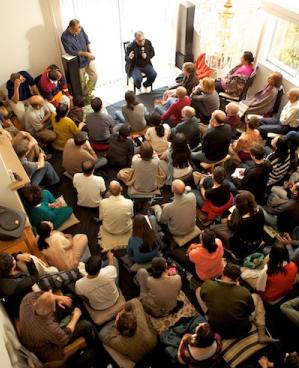
Every Wednesday evening for couple decades, we opened our doors. An hour of silence. A circle of sharing. A meal. No teachers. No curriculum. No learning objectives. No fees. No brand. Just whoever shows up, sitting together in the quiet.
There is no technique for what happens there. And yet people — thousands of them, in a hundred cities — report something they cannot quite name. The deepest learning of their lives, many say. Not a transfer of information. Not an inspiration from a gifted speaker. Something closer to weather changing in a room. The field, teaching.
A couple named Shiv and Deepa started coming sporadically years ago. Shiv was skeptical of meditation. But over time, natural strands of affinity emerged — Deepa loved to sing with my father, and my mother would make kadhee when she knew Shiv was coming. One evening, Shiv shared a poem. He had written it about kadhee. Later, at a retreat, he spontaneously declared: "I'm not the one for prayer, but today I'm going to pray every day that your tribe increases."
Nobody designed this curriculum. Nobody could have. The field drew it out — over years, through small acts, in a rhythm of silence and food and showing up. And when it arrived, it expressed itself as an offering nobody requested: homemade yogurt, hand-delivered every Wednesday, the container exchanged each week like a tiny ritual of reciprocity. For years.
Amazon delivers by drone. Circle gifts are delivered by love.
· · ·
A reasonable reader, at this point, raises the reasonable hand. What's the technique? How do we scale it? What's the impact? How do we know it works?
These are the only questions the thinking mind knows how to ask. They are not wrong. They are the wrong instrument for this ocean.
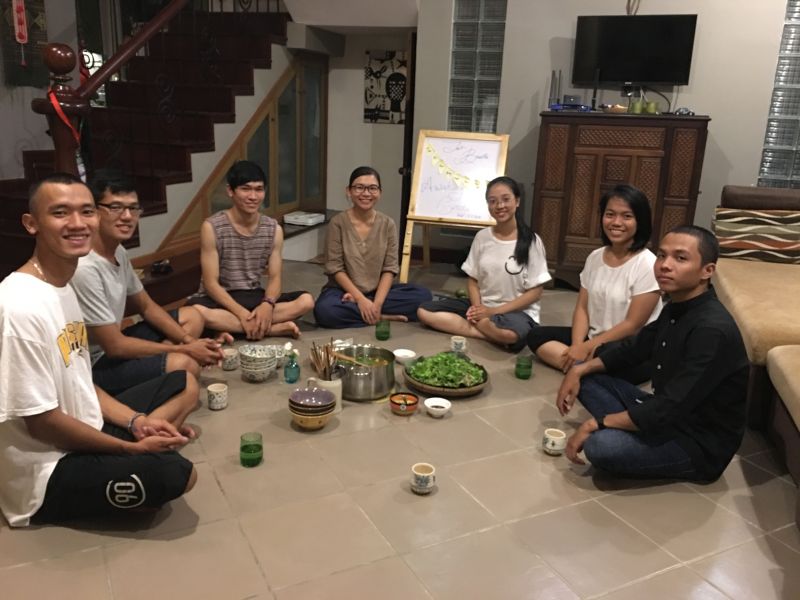 Consider what happens in Vietnam. In cities from Ho Chi Minh to Hoi An, Awakin Circles gather weekly to read a passage on wisdom. ChatGPT could translate the passage in a second. Instead, a group of people spends hours hand-writing the translation. At the gathering, they do not read from a printout or a screen. They pass the hand-written pages around the circle — one sentence per person — then each person asks a question the sentence raised for them. Then the circle goes around again, responding.
Many hands build the scaffolding. Many questions. Many answers. No one wraps the session with a bow tie of conclusion. Everything is a comma.
This is not ChatGPT — which will give you an answer. It is not even a thinking mind — which will help you ask better questions. It is the field that allows the question and the answer to do their dance. The hand-writing is not inefficient. It is the entire point. The slowness is the curriculum.
In Surat, India, eighteen people met as a circle of noble friendship. One man had diabetes. He confessed to a friend: I can never give up sugar. At the next circle, the other seventeen people gave up sugar for a month. Not because a facilitator assigned it. Not because the man asked. Because a field had formed in which his struggle was no longer his alone.
A crowd erases difference. A field metabolizes it.
He gave up sugar too. And then something else happened. And then something else. And then something else.
There is no impact report that captures this. Not because the impact is small, but because it will not stop unfolding. The field keeps working. You cannot draw a box around it and say: this is the outcome. You can only say: the sugar stopped mattering, and then everything else started mattering differently.
A young man arrived at a retreat in Ahmedabad carrying years of loneliness in his body. He did not come to lose weight. He came to volunteer. Months later, he was thirty-eight pounds lighter.
What happened?
"When I first came to Moved by Love, I felt held and loved by a group of strangers. For the first time in my life. Food was my compensation for that deficit. In that retreat, I literally couldn't eat much. I was overfull — overflowing."
And now:
"I can't eat much, and I can't stop loving."
No diet plan produced this. No cognitive-behavioral protocol. What changed was not his diet but the hunger the diet had been compensating for. Once that hunger was fed by other means, the rest followed.
· · ·
Here is the oxymoron at the heart of it: learning awareness is almost a contradiction in terms.
You can learn to think better — technique, practice, repetition, feedback. All the things AI accelerates. But awareness? Krishnamurti's phrase was choiceless awareness, effortless action. You cannot optimize for choicelessness. You cannot engineer effortlessness. You can only create conditions where it is more likely to surface — and then get out of the way.
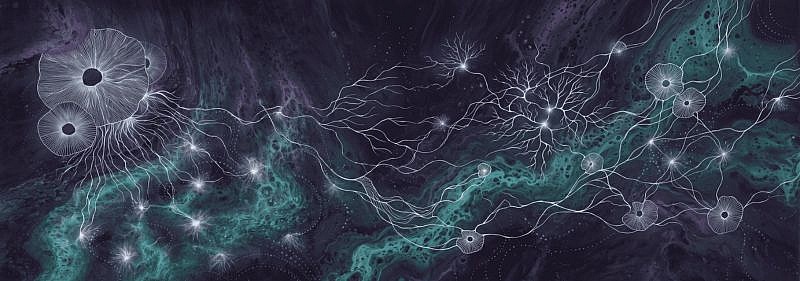
A Japanese farmer named Fukuoka called this "do nothing farming." He used no fertilizers, no pesticides, did not till the soil or weed the fields. He called it doing nothing, by which he meant: tend to the invisible relationships beneath the surface, and nature takes care of the harvest. A Vietnamese farmer in our ecosystem, Hang Mai, distilled the principle further: in the richest soil on earth — found only in virgin forest — just 5% is organic matter. That 5% changes everything. You don't engineer the 95%. You tend the 5%, and nature handles the rest.
Cultivate cultivation. That is the whole teaching. The attempt to extract a replicable technique from what happens in a circle is the thinking mind trying to capture what only awareness can hold. Every time you reach for the technique, the thing itself slips away. Like trying to hold running water in a clenched fist.
In a circle, one person's silence deepens another's. In a pod, someone's honest reflection gives permission for yours. Nobody is "teaching" awareness. The field is holding conditions where what was always already the case becomes noticeable.
· · ·
My mother has been cooking for these Wednesday circles for twenty-seven years. Fifty thousand meals, give or take, served to friends and strangers in our living room.
 One night, home alone, she heard a thumping sound outside. Her first thought was danger. Every instinct said: lock the door, call someone, think your way through this. But twenty-seven years of sitting in silence, feeding strangers, and holding space for whoever walks through your door had built something in her that is not a skill, exactly. It is a capacity.
In that moment of fear, she stopped reaching for thinking — and fell into awareness.
She opened the door. Walked outside. Found three kids throwing oranges at the house.
They started running. But her intent was not to stop them. She had seen thousands of people enter her home and embraced them. Now she saw three eleven-year-olds and she called out: "Hey kids — I feed a lot of people. Can I have those oranges?"
No curriculum in the world teaches that response. No amount of cognitive training produces it. The field produced it. Twenty-seven years of Wednesdays produced it. And it is precisely the kind of intelligence — simultaneously funny, disarming, generous, and brave — that awareness generates when it meets the world without obstruction.
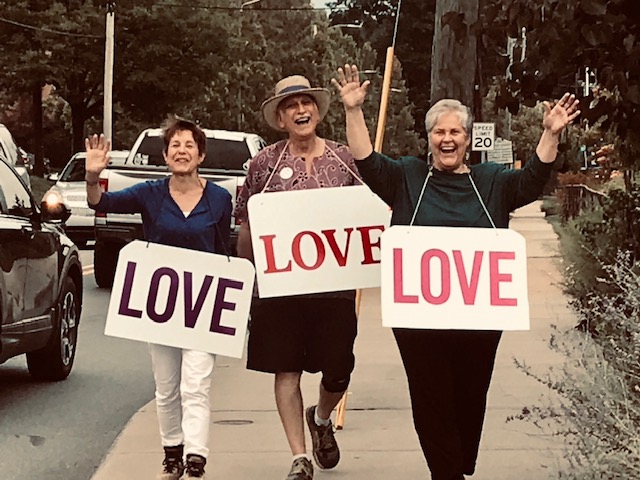 In North Carolina, a woman named Ruth Pittard has spent the past eight years sitting in the town square every Wednesday with a sign around her neck that reads: Love. Rain or shine. She missed one Wednesday, when she was in surgery. She lives in a 600-square-foot home — "more than I need," she says. As a teenager on a farm, she was dropped onto a haystack facing upward at the cosmos, and something arrived in her that has been radiating outward ever since.
When her daughter faced a difficult season, Ruth's prescription was not a book, not a therapist, not a protocol. Join a pod. She could not say why. She simply trusted the field.
Her daughter joined. What was needed, happened.
This is what a fully-cultivated awareness capacity looks like in a single human life. Not a credential. Not a technique. A radiance. A Wednesday held for eight years. A sign that reads Love in a town square where most people are busy reaching for their other superpower.
· · ·

At a Gandhi 3.0 retreat in India, a tech luminary spent two days struggling with a children's story he had started on the plane — a tale of a gardener and a builder finding friendship over tea.
"A key for a tree sounds good to me. But what if first, we sit and have tea?"
He could not have written it at his office. The toil was the learning, but it was toil catalyzed by a field, not a syllabus.
Later that evening, a volunteer scouring for blankets in the cold said: "In the process of providing warmth, I realized I didn't feel cold anymore."
Student and teacher dissolving into simultaneity. Learning one form of intelligence while offering another, in the same moment.
· · ·
The celebrated vision is AI collapsing coordination costs toward a single person — solo founders running companies with fleets of agents. Everyone framing this as liberation.
But there is another direction. Not fewer people. More fields.
The bottleneck for the kind of learning that happens in circles was always the spaceholder — the person skilled enough to tend the 5% so nature can do the 95%. This was impossibly labor-intensive. Below the ROI threshold. Too relationship-dependent, too unscalable by every measure that markets recognize.
AI does not replace the spaceholder. It cannot. Presence is the one thing that cannot be delegated. But it can lower the cost of finding the five strangers who were always meant to sit together — and lower it enough that the circles can multiply faster than the attention economy erodes us.
This is not hypothetical. Several containers are being built along exactly these lines. A Metta Circle where AI senses what someone is holding — a grief they cannot name, a question that keeps returning at 3 AM — and matches them to four or five others holding something similar, then gets out of the way while humans hold three weekly conversations. A Story Booth where one turning-point conversation is held in silence — storyteller, seasoned listener, circle of witnesses — until what wants to emerge finds its voice. A Theatre where films stop being content to consume and become gathering points for community: viewers RSVP, reflect, watch together in a shared window, then sit in a circle with the filmmaker, not to Q-and-A but to witness what stirred.
The tech companies built the metaverse. We are building the mettaverse.
This is AI doing what was previously below the ROI threshold — not automating what we already did, but enabling what we would never attempt.
· · ·
Meanwhile, the dominant culture moves the other direction. Algorithms becoming our moral mirrors. Credit scores define financial virtue. Fitness apps define health. Baby monitors define responsible parenting. "If something happened and I didn't have it on," one mother confided about her infant's breathing monitor, "I don't know how I could live with myself." The monitor had become less a tool than a test.
Metrics translating into moral judgments. Numbers telling us how we are doing. The question Am I living well? replaced by What does my dashboard say?
You cannot put a completion metric on what happened in a circle when Shiv wrote his poem about kadhee. You cannot score the moment a woman opens her door to three kids with oranges. You cannot dashboard the field that drew a children's story from a man who came prepared to give a tech talk. You cannot graph the thirty-eight pounds that fell off a young man who was no longer starving.
The learning that transforms us — not the learning that informs us — resists measurement by its very nature. Which is why market logic can never produce it. Only extract from it.
· · ·

If AI carries the cognitive load — and it will, increasingly — it frees something. Not just time. Capacity. The capacity to invest in the superpower we have been neglecting for decades. The one that was already weakened before AI arrived. The one that no machine participates in, because machines do not sit in silence, do not cook for strangers, do not open the door at night.
But only if we build the containers. And harmonize with ones already forming around us. Only if we tend the fields where awareness grows by osmosis — in living rooms, in retreat halls, in town squares held for eight years with a sign that reads Love.
A populace that develops both superpowers in balance — thinking sharp enough for discernment, awareness deep enough for wisdom — would naturally arrive at what Schumacher called appropriate technology. Right-sized. Right-placed. The question of AI governance answers itself differently when the people asking it are awake.
The inner transformation produces the outer wisdom. That has always been the path — long before any machine existed. What is new is not the possibility but the scale. AI, for the first time, can lower the cost of building the containers where this transformation happens — not by replacing what occurs inside them, but by making it possible to create far more of them than any generation before us could attempt.
· · ·
The mantis shrimp sees sixteen colors in the same water where we see three. There is no argument between them. Both are true. Both are partial. And the ocean does not care which Umwelt you inhabit — it holds all of them, the way awareness holds all weather without being disturbed by any of it.
In a circle, every person is a different Umwelt. Every form of intelligence — visible and invisible — is present. The grandmother's patience. The teenager's unnamed question. The monk's stillness. The translator's quiet devotion.
No single mind holds the whole. But the field does.
The field always did. We were simply too busy thinking to notice.

Share a Reflection
Your thoughts will be shared with the author