[Sharing this collectively written post, on behalf of the larger pod volunteer team. --Marilyn]
664 strangers. Seven days. 2,397 reflections.
And something no one designed.
Every creature inhabits its own sensory universe — what biologists call an Umwelt. The mantis shrimp sees sixteen primary colors where we see three. The bat navigates by sound-shape. The whale sings across ocean basins in frequencies we cannot hear. Each Umwelt is complete. Each is coherent. And each is invisible to every other.
Now consider a room full of humans. A grandmother who has buried a child. An aerospace engineer questioning his life's work. A six-year-old in India learning that honesty and kindness are not opposites. A woman in Malaysia sitting in her parked car at dusk, deciding to stop hating someone. A retired teacher in Minnesota writing a poem about her breakfast cereal while ICE agents patrol her neighborhood.
How many forms of intelligence in that room? How many ways of knowing, layered and invisible to one another, waiting to be called forth?
No curriculum could design it. It can only be allowed.
This is the story of a week in which it was allowed. And an invitation to understand what made it possible — because the conditions can be built.
· · ·
From the outside, a pod looks ordinary — like just another self-improvement offering in a digital age overflowing with them. You read something each day. You do a short practice. You write a reflection. Others read it. Someone, somewhere, notices something in what you wrote and reflects it back.
But it is not a course you complete. It's a space you enter. No teachers, no students — only peers. Some come burned out. Some come curious. Some come skeptical. Some come because a friend insisted. No one quite knows what they're stepping into. The whole thing is offered freely — no fee, no credential, no brand. And behind the scenes, a volunteer crew holds the space. They don't teach. They don't lead. They simply notice, respond, and tend the conditions for something to emerge.
What makes it unusual is not any single element. It's what happens when the elements converge — when the stories of people's deepest struggles, aspirations, and turning points are brought together in a concentrated way. Individually, these stories are moving. But when they converge in a field held with care, something else arises — a collective intelligence where the whole is far greater than the sum of its parts. Synchronicities happen. Unexpected transformations arise naturally.
This particular pod — Born to Flourish — ran for seven days in April 2026, drawing on decades of neuroscience research. Over a thousand people applied. 664 were profiled — each responding to a handful of questions that tell you more about a person's humanity than all of their scraped web data combined — and joined from fifty-four countries. What happened between them is the subject of what follows.
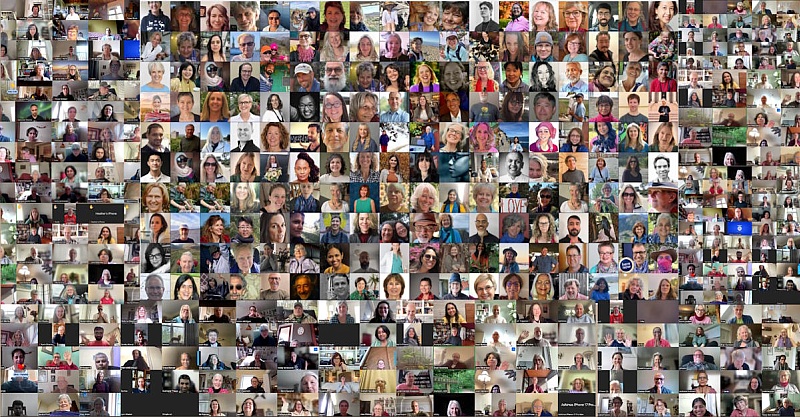
664 podmates from 54 countries
· · ·
Part One
The Science: What the Research Actually Shows
The pod's curriculum drew on the work of neuroscientist Richie Davidson and contemplative scientist Cortland Dahl at the Center for Healthy Minds, University of Wisconsin–Madison. Their claims sound soft until you see the data. They are not soft.
We arrive wired for kindness. Infants between six and twelve months — long before language or socialization — were shown characters displaying helping and hindering behavior. One hundred percent preferred the helper. When we practice compassion, we are not installing new software. We are recognizing what was already there. The analogy is language: every child is born with the capacity, but it needs a community to be expressed. Kindness works the same way.
Flourishing is trainable — and the dose is smaller than you think. Across studies with college students, schoolteachers, healthcare workers, and first responders, five minutes of daily practice over four weeks produced robust changes in both wellbeing and brain function. Teachers who received the training were six times more likely to still be in the classroom three years later.
Flourishing is contagious — and we now know how. In Louisville, Kentucky, Richie's team offered five minutes of daily wellbeing practice to public school teachers and staff. The teachers' wellbeing improved. But the kicker: standardized math and reading scores rose significantly among their students — students who had no idea any research was happening. They were simply being taught by people who were more present. The flourishing traveled. Not through instruction. Through resonance.
The mechanism turns out to be specific. Think of the last time you lost your composure — snapped at someone, spiraled into worry. How long did it take to come back? That recovery speed is measurable in seconds, and it predicts how much negative emotion you carry through your day. Recovery speed responds to practice quickly. But here is the part that changes the scale: people in conversation unconsciously entrain to each other's nervous system rhythms — calibrating not just to each other's moods but to each other's regulatory capacity. When you come back from a difficult moment more quickly, the people around you tend to come back more quickly too. What spreads isn't how calm you are at your best. It's how quickly you return when things go wrong.
The proof at its most striking: a teacher in a low-income Israeli school began practicing these skills on her own. She didn't teach the students mindfulness. She didn't change the curriculum. She simply became a different person to be around. Over five years, her students' emotional regulation improved. Other teachers started changing. The culture of the entire school shifted — from one person's quiet daily practice rippling outward through ordinary interactions.
One teacher. Five years. No curriculum change. Just recovery speed, traveling.
Community is the deciding factor. On the closing call, Cort Dahl — a self-described semi-functional introvert — spoke about the many years he spent living among Tibetan meditation masters in Kathmandu, and how each time he returned to the U.S., his inspiration dropped off a cliff. Over time, going back and forth, he started seeing the pattern: "So many things were reflecting back to me over there. When I was home, I had very little of that." His conclusion, after years of watching people begin to meditate: when people make even one friend whose life somehow touches their practice, they keep doing it. When they don't, the days tend to be numbered. "Ninety-five percent of it is creating the circumstances," he said. "Architecting the web of support. Then the thing — awakening, or whatever it is — becomes almost easy and spontaneous. But if you don't do that, at best it's a slog."
We are not designed to sustain meaningful change in isolation. Willpower is not nothing. It's just not the foundation. The conditions around you are the foundation. And conditions can be built.
The reframe that makes it land. Cort draws a distinction between two approaches to inner work. The causal approach assumes something is broken and sets about fixing it. The fruition approach starts from the possibility that nothing was ever broken — that awareness, connection, insight, and purpose are already here, just unrecognized. "It's so close, we don't see it. It's so easy, we don't believe it." The pod took the second path. Not self-improvement. Self-discovery.
These four pillars — awareness, connection, insight, purpose — formed the spine of seven days. But a curriculum is not a field. Content is only one form of intelligence. And delivering content is not what makes the weather in the room change.
· · ·
Part Two
The Architecture: What the 5% Looks Like
In the richest soil on earth — found only in virgin forest — just five percent is organic matter. That five percent changes everything. You don't engineer the other ninety-five percent. You tend the five, and nature handles the rest.
A pod is not a course. It is a field — a living system designed for flourishing, not extraction. And the design begins with a question most platforms never ask.
Most platforms start with: How do we monetize? Every design decision flows downstream from that question — how to show ads, sell data, capture attention, convert users into revenue.
The pod began with a different one: How do we design so that each person can tune into their highest potential — and walk toward it?
That question — held for over twenty-five years across the ServiceSpace ecosystem, which has been volunteer-run since 1999 with no advertising or fundraising — produced three forms of wealth that converged in this single container.
Wisdom offered as gift. Over five decades of research by Richie and his colleagues, distilled into a freely offered curriculum. But deeper than content delivery: each module asked questions designed to expand our view on life itself. Richie's research shows that an expansion in perspective alone — even without being complemented with formal meditation — can significantly enhance flourishing. Each day's reading was built to produce exactly that: not information, but reorientation.
Technology built for depth, not extraction. Where typical platforms optimize for time-on-screen and engagement metrics, the pod platform optimizes for depth of inquiry and genuine connection. Comments are structured for noticing goodness, not performing opinion. Highlights surface what resonates, not what provokes. While the internet is full of quotes from revolutionary leaders, the pod infrastructure makes it easy to create and share quote cards from the lived wisdom of ordinary people's posts. One participant was so moved by a card carrying her own words back to her — she framed it on her wall, and then showed up to volunteer for this pod. The infrastructure keeps evolving mid-pod — because the builders aren't interested in cost-benefit analysis to create pricing tiers. They are simply looking for ways to give away the best of what they can.
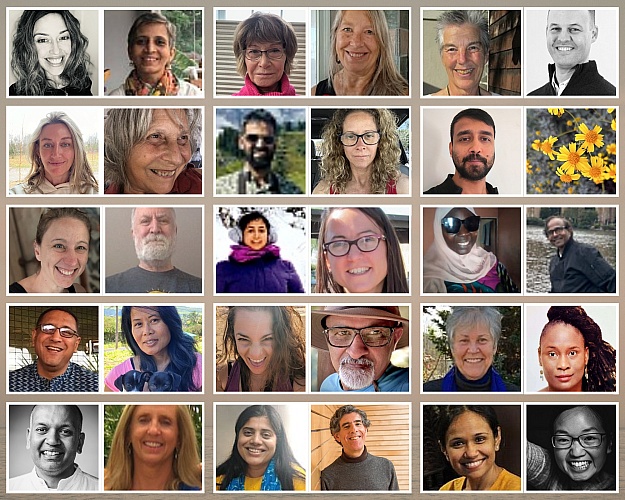
Community as parallel practice. Three hundred people expressed interest in volunteering. Forty-one joined a crew and delivered over a thousand hours across the week — silently, invisibly, without pay or credit. But simply think of it as free labor and you miss the point. They are practitioners. What they are practicing is the same thing the pod teaches: awareness, connection, presence. It's a labor of love. Not free, but priceless.
Here is what the tending actually looked like, in real time, across seven days:
Weavers read every single post — all 1,835 of them — and left comments designed not to evaluate but to notice goodness. Participants said they'd never received such a comment online: someone seeing the best in them, without agenda. Volunteers nominated reflections they found powerful; editors sifted through those nominations to select the ones to feature and amplify. In a separate pipeline, pod members highlighted striking quotes within reflections, quote shortlisters curated those highlights, and graphics volunteers turned the shortlisted quotes into sixty hand-crafted quote cards. An emailer sent 123 personal inbox replies — not automated, not templated, each one a quiet bridge. A content manager left 126 comments, offered 365 hearts, and surfaced 82 highlights. One person. Reading everything. Tending everything.
In total: reflections received roughly 2,400 hearts and 1,300 comments from fellow podmates and volunteers. 150 volunteer reflections were posted alongside. Eighty-nine percent of the volunteer team active on any given day.
These aren't KPIs. They are love made legible.
Peacebuilder John Paul Lederach, who has worked in conflict zones from Colombia to Nepal, noticed that transformation never came from sheer numbers. It came from a small group — thoroughly mixed in, with the capacity to make everything around them rise. Like yeast in dough. Yeast is the smallest ingredient. It cannot rise on its own. But once mixed in, everything else rises.
That is what forty-one volunteers were doing in this pod. That is the five percent.
· · ·
Part Three
The Quiet Regeneration: What the Field Produced
When you align rigorous wisdom with invisible labor and a technology designed for human depth — when you tend the five percent with that kind of care — something happens that no one designed and no one controls.
The weather in the room changes.
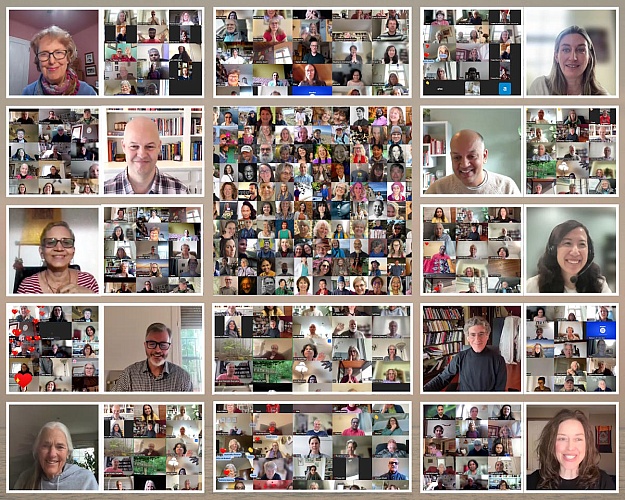
What follows is a handful of voices from a chorus of nearly five hundred — chosen not because they are the most impressive, but because they illustrate how the four pillars come alive when they stop being concepts and start being lived. Many of these people have been practitioners for years. What the pod did was create the conditions in which their deepest stories surfaced, found language, and landed in the bodies of strangers who recognized themselves in them. For every story here, dozens more are woven through the pod's feed — each one carrying its own frequency. These are just the ones we have space to share.
· · ·
Cheryl, in Malaysia, arrived carrying a fresh wound — a job offer withdrawn. Her instinct was to cancel everything. How could I possibly show up, weak and broken inside?
She showed up anyway. A friend said: What makes you think you need to be strong and happy when we see each other? You don't have to justify your existence. Like a tree doesn't need to justify its existence.
Day 3, she noticed herself "consumed by rage." Her default would have been to analyze it, redirect it, fix it. Instead, she tried what the awareness module had suggested. She sat with it. "My offering was: I'm going to sit with you while you spew your toxicity. Take your time." That evening, her youngest threw a tantrum. This time she didn't deflect or diffuse. She stayed.
Then Day 4 arrived — the module on connection — and the research on the difference between empathy and compassion gave Cheryl new language for something she had already lived. Years earlier, she'd had a coworker she deeply disliked — a leader so toxic her subordinates left one by one. Cheryl had been bringing this woman's poison home nightly until her husband said: Enough. It is seeping into you and into this household. And in her parked car one evening, Cheryl had made an inner shift: Hurt people hurt people. She must have been so wounded. The behavior didn't change. But the charge dissolved.
Reflecting on it in the pod, she saw the pattern more clearly — and noticed where it had traveled. "Shifting from feeling with to feeling for has changed my relationship with my mother. Learning to care for her without carrying her pain has actually strengthened our connection."
On the closing call, Cheryl put it simply: "This pod was an invitation for me to encounter life differently. It led me back to myself. And I was able to see myself perhaps with more — rooted in reality — that I'm someone with dignity, beauty, and love."
· · ·
Steph arrived remembering a teacher from thirty years ago — a man she didn't even like — who caught her fighting tears in a hallway and said: Stephanie, you're going to be okay, no matter what you do. I know this about you. Then she wrote something that rippled through the pod for days:
There is kindness in the thirst of my body, reminding me to drink water. There is kindness in the warmth of the sun on my skin. Kindness is how we recognize each other.
By Day 2, she was noticing something harder: the way self-improvement becomes its own trap. "It doesn't always feel like being hard on myself. I tell myself it's improvement. Good taste." The module's reframe — not self-improvement but self-discovery — cracked something open. And the crack widened through comments from podmates who could feel the resonance in their own bodies.
By Day 5, she was writing about her identity as wildly changeable — shy girl to public speaker, people-pleaser to disruptor, anxious American to globe-trotting immigrant. "I didn't try to make these things change; I just saw that they could." But then she hit something more stubborn: her body's relationship to touch. The way it stiffened before conscious thought arrived. She wasn't sure she wanted this story to change. And she held that uncertainty with a steadiness that the week's practice had made more available.
On Day 6, reading about a secret society of grandmothers who delivered pound cakes and cash to strangers for thirty years, she cried — then caught herself: "I noticed that I already do. Because life gives me ways to serve that are also the things I love to do."
From kindness is how we recognize each other to I am already the thing I was longing to become. Nobody taught her that. The field held the conditions in which she could see it.
· · ·
In Argentina, Patricio was living the paradox no one warns you about: a life that looks perfect from the outside while no one is home on the inside. A negotiation consultant, teaching over 200 days a year. One day at an airport, people smiled at him in the check-in line. He recognized their faces but couldn't place them. After chatting, he confessed. They stared: Patricio, we were with you all day yesterday and the day before that.
"I realized I could be successful, effective, appreciated by others — and still not be present in my own life."
He'd been a Buddhist practitioner for over twenty years. That was the moment it stopped being practice and started being the point. On the closing call, he spoke about it with his anxiety companion — Chuck, the "beefy bodyguard" — visibly sitting beside him. "Chuck thought this wasn't a good idea," Patricio said, grinning. "But I told him: we received so much this week. How is it that we can't share a little bit?"
· · ·
Ray, a former aerospace engineer in Michigan, noticed on Day 2 that his entire career had trained him to scan for what's wrong — and that the lens had quietly shaped his inner life too. By Day 3, instead of trying to fix his students' distraction with policies and restrictions, he decided to offer them something simpler: "Pause for a moment. Put both feet on the ground. Notice your breath for ten seconds. Then ask yourself: where is my attention right now? No right answer. Just noticing."
Then on Day 6, the module on purpose brought something unexpected to the surface. He'd once sat in NASA's main conference room in Washington, D.C., hearing the plans for the Artemis mission — detailed, complex, exactly the work his career had prepared him for. One of his earliest memories was watching Neil Armstrong step onto the moon. This was supposed to be that moment. "But as I listened, something felt off. Beneath the accomplishment, there was a quiet question: Who are we doing this for, really?"
Later, alone in his Michigan backyard at 3am, watching a lunar eclipse from a recliner, he found something he hadn't found at NASA. "There was nothing to accomplish. Just witnessing." The same person. A different Umwelt.
· · ·
Connie, a retired teacher, wrote quietly all week. Day 1: a friend bringing egg salad sandwiches during her darkest season. Day 3: a joyful inventory of sounds she'd never noticed while eating lunch — "the crinkle of a chip bag, glass on glass, a clicking from my jaw on the left side. I never realized lunch was such a cacophony!" Day 4: a poem about her breakfast bowl, tracing the hands of immigrant workers who picked the fruit, while ICE agents swept her state.
Then Day 5 asked about moments of insight that rearranged your world. And Connie told a story she'd been carrying for decades.
She had, in her words, "blown my world up." Her actions had hurt others and become a public story. She was a high school English teacher, and one afternoon she stood facing the blackboard, unable to go on. I can't do this anymore. I need to go home, now.
As students filed in, a boy named Ryan approached her. "Mrs. ___, I'm going out to use the bathroom, but I'll be right back." He handed her a piece of paper and left. On it, in large letters, was the Calvin Coolidge quote about persistence and determination. She went to him when he returned. "Why did you give this to me?" He said: "I don't know; I just thought it was neat."
She didn't go home. She didn't quit. "I came back the next day, and the next, and the next."
That post was noticed by the volunteer crew reading the pod's daily reflections. Connie was invited to share her story on the closing call — before Richie and Cort and five hundred people. She was nervous, but she said yes. Standing before the room with the same piece of paper she'd kept for thirty-two years, she finished her story with four words: "I flourished. I absolutely flourished." Then she offered something to anyone in the room who might be facing their own blackboard moment: "Don't give up five minutes before the miracle happens."
One woman. One reflection. One crew member who recognized its frequency. A story that started at a blackboard and ended in a field she'd been building all week without knowing it.
· · ·
Mary's story was brief and staggering. She witnessed a woman named Lesleigh receive a twenty-five-year prison sentence. In that moment, Mary spontaneously resolved to do that time with her. Twenty-five years of visits, calls, letters, appeals — maintained through Mary's own moves across three states. Lesleigh was released in December 2025. "It was a deeply transformative experience for both of us, and for our families, and still is."
No grand framework. Just a quarter century of unwavering presence.
· · ·
Ruth's reflection went back nearly seven decades — to a classroom where a new girl named Inna arrived: visibly poor, unwashed, unable to speak. When a boy wore a gas mask to class as a joke at Inna's expense, the teacher said nothing. When Inna was found to have head lice, the teacher yanked her to the bathroom and scrubbed her hair with visible disgust. No one volunteered to help. Ruth raised her hand. "I just HAD TO." She walked over and took Inna's hand. "I remember a certain, compelling connection, an acknowledgment of kinship as our hands met. I knew — body, mind, and spirit — that personal connection had to happen, and it could come through me."
Inna never returned to school. But that moment became the baseline for Ruth's entire life.
· · ·
And scattered through the days, dozens more:
"Something in me just opened up. It feels like coming home. That full circle feeling is like a long, slow exhale. Ahhh. I am home."
"I am very private. I am uncomfortable talking and sharing with people I don't know. Yet here I am."
"This pod isn't a 'blueprint' for a better me; it is the 'empty cans' that allow my innate coherence to find its own rhythm again."
"To offer something of immense value freely is shocking and extraordinarily unusual in our world. In itself it is an act of such goodness that it inspires a wish to cultivate such generosity in my own life."
"I wish everyone in the world was in this pod and could hear these messages of hope about human goodness."
· · ·
Part Four
From Crowd to Field
We have two superpowers. Thinking built civilizations, split the atom, wrote symphonies. Awareness holds what thinking cannot — the way the sky holds weather without being disturbed by it.
The attention economy has been eroding awareness for decades. AI now threatens even thinking through what researchers call cognitive surrender — adopting the machine's judgment as your own. A writer struggling through draft after draft is doing the thinking in the struggling. When AI drafts the essay, the toil that would have deepened understanding never occurs.
A species heading toward neither superpower fully embodied — scrolling without seeing, outsourcing without understanding.
But there is a third kind of intelligence — one that lives not in any single mind but in what Cort calls the web of support. In the field that forms when people attend to each other with enough honesty and care that the weather in the room changes. Awareness may begin as a private capacity, but it is also what allows one person to register another. Thinking makes us intelligent as individuals. Awareness makes us intelligent together. And when a field holds the conditions for both — that is when the third intelligence comes alive.
A crowd erases difference. A field metabolizes it.
This pod was a field. The curriculum planted seeds. The technology was the mycelial soil. The volunteers were the yeast. And then nature did what nature does when the conditions are right: it produced a quiet regeneration that nobody scripted and nobody owns.
Every moment of practice this week — every time someone noticed their mind wandering and returned, every time someone paused before reacting, every time someone held a story at arm's length — was training their recovery. And that recovery has a reach that is hard to fully trace — especially in the rush to extract or scale fast. The Israeli teacher didn't know her students' emotional regulation was changing. Cheryl didn't know that a shift in a parked car years ago would reach her mother. The volunteers reading posts at midnight couldn't see exactly how their coherence would ignite the field — but they knew it all adds up, in the subtlest of ways.
You cannot put a completion metric on what happened when Cheryl stopped carrying her coworker's toxicity. You cannot dashboard the thirty years Steph carried a teacher's hallway words before discovering she was already what she longed to become. You cannot graph the twenty-five years Mary showed up for a woman in prison, or the seven decades Ruth carried the feeling of Inez's hand in hers.
But you can tend the five percent. You can ask a different question than how do we monetize. You can build technology for human depth instead of flattening it by optimizing everything. You can offer your teachings not as content to broadcast, but as seeds for building shared context — heart to heart.
And then let the field do the rest.
On the closing call, Richie Davidson, the neuroscientist whose life's work made the curriculum possible, listened to the stories — Cheryl's parked car, Patricio's airport, Connie holding up Ryan's thirty-two-year-old piece of paper — and said four words: "My heart is just cracked open."
And then came the final move — the one that separates a field from a club. Instead of centralizing the value at the center, the call closed with a Tibetan dedication of merit: May this goodness spread. Not accumulate. Not scale. Spread. Within us, between us, and beyond us. The vision is not to build fields because they feel good — it is to build fields so that their goodness keeps rippling in every direction. As the old ServiceSpace saying goes: the reward for service is more service. Not a circle of we. A möbius — a force for compassion in the world, with no inside or outside.
664 strangers. Seven days. 2,397 written acts of honesty. And the ancient, ordinary, world-rearranging discovery that what we were looking for was never missing. Only unnoticed.
The field always held it. Perhaps we were simply too busy thinking to see.

Share a Reflection
Your thoughts will be shared with the author