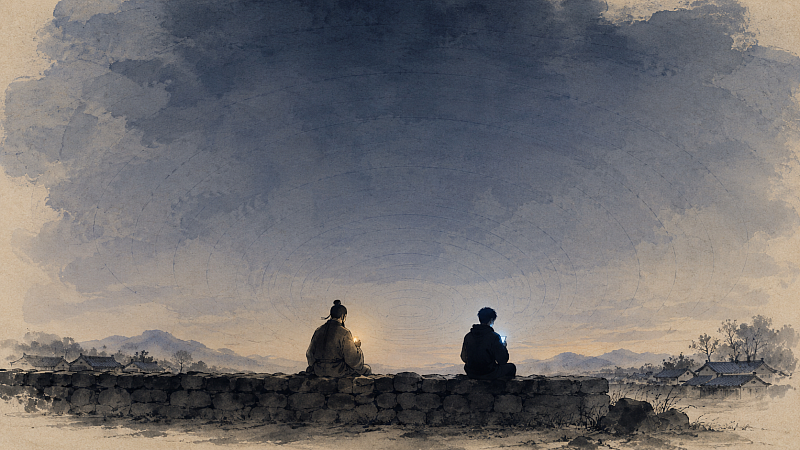
There is a low wall in a village in India where, for as long as anyone can remember, the men have gathered in the evenings. A generation ago they came with hand-rolled beedis and sat in the failing light and talked slowly, the way people talk when there is nowhere the conversation needs to get to. The news they traded was the news of a small world: whose well had run dry, whose daughter was to be married, which field was waiting on rain. Their radius was the radius of a walk, and what they knew, they knew with their whole bodies, because they had stood in it.
Their grandsons sit at the same wall now — same dusk, same crumbling stone warm against their backs. But they are looking down into their phones, tracking a hailstorm ten kilometers off, then five, wondering aloud whether it will swing their way. It doesn't. Their radius has grown enormous and gone strangely thin: they can see the storm coming, but they can no longer quite feel the evening.
This is a small parable of the last hundred years. And it may be a parable of the next ten.
· · ·
When Nehru sat down to write the story of India, he noticed something that still has teeth. Fewer than five in a hundred Indians spoke English, and nearly all the newspapers were printed in it, so the knowing of the country — its sense of itself and of the world — lived in one small lit room while the rest of the house stood dark. The information was real. It simply wasn't shared.
What broke that enclosure was not a better newspaper. It was people walking, village to village, foot to dust, carrying word and gathering it, until a whole subcontinent began to understand its own situation. Knowledge can travel two ways. It can be broadcast from a tower to whoever owns a receiver, or it can be walked, from one person to the next, at the speed of trust. The first is fast, wide, and thin; the second is slow, narrow, and deep. They are not the same substance, and they do not do the same thing to a people.
· · ·
The new English is artificial intelligence, and the arithmetic of the lit room has returned. Roughly one in six people on earth has touched these tools at all; the number who use them the way a carpenter uses a plane — daily, fluently, to make things they could not make without it — is far smaller, and clustered, predictably, among those who already had the most of everything else. The gap is not closing the way the optimists promised. It is widening, and the receivers are being handed out fastest to the people who already owned three.
To their great credit, some of the most public-spirited systems thinkers in this conversation have begun to ask a better question. Not only What should we fear this will do to us? but What do we actually hope it will do for us? Their answer is a good one — maybe the best the mainstream has produced. A commons. Pool the computing power so a public university can afford what a bank can. Build shared databases from which cures can be read, the way one quietly built library of protein shapes, decades in the making, became the ground a Nobel Prize grew from. Point this strange intelligence at diseases too rare to be profitable, problems no quarter's earnings depend on. Make AI serve the public good. It is a generous vision, and it reaches, by instinct, for exactly the right word: a commons.
And yet I find I want to walk around behind it, the way we sometimes circle a house to see what it stands on. Because the question is not only whether AI can be made into a commons. It is whether we still have enough common life left to keep anything common at all.
· · ·
The divide that matters most is no longer running where the old one ran. The old divide was simple and cruel — the lit room and the dark house, the literate and the rest — and on that map, we all wanted, plainly, to be inside. But a second divide is opening underneath the first, and it runs the other way.
On this map, the people furthest ahead may be the ones quietly losing the most. Their attention has been leased out by the hour to whoever bids highest for it. Their intimacy has been sublet to machines that are endlessly available and ask nothing back — a bond with the risk taken out, and the risk was always the point. Each now reads, in effect, a different newspaper: a feed assembled for an audience of one, so finely tailored that no two people stand on the same page.
Once, the trouble was that everyone read the same narrow paper. Now, no one does. We optimized our way clean out of a shared world.
Meanwhile, at the wall, in the kitchen, in the rooms where people still gather with no agenda, something is being kept that the receivers cannot pick up. I don't want to romanticize the grandmother — she would not trade the storm app's certainty for her uncertainty, she is not made wise by what she lacks, and I am not certain I've kept myself from romanticizing her even so. But she has not yet outsourced the evening. She is still in her body, in her village, in the slow exchange that asks something of her, rich in the one currency that has suddenly grown scarce.
Call the first kind of knowing big — the conscious, capturable, broadcastable stuff the machines now handle better than we do. Call the second kind deep — the knowing that lives in the body, in attunement, in the charged space between two people who are actually present to each other. Big data is abundant and getting cheaper by the hour; deep data is the scarce thing now. And the sprint to the front of the big-data line may be the very thing that costs us our place in the deep-data one.
· · ·
So why doesn't everyone tend the deeper commons too?
Maybe because the people closest to the fire are too busy not being burned. Inside the rooms where this technology is built, the felt reality is not abundance but survival — a sprint whose finish line keeps moving, run against rivals who have no intention of slowing. Ask the runners about meaning, about purpose, about what any of it is finally for, and what comes back is a tired smile: that is a question for later, for after, for once we've won. And besides, the intelligence will probably sort it out itself.
But meaning does not settle out downstream like silt. If no one asks the question now, it does not get asked, so the asking falls, as it usually does, to the edges — to the people not running, who have the odd luxury of wondering what the running is for.
A commons no one tends doesn't stay a commons for long. England learned it the hard way: the common fields, grazed in shared trust for centuries, were fenced and sold within a few generations, and the word enclosure entered the language with the sound of a gate latching. Leave a shared thing untended and it doesn't wait politely; it becomes merely available, to be claimed, optimized, walled. Build the commons of compute and cures with no one minding the trust beneath it, and we will watch it enclose, parcel by parcel, into the holdings of whoever moves fastest. Best case, the benefit reaches one nation and not the species.
That is not a commons. It is a larger lit room.
· · ·
Still, the generous vision leaves something out. What keeps a commons common was never the grass; it was the trust among the people who grazed there — the unwritten agreement, renewed by presence, that this belongs to all of us and to none of us.
The material commons rests on a spiritual one. Beneath the shared field is a shared heart, and when the heart goes, the fences come.
That trust can't be installed. It can't be funded into being or measured into health; the moment we try to count it, it grows shy and slips out the back. Coherence — the alignment between people that lets one heart register another — is not manufactured but unobstructed. We clear away what is in the way, and it returns on its own, the way a spring returns once we stop trampling the place it wants to rise.
The old teachers had a word for the clearing itself: shunya. Emptiness — not the emptiness of lack, but the emptiness of capacity, the hollow that makes a thing useful. Thirty spokes meet at the hub of a wheel, says the Tao Te Ching, and it is the hole at the center, the nothing, that lets the wheel turn; clay is thrown into the shape of a pot, but it is the empty space inside that holds the water. We are forever admiring the spokes and the clay. The usefulness was always in the emptiness.
This is the order I suspect the vision has backwards. Before the commons, coherence; before coherence, emptiness; before the field, the clearing. We do not grow a field by gripping it — though I'll admit that's an easy thing to say from a quiet room, and I hold it more as a hunch than a proof.
· · ·
So the movement this moment is asking for is not another tower. The towers will build themselves; the market has never needed our help broadcasting what it can sell.
What no one is building — what the market cannot build, because it cannot be sold — is a school for the deeper literacy: a place to relearn coherence, the old walking in a new shape.
Strike one tuning fork and another across the room will sing, but only if it is already tuned to the same note. That is most of what coherence is — one steady heart setting another humming, when the other is tuned to receive it. We already have rooms where this happens: circles that sit together in silence, small groups that read and reflect as one, kitchens where the meal is a gift and the check reads zero. And there could be new kinds of rooms, too, where the machine is not the center but the quiet helper, not the substitute for relationship but the servant of it. AI could help us find one another, reveal hidden gifts, carry the logistical water so the gardeners can keep both hands in the soil — and then, its work done, become as forgettable as the chair we are sitting on.
None of this is hypothetical. I first heard him decades ago, in our living room — Prahlad Tipanya, a village schoolteacher from the Malwa region of central India, born poor and with no family tradition of music, who one day heard a five-stringed tambura and taught himself to sing the couplets of Kabir in the folk meter of his home. At first he simply sang — to the divine, under a tree — to whoever happened to be near. People began walking in from neighboring villages to sit inside the quiet his singing opened: a commons of attention no one had announced and no one owned. Then he began walking too, village to village, the old way, until his voice was known across a country he never set out to reach. He did not build any of it. He cleared a space within himself, sang into it, and a field gathered around the song. The way he tells it, the singing has to come first; the gathering takes care of itself.
· · ·
And the generous vision — the cures, the compute, the public good? It's a beautiful vision, but it needs roots. For twenty-five years, the ServiceSpace experiments have been quietly testing this same inversion, on a scale almost no one suspects. We are known, if we are known at all, for the visible things: pay-it-forward meals, circles in living rooms, retreats for the slow work of cultivation. Almost no one knows the machinery underneath — millions of lines of code, written long before the current boom, that let strangers micro-volunteer before there was Wikipedia; infrastructure that has sent two emails a second for decades and never once carried an ad or asked for anything; millions arriving each month to find nothing sold to them, no funnel narrowing toward a purchase, no attention quietly leased away. The machine was there the whole time, and almost no one felt it. That was the point. Build the tool, then let it disappear; gather people, then let the room become the technology; trust the field before scaling the form.
What we keep finding is that when the shared heart is tended first, the shared field can bloom. Trust is not the soft afterthought. It is the hard precondition.
If even a few communities can demonstrate this, not as theory but as living proof, then the universities may look, and the governments may look, and one day even the runners by the fire may look up. Institutions follow proofs the way water follows the lowest path. We don't argue them into it; we show, in some unglamorous corner, that the thing grows. And then we get out of the way.
· · ·
There is a phenomenon in old forests called a mast year. Every so often — at an interval no one can predict and no authority declares — the oaks across an entire region fruit all at once, burying the ground in acorns, far more than any squirrel could eat. No tree sends the memo; there is no conductor. And yet they synchronize: a whole forest deciding together, through signals we still do not fully understand, to be lavishly, wastefully abundant in the very same season.
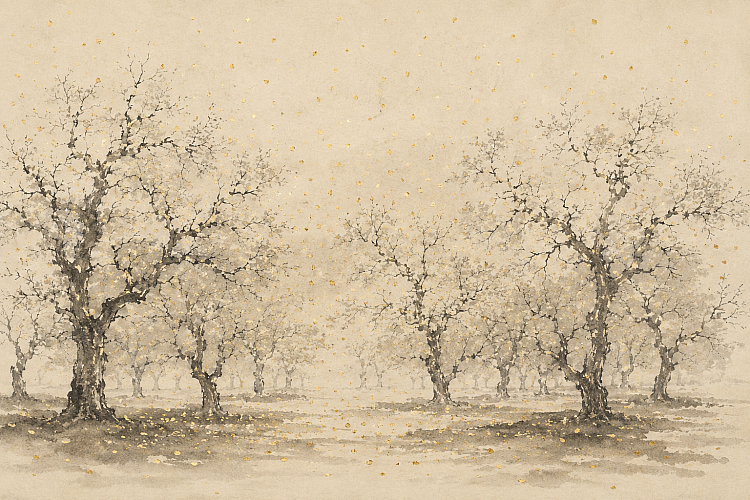
That is what a commons looks like from underneath. Not a system but a synchrony, an abundance no one planned and no one owns. We will not engineer it; we can only tend the conditions and trust the forest. Most of us plant in years whose harvest we will never see, not because we have calculated the yield but because planting is simply what we have become.
The runners by the fire would call this foolish — seeds, now, with the sky already full of smoke? — but the seed does not consult the timeline. It only asks for ground.
The radius of human knowing has, for a hundred years, done nothing but widen and thin: the walk giving way to the wire, the wire to the glowing screen, the screen now to the intelligence behind it, each step reaching farther and touching less.
And here is a movement that runs the other way — not wider but deeper, not faster but truer.
Back at the wall, the grandsons are still looking down. But it is evening, and the light is doing what the light does, and any one of them could look up. The storm never came; the field still wants rain. And the oldest knowledge in the world is waiting where it has always waited — not on the tower, not in the feed, but in the person sitting near enough to touch, at the speed of a walk, in the patient dark.
A note on the work beneath this essay. The why is above; the how has been underway for twenty-five years. ServiceSpace is a long experiment in what emerges when you assume people want to give. Beneath it runs a quieter practice — building technology to be the beam rather than the tower: infrastructure that gathers people, then steps out of the room. Shunya Labs is where that practice is being offered to others now — not a louder signal, but an emptier carrier.

Share a Reflection
Your thoughts will be shared with the author