In April 2026, neuroscientist Richie Davidson (TIME 100, founder of the Center for Healthy Minds) and contemplative researcher Cortland Dahl (Tergar) partnered with ServiceSpace to run a week-long Born to Flourish pod — built around their research on awareness, connection, insight, and purpose.
What follows is not a proposal. It's a record of what actually happened — and a look at the infrastructure that made it possible. The question underneath: what if your broadcast energy didn't end at the broadcast?
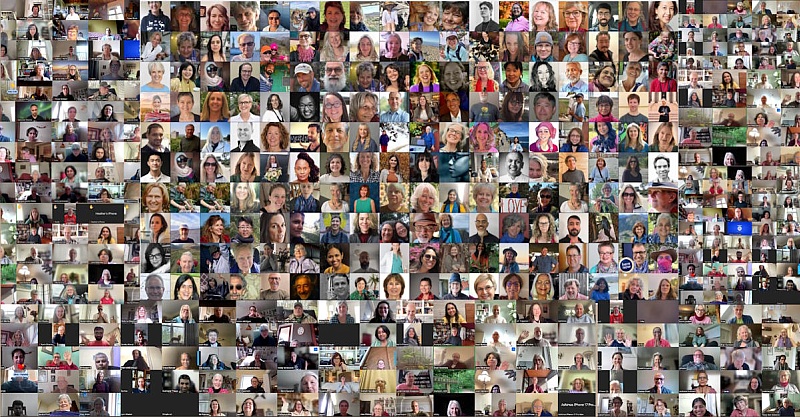
At a Glance
54 countries
& hearts
writing
varied roles
zero dollars paid
Flourish wisdom bot
The FlowFrom Broadcast to Emergence
The sequence moved through six stages. Each one fed the next. Nothing was forced; the design simply made it easy for energy to flow downstream.
How It WorksTurning Individual Learning Into Collective Soil
A pod is not a course people complete — it's a field they enter. The design turns what could be a solitary learning experience into a collective one through a network of volunteer roles, each tilling the soil in a different way.
Community Weavers read every reflection, add thoughtful comments, heart posts, and highlight quotable passages. They're participants themselves — fellow travelers, not teachers — but they serve as invisible threads connecting the beads. Blessing Whisperers take this even further: their role is entirely invisible. They read posts, hold each person with love, add a heart. No comments, no tasks — just a quiet, spiritual holding of the pod's field through metta.
Quote Shortlisters scan the weavers' highlights and nominate the most compelling passages, which flow to Graphical Genies who turn them into beautiful quote cards — a podmate's own words rendered as art and shared back into the feed. A person writes something honest at midnight; by morning, it's been seen, held, highlighted, and transformed into something the whole pod carries.
Editor's Picks curate a daily selection of reflections for podmates who can't read everything — and when a reflection is selected, the author gets a notification. A meaningful moment of feeling seen. Voice of the Pod manages the inbox — every email representing ServiceSpace. Event Coordinators and Live Call roles (emcee, invocation, weather report, breakout facilitators) shape the orientation and closing calls — weaving individual stories into collective themes.
And above it all, the Pod Host mirrors the whole that is greater than the sum of the parts — not broadcasting, but deepcasting: catching ripples, holding space for emergence, and tending conditions that no one can engineer.
The result: 327 people raised their hand to volunteer. 41 served. Over 1,000 hours of labor, given freely. But the hours aren't the point — it's the upstream effects of serving: inner transformation to relationships to collective field intelligence to non-linear emergence to organic regeneration. That cycle is what social permaculture tends.
The AI ThreadHow AI Enhances Social Permaculture
AI shows up at every stage of the sequence — not replacing the human, but extending what no human facilitator could track at scale.
The Flourish Bot. We built a Dharma Lab bot trained on all of Cort and Richie's Dharma Lab videos plus 500 of Richie's most cited research papers. Someone asks "I know what to do but can't do it" — and the bot surfaces Episode 21, minute 27. It animates the entire repository. We then harvested 100 questions from podmates' reflections and had the bot respond — taking the AMA-style offering to a new level. 400+ queries, including deeply sincere threads where someone follows up with "Cort" based on something said on the closing call.
"Thank you for the extraordinary work on the Dharma Lab bot. I had the opportunity to play around with it and I was very impressed. I also tested it with some suicide-related questions and I was pleased to see how responsibly it responded."
"So inspiring. Especially cool to see the back and forth using the Flourish Bot!"
The Mirror. With a click of a button, AI can synthesize the pod's reflections into a "mirror" — surfacing patterns, open questions, and nudges for the next day's volunteers. The mirror helps the pod see itself: where the energy is, where the edges are, what wants to emerge. It's the whole seeing itself from maximal number of angles.
The Circle Agent. After the pod, the Circle Agent reads millions of micro-interactions — who resonated with whom, which reflections sparked the deepest threads, where respectful differences pushed people's thinking — and proposes small-group circles matched on resonance, edge, serendipity, and bridge potential. During Metta Circles, AI serves as a guardian: mirroring group dynamics, supporting coherence in the space without controlling it.
The Community Bot (emerging). The world has designed chatbots as individual experiences — but what if the deepest wisdom arises in community? We're innovating designs where chatbots become catalysts for collective inquiry: questions from one podmate's reflection, answered by the bot, open for other podmates to respond, forking into tangential dialogues. Not a solo Q&A — a community conversation seeded by AI.
In each case, the pattern is the same: AI handles coordination and pattern recognition that exceeds human memory; humans hold the presence, the care, and the relationships. Technology enables connection, then gets out of the way.
What Happened InsideThe Arc
Days 1 and 2 opened with warmth — people noticing how neuroplasticity already shows up in their lives. Day 3 brought friction: catching yourself mid-distraction is uncomfortable. Day 4 hit a nerve — the precise moment empathy tips into overwhelm, and what shifts when you move toward compassion instead. Day 5 cracked something open. Day 6 surfaced a productive tension: the gap between what you say you value and what you actually live.
By the closing call, Richie said:
Cort reflected on what the peer-learning design had produced:
"As per research, community is the 'single most powerful affordance' for inner change. What you have done is something I've never experienced anywhere in the world."
But the stories that mattered most came from participants.
"I have never had the experience on any course of feeling so supported, seen and part of the same magical journey. This week has been life changing!"
A woman whose dog died the day after the pod closed found herself in a vet's emergency room — and instead of collapsing, sat with the anxious strangers around her, did a lovingkindness meditation, and noticed the atmosphere in the room shift. She wrote: "I don't think I would've done nearly so well with all of this if I hadn't just completed the pod."
A teacher in Argentina who'd been teaching 200+ days a year ran into people at an airport who smiled warmly at him. He couldn't place them. They looked at him, stunned: "Patricio, we were with you all day yesterday and the day before that." He realized he could be successful, effective, appreciated — and still not be present in his own life.
"I was touched by the kind replies of others in my pod. This was one of the very best spiritual programs in 30 years."
ExampleThe Flourish Curriculum
Each pod builds its curriculum around the host's body of work — typically 7 daily modules, each with a short video, a guided practice, and a reflection prompt. Here's what the Flourish Pod looked like:
- We Are Born to Flourish
- The Noticing Is the Practice
- The Superpower of Awareness
- The Power of Connection
- Insight: Seeing Through Our Stories
- Purpose: Meaning in Everyday Life
- Change Your Mind, Change the World
The curriculum is co-created with the host over 10–20 hours, with experience and support from seasoned ServiceSpace volunteers who've run dozens of pods. The host brings the content; we help shape it into a journey that builds on itself — moving from personal to relational to collective, from understanding to practice to commitment.
For HostsWhat It Takes
Hosting a pod is a practice in itself. Here's a rough sense of the commitment, for a Pod Host with a background in thought leadership:
All of it is supported by the platform, the AI tools, and a community of practice. The host's primary job is not logistics — it's presence.
The Fuller PictureA Sequence, Not a Program
The blueprint describes four layers — from warming a field (DailyGood, Awakin Calls, wisdom bots) to inviting participation (pods, reading circles, story booths) to forming committed circles (Metta Circles, host training) to what emerges when the web of relationships becomes self-sustaining. Each layer builds on the relational data and trust generated by the previous one.
What the Flourish Pod demonstrated is that the full sequence — broadcast, pod, bot, volunteer engagement, metta circles — can be activated around your content, your community, your themes. And something alive comes out the other end. Not because we engineered it, but because the conditions were prepared.
All of it runs without price tags, advertising, or even a wish for scale. That's not incidental — it's structural. When something is offered freely and with skilfulness, gratitude overflows, and the people who receive naturally become the people who give. The funnel becomes a cycle. The cycle becomes an ecology. And the people who tend it are themselves transformed by the tending.
The question isn't "what do I need to build?" It's "what grows here," in the field of our shared aliveness?