
Last month in the North Dakota Badlands, forty-some strangers spent three days with no agenda and no price tag, and I came home asking whether something sits between a relationship, which happens one person at a time, and a norm, which can be copied: a field that forms among particular people and reaches those who were never in the room. In Medora the evidence was small: a caterer who put out the nice bowls, a fiddle unplayed for eighteen years, a town of 160 that turned out to be the center. A few weeks later I landed in Birmingham, Alabama, where in 1963 that same question was answered under fire hoses. Below are a few reflections from what the city taught me.
I drove into Birmingham without knowing who Shuttlesworth was. I flew out of an airport bearing his name.
I knew Birmingham the way most people know it: a church bombing, four girls, a letter from a jail, dogs and fire hoses on the evening news. I had no idea I would sit with a pastor who had known him, or meet people who remembered a time when even a handshake across the color line could be an act of courage.
What follows is what they taught me, and what I am still trying to hear.
• • •
Three years after the Supreme Court ruled against segregated public schools, Birmingham's classrooms remained segregated. The city was notorious for the bombings that gave it a second name: Bombingham. In September 1957, Fred Shuttlesworth drove his wife Ruby and two of their daughters to the all-white Phillips High School to enroll them. A mob was waiting. They beat him with chains and brass knuckles until he lost consciousness; Ruby was stabbed trying to help him. He said later that as he went under, something told him he could not die there. There was still work to do. That evening, in the hospital, a reporter asked what he was working for. He said: for the day when the man who beat him with chains could sit down with his family as a friend.
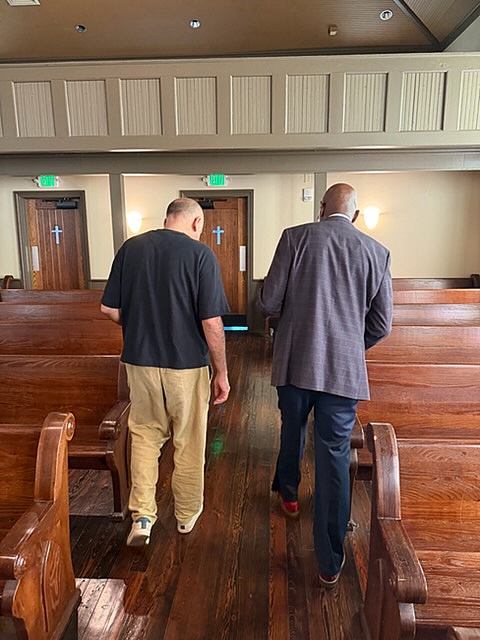 At Bethel Baptist Church, in the plain brick room where his congregation kept meeting after each of the three bombings, Rev. Thomas L. Wilder, Jr. told me what happened at the mass meeting that followed. The church was full and furious. People were ready to turn Alabama over. Shuttlesworth, still bandaged, asked how many of them were angry. The whole room shouted. Then he asked how many of them had been beaten. Silence. And if the man who was beaten is not angry, he said, then you are capable of peace, too.
For several years, Shuttlesworth pressed Martin Luther King Jr. to bring the national movement to Birmingham. King was cautious. The city was dangerous, the Black professional class was divided, and the campaign in Albany had ended in frustration. What finally moved Birmingham was a collective force -- each doing what each could do. A. G. Gaston opened his motel as the movement's headquarters, and the motel was bombed for it. Ralph Abernathy inspired from the pulpit. Wyatt Walker timed protest routes with a stopwatch. Lola Hendricks helped organize the campaign and personally asked Bull Connor, the commissioner who ran the city's police and fire departments, for a marching permit. He refused. Her nine-year-old daughter, Audrey, would soon join the children's march. James Bevel trained the children. Lamar Weaver, a white steelworker, sat beside the Shuttlesworths in the whites-only waiting room of the train station and was chased out of the city for it. Several years earlier in Montgomery, Georgia Gilmore and the women of the Club from Nowhere had sold pies and cakes to keep the bus boycott's carpools running.
History keeps the faces in the photographs. What the photographs cannot show is the field of relationships that made the walk possible.
And in April of 1963, Dr. King entered a movement that had been gathering strength for years, and was arrested for marching without a permit. Someone brought him a newspaper in which eight clergymen of the city called the demonstrations unwise and untimely. He had nothing to write on. So he answered them in the white space around their words, then on scraps of paper that a trustee smuggled in. The clergymen had their words in print. King had the margins. And from those margins grew a letter containing a sentence that would travel far beyond Birmingham:
“We are caught in an inescapable network of mutuality, tied in a single garment of destiny. Whatever affects one directly, affects all indirectly.”
• • •
The movement asked its volunteers to sign a card.
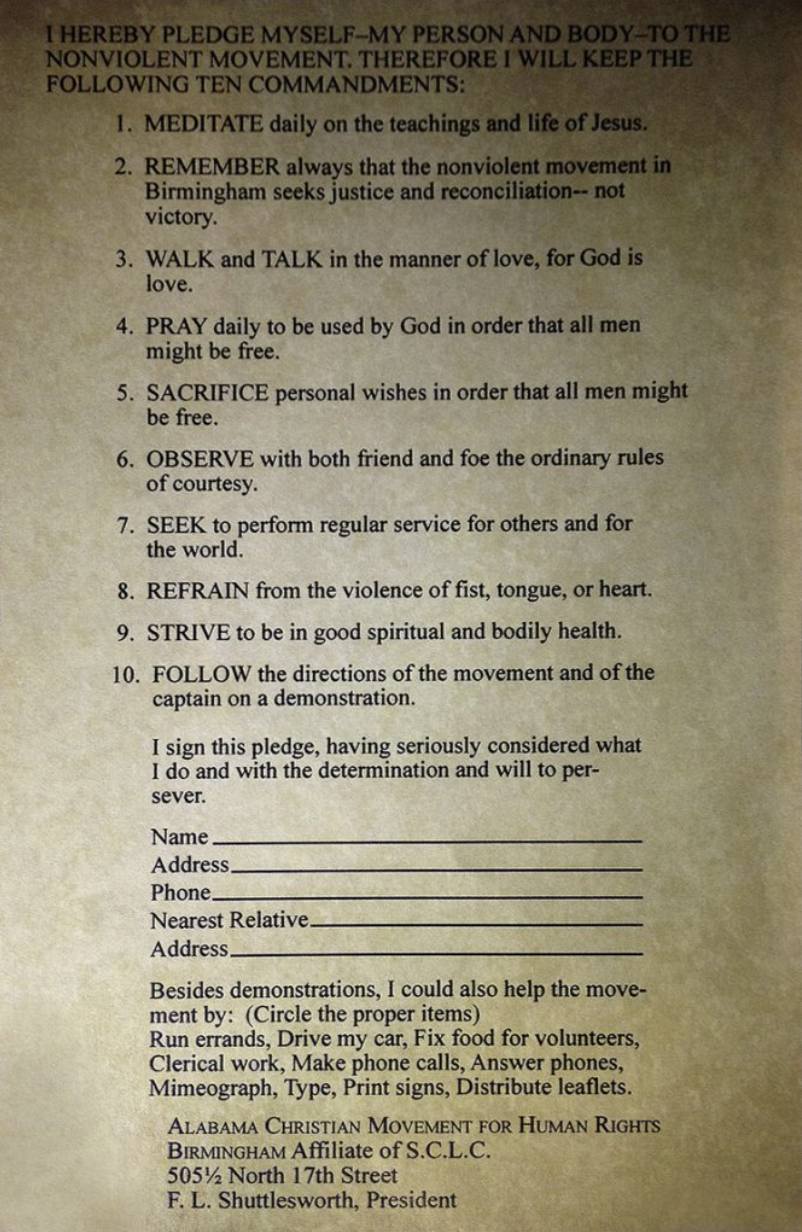 It is a one-pager, headed Alabama Christian Movement for Human Rights. It lists ten commandments. The first asked them to meditate daily on the life and teachings of Jesus. The second named the goal: justice and reconciliation, not victory. The third was to "Walk and talk in the manner of love, for God is love." The fourth called for daily prayer. And then the eighth: "Refrain from the violence of fist, tongue, or heart."
Rev. Thomas Wilder, who has pastored Bethel since 1988 and who gave Lamar Weaver's eulogy when his body was brought back to the city he had been run out of, told me which word on that card was the hardest. Not fist. You can train your body to go limp. Not tongue. You can train your mouth to stay shut when someone spits in your face. The last word. The heart. Nobody could make that choice for you, and nobody could see whether you had. What a community could do was help you become someone capable of making that choice, which is what the basement workshops and the singing were for.
The first commandment prepared them for the eighth. The Sermon on the Mount, among the teachings the marchers committed to meditate on daily, has a shape that repeats six times in a single chapter. You have heard that it was said. But I say to you. You have heard do not murder; I say do not be angry with your brother. You have heard an eye for an eye; I say turn the other cheek. You have heard love your neighbor and hate your enemy; I say love your enemies and pray for those who persecute you. Each time, the law is moved one room deeper, from the hand to the heart. The Birmingham card was that sermon rewritten as a sign-up sheet. And the movement's genius was that it refused to separate the inner work from the outer, asking ordinary people to commit to both on the same small card.
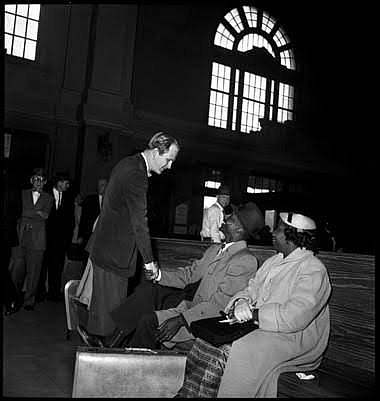 Lamar Weaver had been four years old when he witnessed the killing of a Black teenager near Centre, Alabama. He said later that it set the course of his life. There is a photograph from 1957 of Weaver, a white steelworker, shaking Fred Shuttlesworth's hand at Birmingham's train station, Ruby looking on. They had been challenging the segregation of the whites-only waiting room. A mob attacked Weaver, and a judge ordered him to leave town. Two Black funeral directors, the Poole brothers, hid him in a casket while the mob searched for him, then helped him escape Birmingham. He traveled to Washington to testify before a Senate subcommittee on civil rights. When he died in 2013, his family brought him home to Bethel for his funeral. His son said they would bury his heart in Birmingham.
• • •
Seventeen years after the Birmingham letter, and a hundred and fifty miles east, an old man stood before the graduating class at Spelman College and told them about strings.
 Howard Thurman was eighty. He had been raised in Daytona by a grandmother born into slavery who would not let him read her the letters of Paul, because the plantation minister had used them to preach slaves, obey your masters. In 1936 he led a delegation of Black Americans to meet Gandhi, who asked them at the end to sing, and wondered aloud whether it might be through Black Americans that the unadulterated message of nonviolence reached the world. Thurman went home and wrote Jesus and the Disinherited, about what happens inside a person whose back is against the wall. He named three hounds that track the oppressed: fear, deception, and hatred. The wall is outside. The hounds get in. And once they are in, they do the wall's work for it. A young doctoral student in Boston used to take notes on his sermons and come over on Sundays to watch baseball, and during the Montgomery boycott he reread the book. When that student, Martin Luther King Jr., was stabbed in Harlem in 1958, Thurman came to the hospital and told him he must deepen his channels, or the movement would swallow him up.
So when Thurman told the Spelman graduates that there is something in each of them that waits and listens for the sound of the genuine, he was describing the eighth commandment from the inside. And he gave it a shadow. If you cannot hear that sound, he said, you will spend your life on the ends of strings that somebody else pulls.
Then he turned it around. There is a sound of the genuine in you, too, he said, meaning the other, the stranger, the one who is hard to love. And if I cannot hear it in you, then in my scheme of things, you are not even present.
He did not say unwelcome, or lesser. He said not present. Not in the room. Whole cities can be built on that absence. One was.
• • •
In 1931 Gandhi stood in front of a Montessori training college in London and told them where he had learned the thing he would die for. He had discovered early, he said, that to realize Truth he would have to obey the law of love even at the cost of his life. And where had he learned that law? From children, he said. The greatest lessons, if we would only stoop to learn them, come from the so-called ignorant ones.
By May of 1963 the Birmingham campaign was running out of adults. An adult who marched could lose a job, and in that city a job was the house and the family's credit and sometimes more. James Bevel had been holding workshops in the church basement, teaching teenagers how to be spat on without spitting back. A radio DJ with the whole city's Black teenagers listening announced, in code, that there would be a party at the park. On May 2 the children left 16th Street Baptist Church in waves of fifty, singing, and nearly a thousand were arrested by nightfall. The next morning more came, and the hoses came, and the dogs, and the photographs went around the world.
The youngest was nine. Her name was Audrey Faye Hendricks, Lola's daughter, and she was the only child in her class who went. Her parents stood on the sidewalk and watched her be arrested. She had never lived a day outside the world segregation had made for her. She walked into its machinery and declined its description of who she was.
It is tempting to call this spontaneity. It was not. The workshops, the songs, the card, the years Shuttlesworth had spent being bombed and beaten and coming back: nothing about it was accidental. But the children had not been part of the original plan. The leadership was still arguing when the first fifty walked out the door. What came through that door was organized to the minute. What it released, no one had organized, and no one could have.
Three days later Charles Billups led a few thousand people out of New Pilgrim Baptist in their Sunday clothes, toward the jail where the children were held. Bull Connor was waiting with the hoses. Billups knelt, and the march knelt, and then he stood and told Connor to turn on the water, because they would stand there until they died. The march walked forward. Connor gave the order. The firemen did not move. Some were crying. One was heard to say that they were there to put out fires, not people.
Historians have found more than one reason for what the firemen did; their chief had told them to take orders from no one but him. It is possible the marchers put nothing new in them at all. Perhaps they only changed what those men felt able to do. A child does not walk alone into a line of police; held by fifty others and a song, she can. A man with a hose does not lower it alone either. Nobody knows all that moved them. But none of them, on either side of the street, had arrived at that moment alone.
• • •
Sixty-three years later we seem to be running a different experiment.
Yuval Noah Harari recently described a video that friends kept sending him: a thirty-minute lecture, in his voice, with his face, making arguments about the future. It took him a minute and a half to decide it was not him. His sisters, who have known him for fifty years, had sent it with a note: is this you?
A minute and a half, for a man to tell his own voice from its counterfeit.
Harari's larger worry is that what is being built is less a tool than a population: intelligences arriving at the speed of light, without boats or visas, that will take jobs and change cultures and, for the first time in history, make it possible to mass-produce intimacy. One confidant, manufactured for each of us, remembering what our mothers forgot, fluent in whatever we need to hear. The machine does not have to be conscious to do this. It only has to be convincing, and we only have to be lonely.
I have been thinking about Thurman's strings, and about the part of King's letter that is hardest to read. Its sharpest passage is not about the Klan. It is about the white moderate, more devoted to order than to justice, who agrees with the goal but objects to the method. Someone who may sincerely wish for a better world, yet prefers not to disturb the one he inhabits.
Being in Birmingham made me wonder about three kinds of jail.
The first was the one King sat in. It had walls, a locked door, men with keys. Behind it stood an entire system of laws, police, and violence that could determine where a person lived, learned, worked, or walked. King was confined by it, yet something in him remained free enough to write a letter that traveled far beyond those walls.
Thurman knew a second kind. The wall could be outside, but the hounds of fear, deception, and hatred could get in. They could do the wall's work from within, even as a person struggled against it. And if you could no longer hear the genuine in yourself, you might spend your life on the ends of strings somebody else pulled.
And now perhaps we're building a third. A jail without visible walls, in which the door appears to be open. One more scroll, one more conversation with something that seems to understand us better than our closest friends, one more difficult human encounter quietly replaced by a frictionless alternative. The strings Thurman warned about were hard to see, but they did not learn. Now the hand on the string watches which pull works and adjusts. It does not need to lock the door if it can persuade us to stay.
These are not equivalent confinements. Jim Crow was enforced by law, police, and dynamite. Our digital environments work through design, incentives, dependency, and convenience. The difference in suffering and coercion matters. But Birmingham left me with an unexpected question: What does it mean to be free when the door is already open?
King could address the clergymen by name. The moderate I have begun to worry about is harder to reach. I keep finding him in myself, holding a phone, agreeing with everything I say about attention and presence, and then quietly saying later. King was locked in a room and wrote his way out. We can leave any room we like, and we stay anyway. King was free inside a jail. We are jailed inside a freedom.
The laws still need writing. The incentives still need changing. But the Birmingham commitment card understood something that no legislation can accomplish for us. Fist, tongue, heart. Nobody could make that last choice for another person, although an entire community could help prepare them to make it.
None of this is an argument against the machines. It is possible to build the other kind, too, one that strengthens a relationship and then leaves the room; a few of us are trying. But a machine can become better at predicting what I want without helping me discover what is worth wanting.
And if it can do most of what I do, better than I can, what is left that is mine?
The children in Birmingham did not march so that someone would one day find them useful. They marched because they were already whole.
• • •
On the morning of September 15, 1963, the Sunday School lesson at 16th Street Baptist Church was titled A Love That Forgives.
A girl named Carolyn McKinstry, who had marched in May and been hit by the hoses, was the Sunday School secretary. On her way to the office she passed the downstairs bathroom, where four of her friends were fixing their hair for Youth Sunday. At the top of the stairs the phone was ringing. A man's voice said three minutes and hung up. Fifteen steps later, the bomb went off.
Addie Mae Collins. Denise McNair. Carole Robertson. Cynthia Wesley.
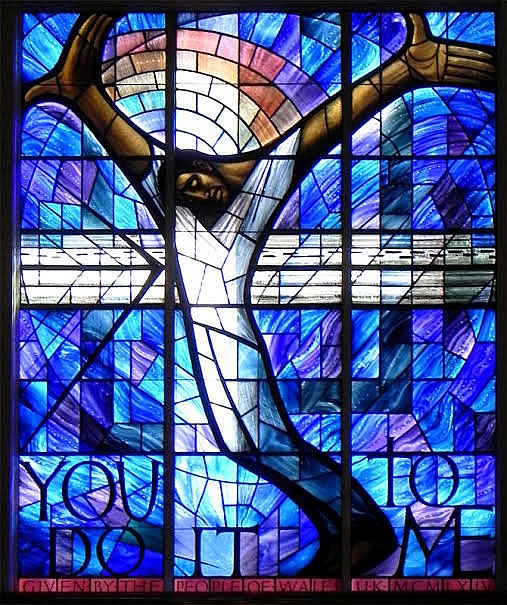 Sitting in 16th Street Baptist Church that afternoon, I found myself looking toward a stained-glass window at the back of the sanctuary.
Back in 1963, four thousand miles away, in a village on the Welsh coast, a stained-glass artist named John Petts heard the news on the radio. He had been a conscientious objector in the war. He had children. He telephoned the editor of the Western Mail and asked for the front page: the people of Wales would replace the church's window.
Then came a rule that has stayed with me. No one could give more than half a crown, a coin worth about thirty-five cents at the time.
They did not want a rich man's gesture. They wanted a window given by a people, in small coins, by thousands of hands, none of which could claim it. The money came from chapels and school collections and kitchen jars. Two years later the window was set into the church: a Black Christ, head bowed, arms thrown wide, one hand pushing away and the other open. Beneath him, four words from Matthew's Gospel.
You do it to me.
The words run in more than one direction: toward the men with the dynamite, toward the people with the coins, toward whoever happens to be standing under the glass.
That rule touched me. A gift so small that no one giving it could feel they had bought anything, and so what they bought could not be owned. The people who paid for the window never met the people who would sit beneath it. Something passed between them anyway. It crossed an ocean. It became visible, but only when the light came from outside.
The window did not undo the morning. It did not give the four girls back. It was a small act in the presence of a loss that has no size. But it showed something the men with the dynamite could not have conceived, because their whole understanding of the world depended on it being false:
There is no outside.
• • •
At lunch I sat with four people who live inside this story. Tracy had known Shuttlesworth and had sat with Gaston. Joshua had been reading adrienne maree brown, and connected it to our Gandhi 3.0 vision. Tyler and Mark run a studio whose office is across the street from the building where the Klan planned the bombing; for Bryan Stevenson's Legacy Museum, they had followed people across Alabama collecting soil from the places where men were lynched, one jar at a time.
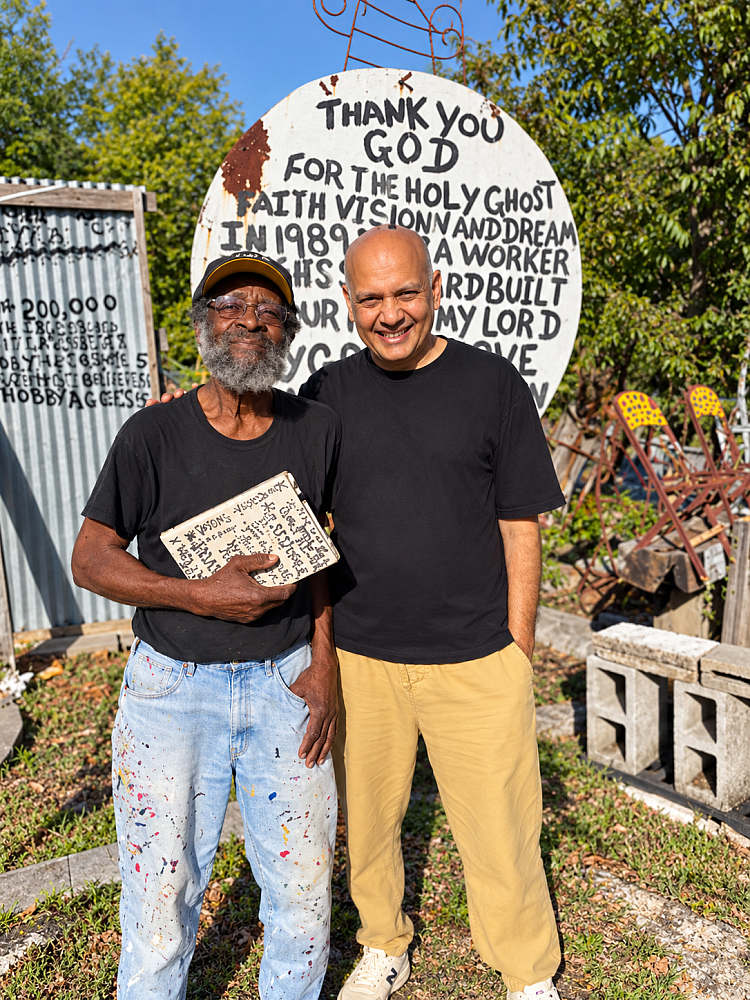 On this trip I also met Joe Minter, who says God called him to make art in 1989. In his backyard, beside a historic Black cemetery, he has spent the decades since turning discarded objects into what he calls African Village in America. As we stood there, he called upon the 100,000 ancestors he believes rest beyond the fence. Things other people had thrown away had become a place where the forgotten could be remembered.
Tyler and Mark are imagining something else with ordinary objects. Their next project is in Kelly Ingram Park. Along the paths where children once marched, they plan to place objects so ordinary that most people will walk past them: a trash can, a newspaper stand, the furniture of any city block. In daylight, nothing remarkable. At night, they will light from within. And if you stop, they will speak.
Earlier that morning, I had walked through the park. Nothing has been installed yet. A trash can was just a trash can. A newspaper stand was just a newspaper stand. Nothing was keeping me there. Nothing lit up. Nothing spoke. I walked for a few minutes in silence.
I don't have a conclusion. I have Thurman's question, which has gotten harder since he asked it. Can I hear the genuine in myself, now that machines are learning to imitate it? Can I hear it in you, when a digital companion is offering to stand in for you? And can we still build the kind of room where something comes alive between us that neither of us brought, even as more of our lives are being designed so that we never have to meet?
A jail is a room built to stop movement. A window is the one place in a room that does not. And stained glass has a curious limitation. However fine its design, however deep its blues, it cannot light itself.
It needs the thing it cannot make.

Share a Reflection
Your thoughts will be shared with the author