[At a few gatherings last week, I was reminded of a helpful framework of four words: agreement, alignment, resonance, coherence. Some reflections, weaving together fresh experiences and older ServiceSpace stories.]
In 1665, Christiaan Huygens was ill in bed, and two of his pendulum clocks were hanging on the wall opposite. Having nothing better to do, he watched them. Within half an hour, no matter how he set them going, the two pendulums fell into step, swinging in opposition like a pair of hands clapping. He wrote to his father about "an odd kind of sympathy" between the clocks. He guessed the cause himself, though it took three centuries and a laboratory to prove him right: the clocks were nudging each other through the wooden beam they hung from. Every tick sent a tremor down the wood, and the tremors kept arriving until neither clock could tell where its own rhythm ended.
Most of us would call this harmony. Two clocks on a wall, keeping time together.
But consider what the clocks could not know. They didn't know whether the wall was straight. They didn't know whether the house was sinking an inch a year into soft ground. They didn't know what time it was out where the sun comes up. Two clocks can agree with each other perfectly and both be wrong about the morning.
Good for the room.
Bad for the house.
• • •
When we say we're "on the same page," we're often conflating four different things. In practice, each sees a wider slice of the world than the one before.
The first is agreement. We will do the same thing, regardless of how either of us feels about it. Agreement lives in calendars and contracts and the handshake at the end of the meeting. It asks nothing of your interior; you can agree with your whole mouth and none of your heart. Every working relationship needs it. Nothing is alive yet.
The second is alignment. We agree we should do this. The compass needles point the same way. This is real, and still more partial than it looks, because two people can want the same thing for reasons that happen to coincide this year and would split the moment the wind changed. Aligned on where we're going; strangers about where we're coming from.
Resonance is the third, and it turns the question around. Alignment asks about the destination; resonance asks about the source. Not the same north but the same well. You know it when you're in a room that has it. Decisions arrive without anyone pushing. Disagreement feels more like weather than war.
Most of us stop here, because resonance feels like arrival. The pendulums are swinging together. The wall is humming.
Yet all resonance tells you is that we share a source. It says nothing about whether that source is good for anyone outside the room. A choir is resonant. So is a mob. Some of the most synchronized crowds in history were marching toward catastrophe, and they felt wonderful doing it.
Coherence is the fourth word, and the one that includes the wall. To be coherent is an aliveness that is born of the right relationship with everything your circle sits inside of: the neighbors, the watershed, the grandchildren, the people who weren't invited, the beings who can't speak. It accounts for what nobody in the room can see, and so it asks the question the other three never get around to asking. Does what we're doing together regenerate, or does it extract? If it spread everywhere, would the world be more alive?
Which is why I sense that coherence isn't really a fourth rung at all. Agreement, alignment, and resonance are things that happen inside a field. Coherence is the health of the field itself. It doesn't require agreement, or even harmony. It allows us to hold our convictions without becoming them, and to remain openhearted even when we must set boundaries.
Coherence isn't the highest form of agreement; it's the larger relationship that allows us to support each other's flourishing, whether or not we agree.

I've written before about three shapes. Squares are where we organize transactions: contracts, calendars, corners where decisions get made. Agreement and alignment live there. Circles are where we belong, and resonance is a circle's gift; but every circle has an inside and an outside, which is why a circle can be a choir or a mob. The third shape is the sphere. It has no corners for power to gather in and no edge where belonging stops. Squares of transaction sit inside circles of care, and both sit inside spheres of regeneration. Coherence is the sphere.
• • •
Years ago, a Himalayan monk told me a story about his own teacher. At seventeen, the teacher found himself in a class taught by Gandhi, and being outspoken by nature, he raised his hand. "Sir, all this talk of Ram Rajya is a utopia. It won't work." Gandhi asked gently what the alternative was. The young man had read Das Kapital, and said so: communism. Gandhi folded his hands, bowed slightly, and asked, "Just as I permit you to believe whatever you like, would you also permit me to believe in utopia?"
In tug-of-war, you brace for resistance. Here, in a single moment, Gandhi let go of the rope. There was no agreement reached. There was not even an attempt at one. And the young man stayed with him six months, and then spent the rest of his life in serious cultivation.
That is what coherence looks like when it comes first. Gandhi wasn't trying to win the argument, or align the boy's politics with his own. He could hold his conviction without needing the young man to share it. The relationship was larger than the disagreement, and from that relationship, everything else grew on its own schedule.
The usual way to build anything together runs the other direction. First get agreement. Hope it ripens into alignment. If you're lucky, resonance shows up somewhere along the way, and coherence, perhaps, at the summit. It's how most of our organizational life works, and it may be why so many well-meaning efforts end up technically successful while staying blind to the harm they do beyond the room.
What if we started from the ground instead?
I once watched this happen to a man named Saavji-bhai, one of the biggest diamond merchants in the country, who came to a day-and-a-half gathering in Surat with a question he wanted answered: Can profit and love co-exist? When the circle anchors said, "Let's hold the question," he shot back, "I don't want a certificate for my question, I want an answer." Fair enough. By the end of the retreat, most people in the room had been moved to tears at some point, and at lunch I asked him whether he'd found a helpful response. "No," he said. "I didn't find an answer. But in this field of love, the question itself has evaporated."
Agreement might have settled the question. Coherence changed the place he was asking it from.
• • •
Our Moved by Love retreats are built on that bet, over many years of experimentation. No fees, no agenda, no wish-list of outcomes to steer towards. If you asked a guest why they were coming, most couldn't tell you. "I don't know exactly why I'm here" was the common refrain in one opening circle, and after enough people said it, it became clear that nobody knew. That was the point. One woman put it better than the invitation ever could: "Every cell in my body immediately knew I was coming, and then my mind rushed in to find reasons."

So the first full day often ends in a silent dinner. Sixty people eating by candlelight builds into a single wave, and everything that follows rides on it.
What makes the wave possible is mostly invisible. Behind every retreat is a crew of volunteers, often as many volunteers as there are guests, who gather days before anyone arrives. They set cushions and run the mics and stir the daal, and they practice together. I wrote about their way of working after North Dakota; the short version is that they serve without keeping anything, and when something inevitably comes back, they let it slip into the field again. One of them chops veggies with full attention. Another notices, and chops differently. By the time the guests walk in, the room is already humming, and they fall into step with it before anybody has said a word, the way Huygens's second clock fell into step with the first.
This is also the humbling part. What the volunteers transmit is not the agenda. It's whatever they actually are: their sincerity or their hurry, their care or their performance of care. And it doesn't travel one way. Anyone who has hosted a circle knows that the quality of attention moves both ways, and that the host's presence can help a room open. Coherence opens the channel from both ends. The question isn't whether the crew feels anxious or calm. It's whether they can meet whatever arises without losing their capacity to care.
Jayeshbhai, who has hosted more of these than anyone, understood this long before anyone tried to measure it. Shaheen once brought a group of schoolchildren to him. They kicked off their flip-flops in a heap and raced inside. Jayeshbhai quietly lined the sandals up. The next day the children did it again, and he lined them up again. On the third day, the children lined them up themselves. No lecture, no rule, no reward. Just a man in right relationship with a pile of shoes, and children who caught it.
Forty volunteers holding two hundred guests sounds like bad arithmetic until you remember how bread works. John Paul Lederach, after a lifetime in conflict zones, said what every transformation he witnessed lacked was never critical mass. It was critical yeast: the smallest ingredient, mixed all the way through, and the only one that makes everything else rise. The question is never how many. It's who, and what state they're in.
• • •
Once a field like that is coherent, something begins to happen that none of us can fully explain, though we've learned to count on it.
Unidentified volunteers start "tagging" people with gifts. A woman came to breakfast in quiet tears, having just heard that her best friend had lost another pregnancy. Later that day, an anonymous letter to the unborn child was waiting in her room. On a bus ride, someone overheard that Sallyann had never once spent her mother's birthday apart from her. By Saturday, sixty strangers had recorded a birthday song, and her mother in London had watched it, weeping, more times than she could count.
None of this was planned. No committee assigned it. And yet it was never random. If someone spoke Japanese, the note on their pillow was in Japanese. The field was listening, all of it, all at once, and acting faster than any individual mind could have organized.
But warmth is the easy proof. The harder one came on the fifth day of one gathering, when a prominent person in the circle said, in front of everyone, "Today I want to say I'm sorry. For years, I've closed my heart with judgment toward one among you." He looked straight at the person. "I should have checked with you first. I realize now I was mistaken." No one had mediated. The apology simply surfaced, the way a spring surfaces when the ground above it has been tended long enough.
And sometimes the thing that surfaces doesn't resolve. Last month in the Badlands, as a colleague walked us through a century of data on how America's sense of "we" rose and fell, someone asked the question the chart couldn't answer: whose we? The decades on the upswing held internment camps and Jim Crow. The question was fair, and it hurt, and it was ours to hold.
That same night a story told truthfully from one person's wound landed on other people's wounds. There was no neat ending. Both ruptures happened to fall on Samvatsari, the Jain day of forgiveness, and on the last morning we held the prayer Jains say once a year: for whatever harm I have caused any living being, knowingly or unknowingly, I ask forgiveness. It makes no claim of innocence.
That's precisely where coherence and resonance part ways. Resonance might have drawn us back toward harmony. Coherence asked us to stay present to what had broken it. The real test of a field isn't how beautifully everyone moves together; it's whether the field remains openhearted when they don't. Can it receive both appreciation and criticism without clinging to one or resisting the other? Can it hear the person who isn't in the room? Can it recognize that even a disruption might carry something it needs to learn?
In North Dakota, I spent a coffee break with a man named Luke, and I'd guess we don't vote the same way. I told him I saw a child's innocence in his eyes. He lit up: he has a five-year-old who is non-verbal, and the two of them say I love you through their eyes. His views didn't disappear in that moment. They just stopped being the whole story.
A field that depends on harmony is a choir. A field that can remain openhearted through whatever arises is a home.
This is what I mean when I say coherence has an intelligence of its own. It isn't that the people in the room got smarter. It's that something became available to them which thought alone could not have reached.
• • •
The hardest part to convey is that the transformation cannot be scheduled, only prepared for.
Before the Salt March, seventy-eight people practiced for fifteen years. Fifteen years without a single visible result. Gandhi had a line about this that I've never been able to shake: "Whether humanity will consciously follow the law of love, I do not know. But that need not disturb us. The law will work, just as the law of gravitation works."
What he meant, I think, is that coherence doesn't produce transformation the way a lever produces motion. It produces conditions. Thich Nhat Hanh said that in April there are no sunflowers in France, and so we say the sunflowers do not exist, but the farmers who planted the seeds can already see them on the bare hills. They lack only sun, heat, rain, and July. When the conditions are ripe, grace does the rest, usually after the retreat has ended and usually somewhere no one was looking. In Birmingham in May of 1963, a few thousand people in Sunday clothes knelt in front of the fire hoses, then stood and walked forward. Bull Connor gave the order. By most accounts, the firemen did not move. Nothing about that march was spontaneous; the workshops and the songs and the years of being bombed and coming back were organized to the minute. What they released, no one had organized. Nobody on either side of that street had arrived at the moment alone.

Ketan went back to his office the week after one gathering and was robbed. He responded with forgiveness and a hug, and then wrote to us, bewildered, asking why there had been tears of compassion in his eyes while he lost the money. Hang Mai went home to Vietnam and persuaded a party magazine that for once, on the anniversary of the war's end, it should run twenty pages on healers instead of heroes. Sehr went back to her mother's chain of salons in Dubai and asked several hundred staff whether they'd give free services to their clients' maids during Ramadan. Every one of them said yes.
Those are the traces that matter. Not what happens in the circle, but whether the circle's quality of relationship survives contact with a boardroom, a thief, a bureaucracy, a payroll. A Hawaiian elder said it on the fourth day of another gathering: what we were feeling wasn't something we could pack and take home. "We have to grow it in your heart, plant it in your kin, and give it time and space to bloom at its own pace."
• • •
Which leaves the practical question. How do you sense coherence, before the handshake, before the agenda?
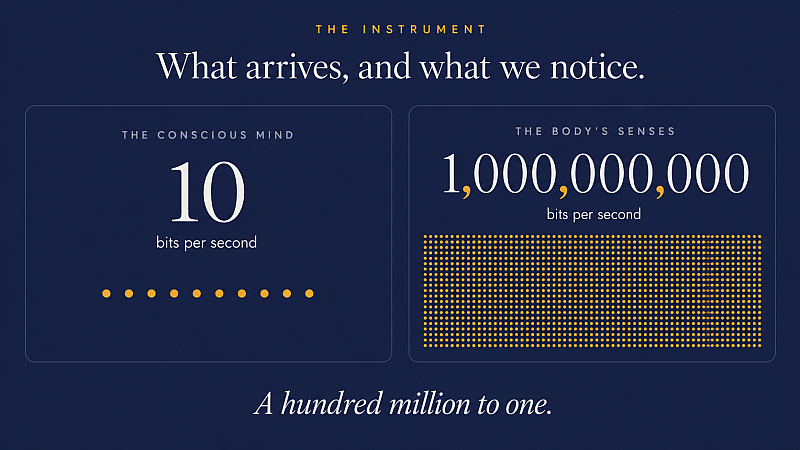
Researchers at Caltech recently put a number on something relevant. The conscious mind processes roughly ten bits of information per second. The body's senses take in about a billion. Nobody should claim the billion are wiser; they're just there, and mostly unconsulted. Which is what that woman meant: every cell knew she was coming, and only afterward did her mind rush in with reasons.
But a body can inherit the mind's blind spots as easily as it can correct them. A mob feels something in its body, too. The question that stopped a room in the Badlands didn't come from anyone's gut; it came from someone noticing who wasn't on the chart. So sensing coherence can't only mean listening more deeply to ourselves. It has to include listening for what our own bodies, and our own circles, cannot know.
Ten bits for the handshake. A billion for everything else.
Huygens's clocks found their sympathy through a piece of wood. The volunteers find it through serving veggies and soup over a few days of practice. The diamond merchant found it, and lost his question. None of them reasoned their way to it. And none of it would matter if the clocks only learned to keep time with each other.
The question was never whether we can swing together.
It's whether we can feel the house.

Share a Reflection
Your thoughts will be shared with the author